Memory Transfer Learning
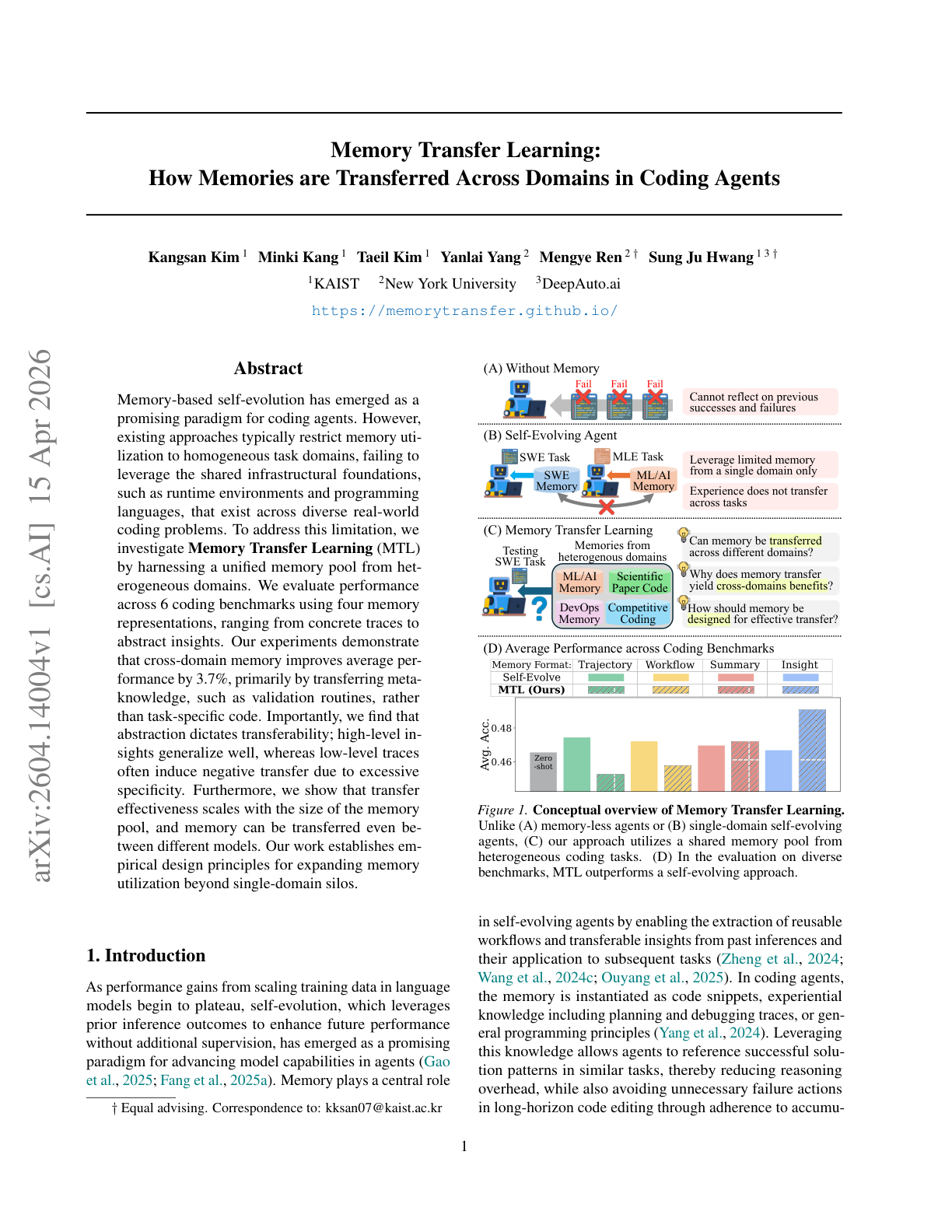
Coding agents learn from experience, but that knowledge stays locked in silos. Solve a thousand SWE tasks, and none of that wisdom helps with competitive coding. This paper introduces Memory Transfer Learning, a framework where coding agents share a unified memory pool across six heterogeneous coding benchmarks, testing what transfers between domains and what does not.
Ask this paper
Unified memory pool across domains: The framework pools memories across six heterogeneous coding benchmarks rather than isolating them by task type. Cross-domain memory improves average performance by 3.7%, a modest but consistent lift that previously would have been invisible under standard single-domain evaluations.
Abstraction dictates transferability: Four memory formats ranging from raw execution traces to high-level insights are compared. High-level insights generalize well, while low-level traces often cause negative transfer by anchoring agents to incompatible implementation details. The takeaway: memory design matters more than memory volume.
Meta-knowledge, not code: The transferable value is not task-specific code but meta-knowledge such as validation routines, structured action workflows, and safe interaction patterns with execution environments. Algorithmic strategy transfer accounts for only 5.5% of the gains, with procedural guidance doing most of the work.
Scaling and cross-model transfer: Transfer effectiveness scales with the size of the memory pool, and memory can even be shared across different models. Combined with the finding on abstraction levels, the results point toward memory systems that curate insights rather than simply logging everything the agent did.