Asynchronous Software Engineering Agents
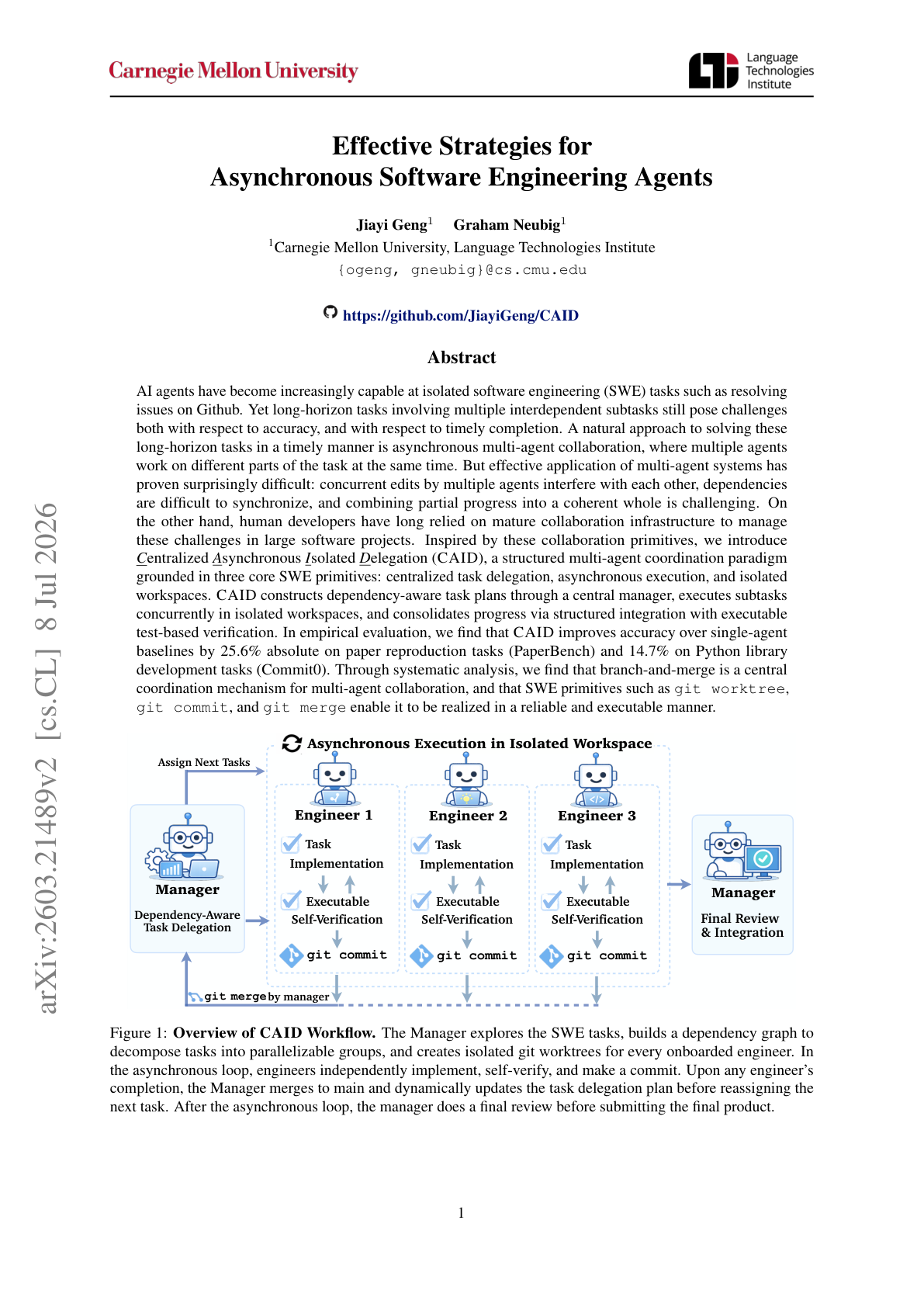
New research from CMU introduces CAID (Centralized Asynchronous Isolated Delegation), a coordination framework for running multiple coding agents in parallel on complex software engineering tasks. Inspired by how human developer teams collaborate, the work demonstrates that simply giving a single agent more iterations helps, but coordinating multiple asynchronous agents with the right strategies produces significantly larger gains.
Ask this paper
Branch-and-merge as coordination primitive: The key finding is that git operations (worktree, commit, merge) serve as the critical coordination mechanism for multi-agent collaboration. By isolating each agent in its own workspace branch and merging results through structured integration with test verification, the system avoids the conflicts and interference that plague naive parallelism.
Substantial gains on complex tasks: CAID achieves a 26.7% absolute improvement on paper reproduction tasks and 14.3% on Python library development tasks compared to single-agent baselines. These are tasks that require sustained, multi-step reasoning across large codebases, exactly where coordination overhead is typically highest.
Optimal parallelism is not monotonic: Increasing the number of agents does not always help. Performance improved from 2 to 4 engineers but decreased when expanding to 8. Overly fine-grained task delegation introduces integration overhead and conflict resolution costs that outweigh the parallelism benefits.
Delegation quality matters most: The analysis reveals that imprecise task handoffs and underspecified subgoals are the primary sources of coordination failure. When delegation is coarse-grained or misaligned with the dependency structure of the task, agents may produce locally correct outputs that are globally inefficient to integrate.