Meta-Harness
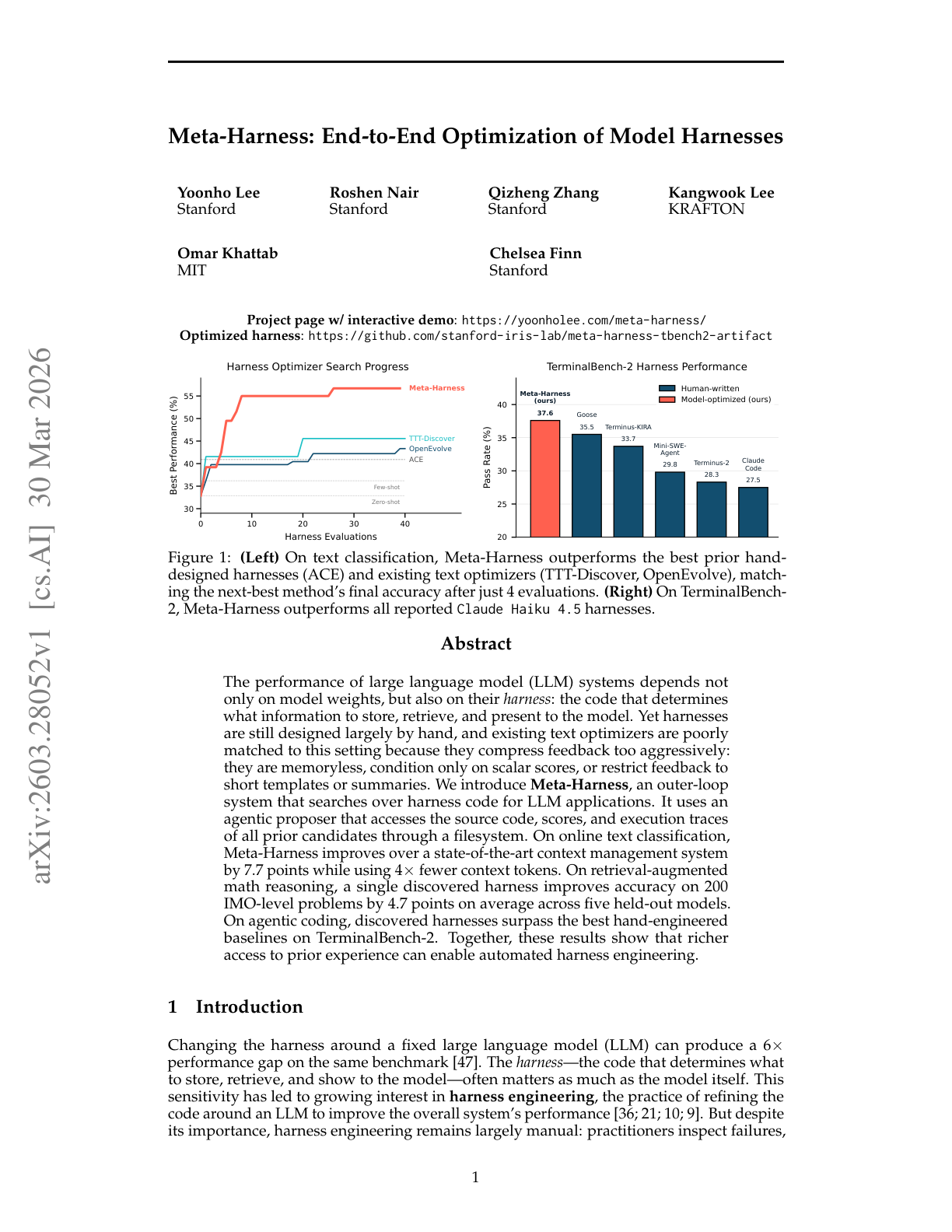
Researchers from Stanford and MIT introduce Meta-Harness, an outer-loop system that automatically searches over harness code for LLM applications. The performance of LLM systems depends not only on model weights but also on the harness: the code that determines what information to store, retrieve, and present to the model. Yet harnesses are still designed largely by hand, and existing optimizers are poorly suited to the task.
Ask this paper
Agentic search with full experimental context: Meta-Harness uses an agentic proposer that has access to the source code, scores, and execution traces of all prior candidates through a filesystem. This expanded access to prior experimental data enables the system to propose meaningfully different harness designs rather than making incremental edits.
Strong gains across diverse domains: On online text classification, Meta-Harness improves over a state-of-the-art context management system by 7.7 points while using 4x fewer context tokens. On retrieval-augmented math reasoning, a single discovered harness improves accuracy on 200 IMO-level problems by 4.7 points on average across five held-out models.
Harness engineering as a first-class problem: The work formalizes a key insight that has been gaining traction: changing the harness around a fixed LLM can produce a 6x performance gap on the same benchmark. This makes automated harness optimization a potentially higher-leverage intervention than model scaling for many applications.
Transferable harness discoveries: The harnesses discovered by Meta-Harness generalize across models. A harness optimized on one model transfers to five held-out models with consistent gains, suggesting that good harness design captures task-level structure rather than model-specific quirks.
Abstract
The performance of large language model (LLM) systems depends not only on model weights, but also on their harness: the code that determines what information to store, retrieve, and present to the model. Yet harnesses are still designed largely by hand, and existing text optimizers are poorly matched to this setting because they compress feedback too aggressively. We introduce Meta-Harness, an outer-loop system that searches over harness code for LLM applications. It uses an agentic proposer that accesses the source code, scores, and execution traces of all prior candidates through a filesystem. On online text classification, Meta-Harness improves over a state-of-the-art context management system by 7.7 points while using 4x fewer context tokens. On retrieval-augmented math reasoning, a single discovered harness improves accuracy on 200 IMO-level problems by 4.7 points on average across five held-out models. On agentic coding, discovered harnesses surpass the best hand-engineered baselines on TerminalBench-2. Together, these results show that richer access to prior experience can enable automated harness engineering.