Coding Agents as Long-Context Processors
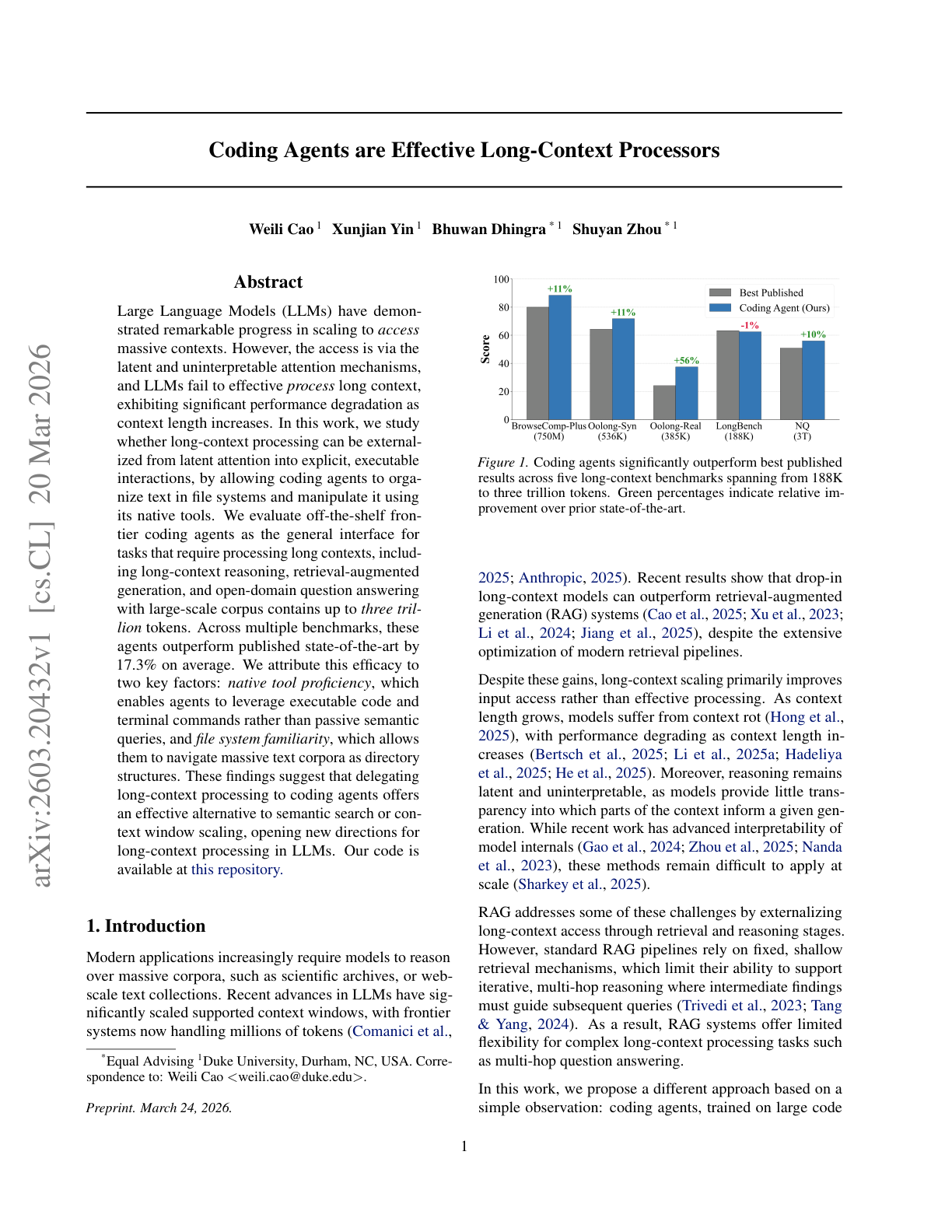
This research asks whether long-context processing can be externalized from latent attention into explicit, executable interactions. Instead of scaling context windows, the authors let coding agents organize text in file systems and manipulate it using native tools, evaluating them on tasks spanning long-context reasoning, retrieval-augmented generation, and open-domain question answering with corpora containing up to three trillion tokens.
Ask this paper
17.3% average improvement over state-of-the-art: Across multiple benchmarks, coding agents outperform published state-of-the-art long-context methods by 17.3% on average. This result challenges the assumption that long-context capability must come from larger attention windows or more sophisticated retrieval mechanisms.
Native tool proficiency as the core enabler: The efficacy is attributed to the agents’ ability to leverage executable code and terminal commands. Rather than compressing information into a fixed-length representation, agents can write scripts to filter, sort, and transform data as needed for each query.
File system familiarity drives scalability: Coding agents can navigate massive text corpora by treating them as directory structures. This spatial organization enables efficient access patterns that scale far beyond what attention-based mechanisms can handle, reaching into the trillions of tokens without degradation.
A practical alternative to context window scaling: The work proposes that delegating long-context processing to coding agents offers an effective alternative to both semantic search and context window scaling. For practitioners, this means existing coding agent infrastructure can double as a long-context solution without architectural changes to the underlying model.