Beyond Scalar Rewards
First page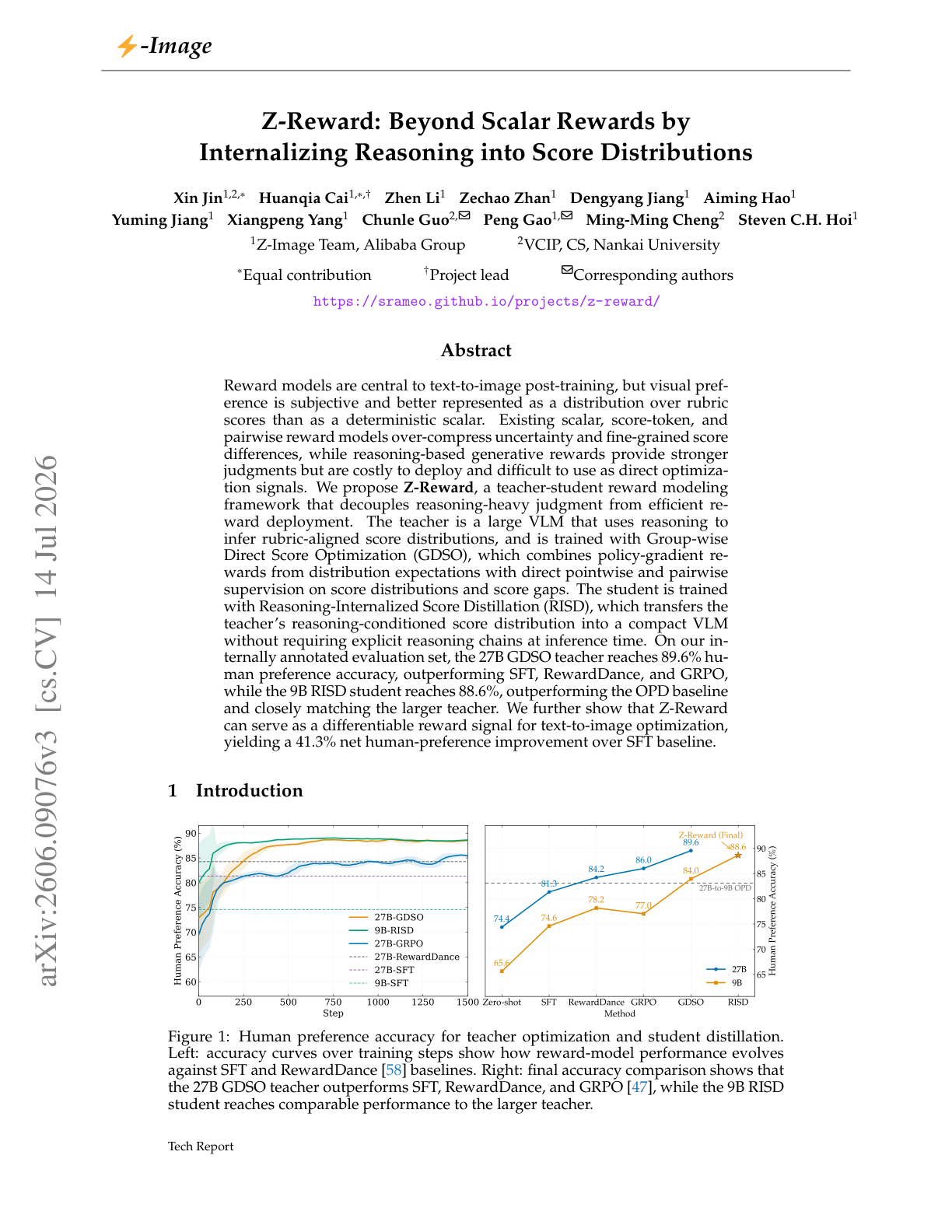
Paper summary
Reward models usually compress a judgment into a single scalar, but this paper argues human preferences are better captured as score distributions, and proposes Z-Reward, which internalizes reasoning into a predicted distribution before scoring. A large vision-language teacher does the reasoning-heavy judgment and is distilled into a compact student for efficient deployment, with the 27B teacher reaching 89.6% human-preference accuracy and the 9B student nearly matching it at 88.6%. Used as a reinforcement learning signal, it delivers a 41.3% net preference improvement over a supervised baseline, beating GRPO and other reward methods.