Chain-of-Agents
Free while signed in. Answers cite the passages they came from.
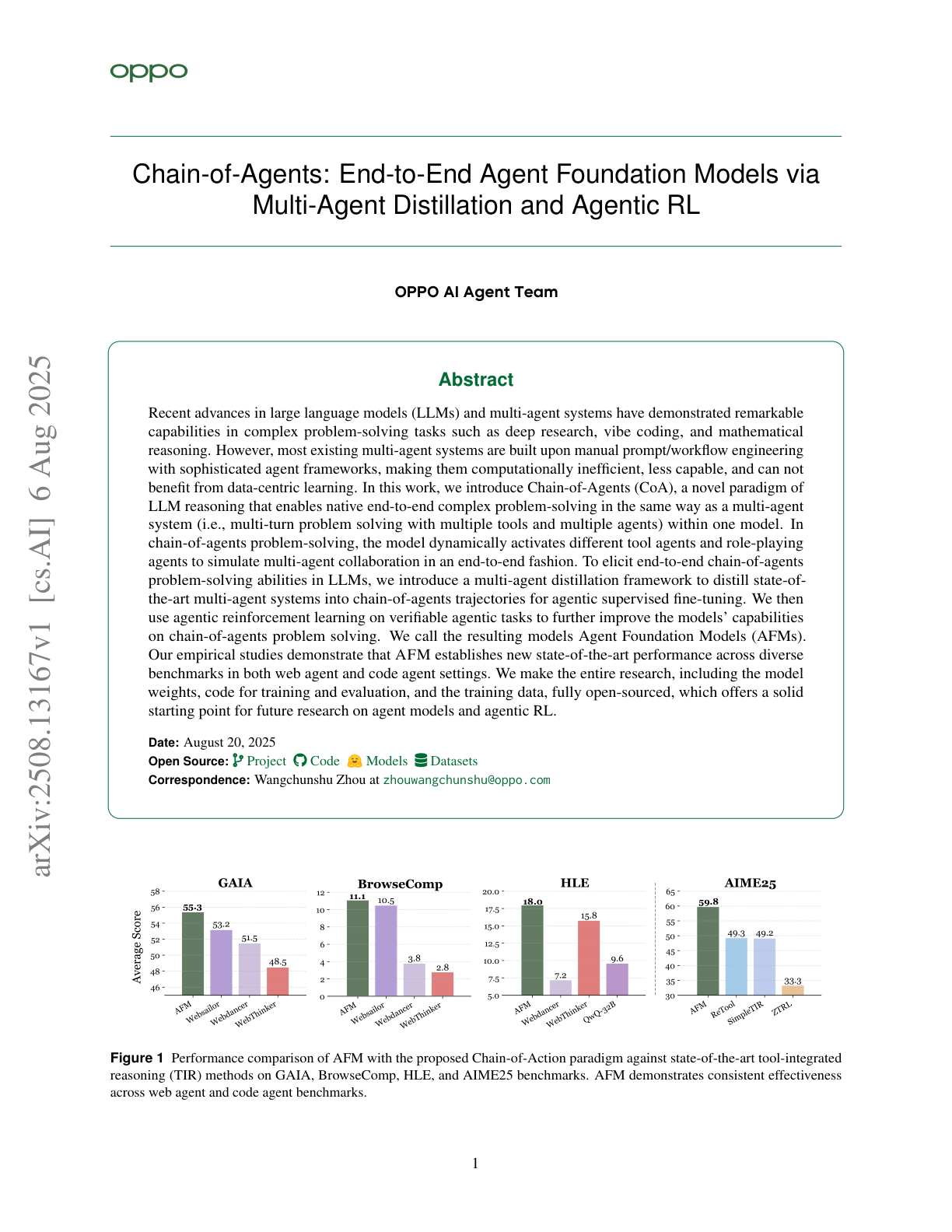
OPPO proposes training single models to natively behave like multi‑agent systems, coordinating role‑playing and tool agents end‑to‑end. They distill strong multi‑agent frameworks into CoA trajectories, then optimize with agentic RL on verifiable tasks. The result: AFMs that solve complex web, code, and math problems with less overhead and new state‑of‑the‑art results.
Paradigm shift: CoA generalizes ReAct/TIR by dynamically activating multiple roles and tools within one model, preserving a single coherent state while cutting inter‑agent chatter.
Training recipe: 1) Multi‑agent distillation turns successful OAgents runs into CoA‑formatted traces with planning, tool calls, observations, and reflection, filtered for difficulty and quality; 2) Agentic RL targets hard queries where tools matter, with simple binary rewards via LLM‑as‑Judge for web tasks and executable or exact‑match rewards for code/math.
Main results: With Qwen‑2.5‑32B backbones, AFM sets new pass@1 on GAIA 55.3, BrowseComp 11.1, HLE 18.0, and leads WebWalker 63.0; it also tops multi‑hop QA suites across sizes.
Code + math: AFM‑RL‑32B reaches AIME25 59.8, MATH500 94.6, OlympiadBench 72.1, and LiveCodeBench v5 47.9, beating prior TIR methods including ReTool and Reveal.
Efficiency and robustness: Compared to traditional multi‑agent systems, AFM cuts inference tokens and tool calls substantially; the paper reports an 84.6% token cost reduction while staying competitive. It also generalizes to unseen tools better when strict formatting is required.
Test‑time scaling: Best‑of‑3 and pass@3 markedly boost AFM, e.g., GAIA 69.9 and HLE 33.2, closing the gap with larger proprietary agent stacks.
Open source: Models, data, and training code are released to spur research on agent models and agentic RL.
Get next week’s papers.
The same picks and the same summaries, in your inbox. Free, and 176 issues deep.
Subscribe on Substack