ComputerRL
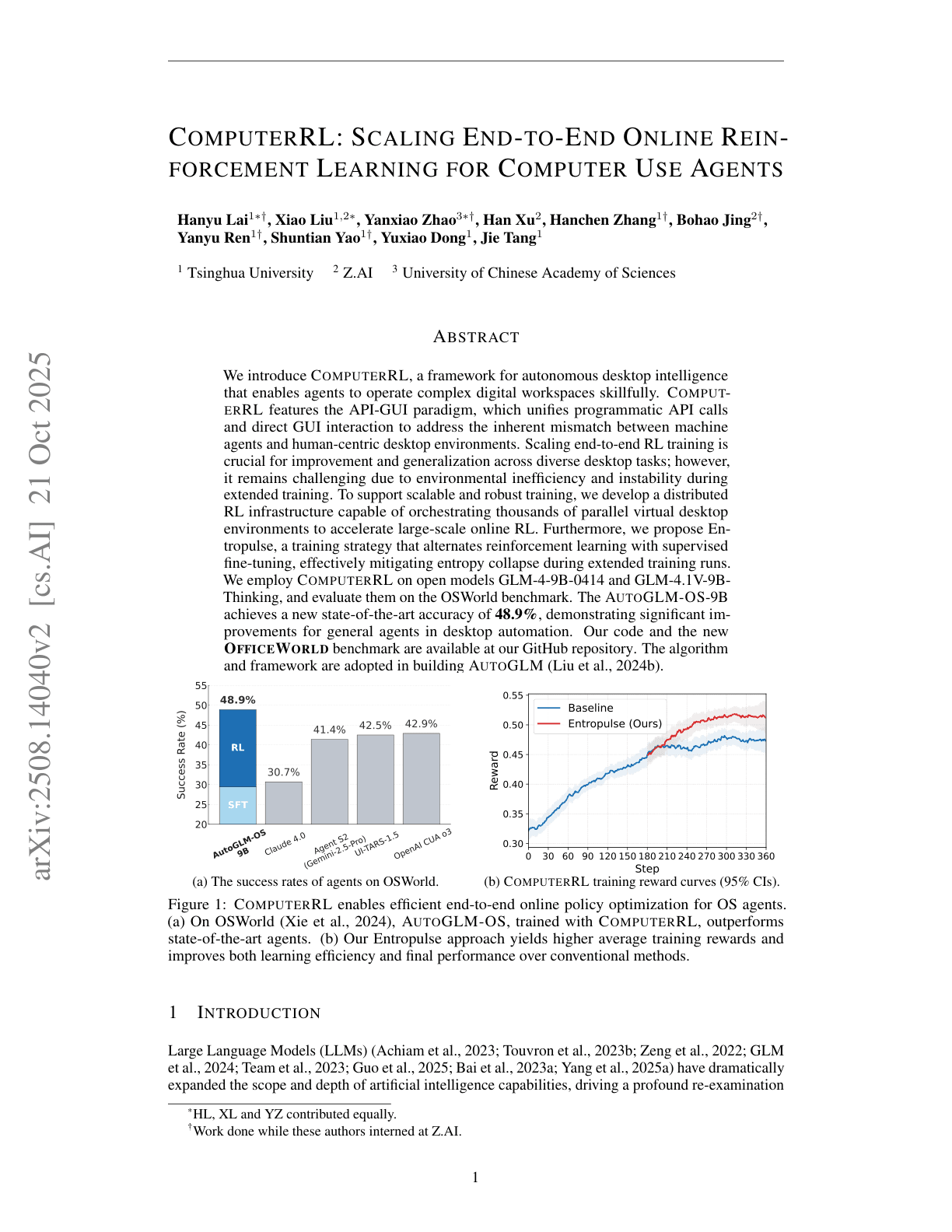
A framework for autonomous desktop agents that unifies API calls with GUI actions, plus a scalable RL stack and a training recipe (Entropulse) that alternates RL and SFT to sustain exploration. Evaluated on OSWorld, it sets a new SOTA with strong gains in efficiency and robustness.
Ask this paper
API‑GUI action space. Moves beyond human‑centric GUIs by combining programmatic APIs with direct GUI control. LLMs help auto‑generate app‑specific APIs via requirement analysis, implementation, and unit tests, lowering the cost of adding new tools.
Massively parallel desktop env. A refactored Ubuntu VM cluster (qemu‑in‑docker + gRPC) delivers thousands of concurrent instances with improved stability, monitoring, and AgentBench‑compatible interfaces, enabling large‑scale online RL.
Fully asynchronous RL. Built on AgentRL with decoupled actors/trainers, dynamic batching, and bounded replay to reduce off‑policy bias and maximize GPU utilization during long‑horizon desktop rollouts.
Entropulse training. After an initial step‑level GRPO phase with verifiable, rule‑based rewards, successful rollouts are distilled via SFT to restore entropy, then RL resumes, yielding higher rewards and sustained improvements.
Results and analysis. AUTOGLM‑OS‑9B reaches 48.1% on OSWorld and 47.3% on OSWorld‑Verified, outperforming OpenAI CUA o3, UI‑TARS‑1.5, and Claude Sonnet 4, while using up to one‑third the action steps of strong baselines; ablations show API‑GUI and multi‑stage training drive the gains. Error sources cluster into multi‑app coordination, vision, and operational slips.
Abstract
We introduce ComputerRL, a framework for autonomous desktop intelligence that enables agents to operate complex digital workspaces skillfully. ComputerRL features the API-GUI paradigm, which unifies programmatic API calls and direct GUI interaction to address the inherent mismatch between machine agents and human-centric desktop environments. Scaling end-to-end RL training is crucial for improvement and generalization across diverse desktop tasks; however, it remains challenging due to environmental inefficiency and instability during extended training. To support scalable and robust training, we develop a distributed RL infrastructure capable of orchestrating thousands of parallel virtual desktop environments to accelerate large-scale online RL. Furthermore, we propose Entropulse, a training strategy that alternates reinforcement learning with supervised fine-tuning, effectively mitigating entropy collapse during extended training runs. We employ ComputerRL on open models GLM-4-9B-0414 and GLM-4.1V-9B-Thinking, and evaluate them on the OSWorld benchmark. The AutoGLM-OS-9B achieves a new state-of-the-art accuracy of 48.9%, demonstrating significant improvements for general agents in desktop automation. Our code and the new OfficeWorld benchmark are available at https://github.com/thudm/ComputerRL. The algorithm and framework are adopted in building AutoGLM (Liu et al., 2024b).