Full-Stack Fine-Tuning for the Q Programming Language
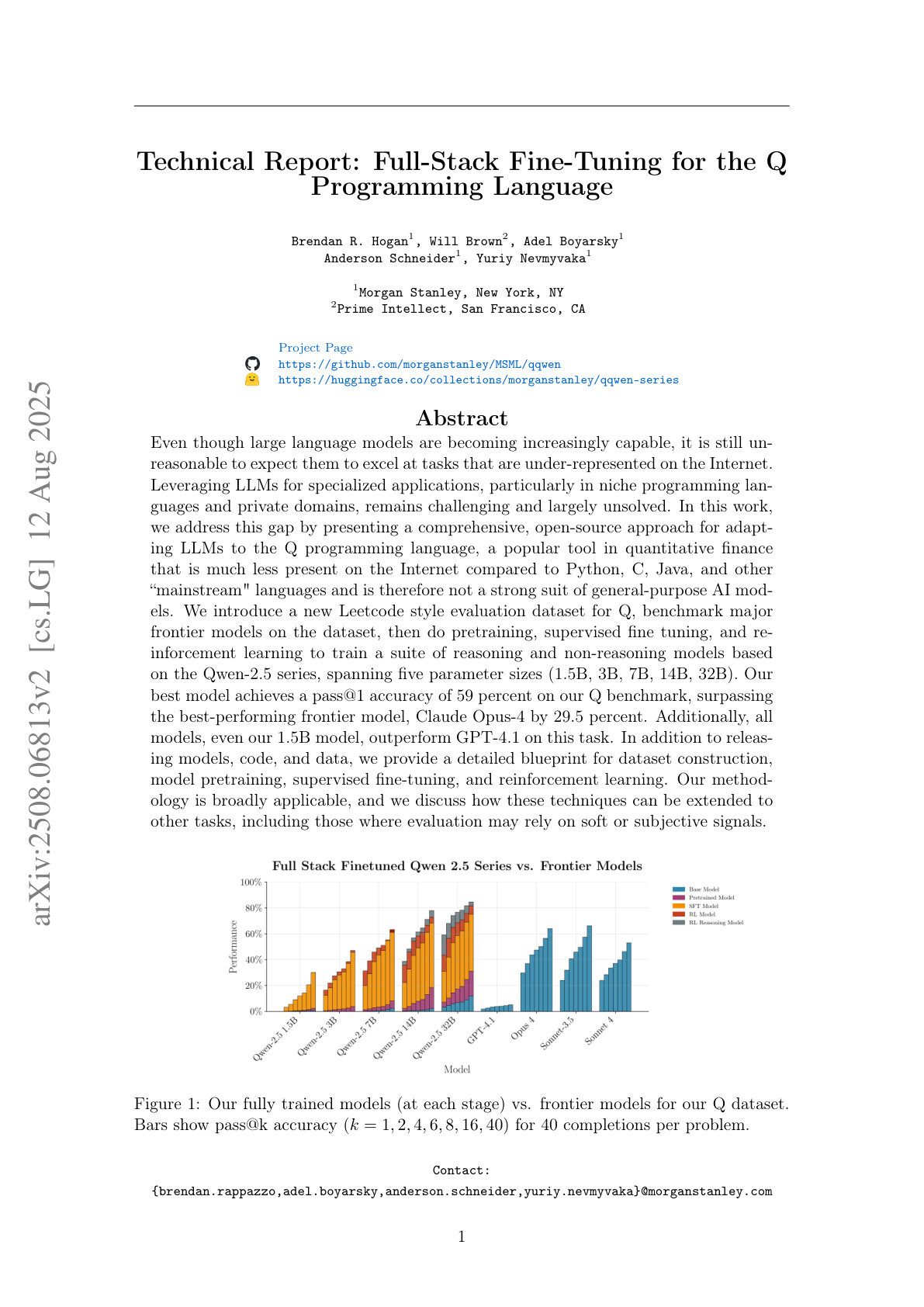
Presents an open-source blueprint for adapting large language models to niche programming domains, with Q (used in quantitative finance) as the test case. The team builds a benchmark, curates data, and trains Qwen-2.5 models with pretraining, supervised fine-tuning, and reinforcement learning. Their largest model surpasses Claude Opus-4 by nearly 30% on Q-LeetCode tasks, and even the smallest model beats GPT-4.1.
Ask this paper
Benchmark creation – Introduced the first LeetCode-style dataset for Q, comprising 678 problems with automated and human-verified solutions.
Model performance – Trained models from 1.5B to 32B parameters; all exceed GPT-4.1, and the 32B reasoning variant achieves 59% pass@1, +29.5% over Claude Opus-4.
Training pipeline – Multi-stage process: domain-adaptive pretraining on Q code, supervised fine-tuning on curated tasks, and reinforcement learning with programmatic rewards.
Lessons learned – Robust evaluation harness and data quality are critical; reward hacking is pervasive without careful separation of solution/test generation; large models (≥14B) are essential for meaningful gains.
Limitations – The dataset uses “pythonic” Q (algorithmic tasks), not typical finance workloads (queries, time-series analytics), so real-world performance may differ.