Elastic Decision Transformer
An advance over Decision Transformers that enables trajectory stitching at inference time.
Ask this paper
Adaptive history length: Adjusts to shorter history at test time, enabling transitions to diverse and better future states.
Trajectory stitching: Unlike vanilla Decision Transformers that treat trajectories as fixed, EDT composes segments from different trajectories.
Offline RL gains: Achieves stronger performance on offline RL benchmarks where data quality and coverage vary.
Decision Transformer evolution: Part of the broader effort to make Decision Transformers competitive with Q-learning approaches on offline RL tasks.
Abstract
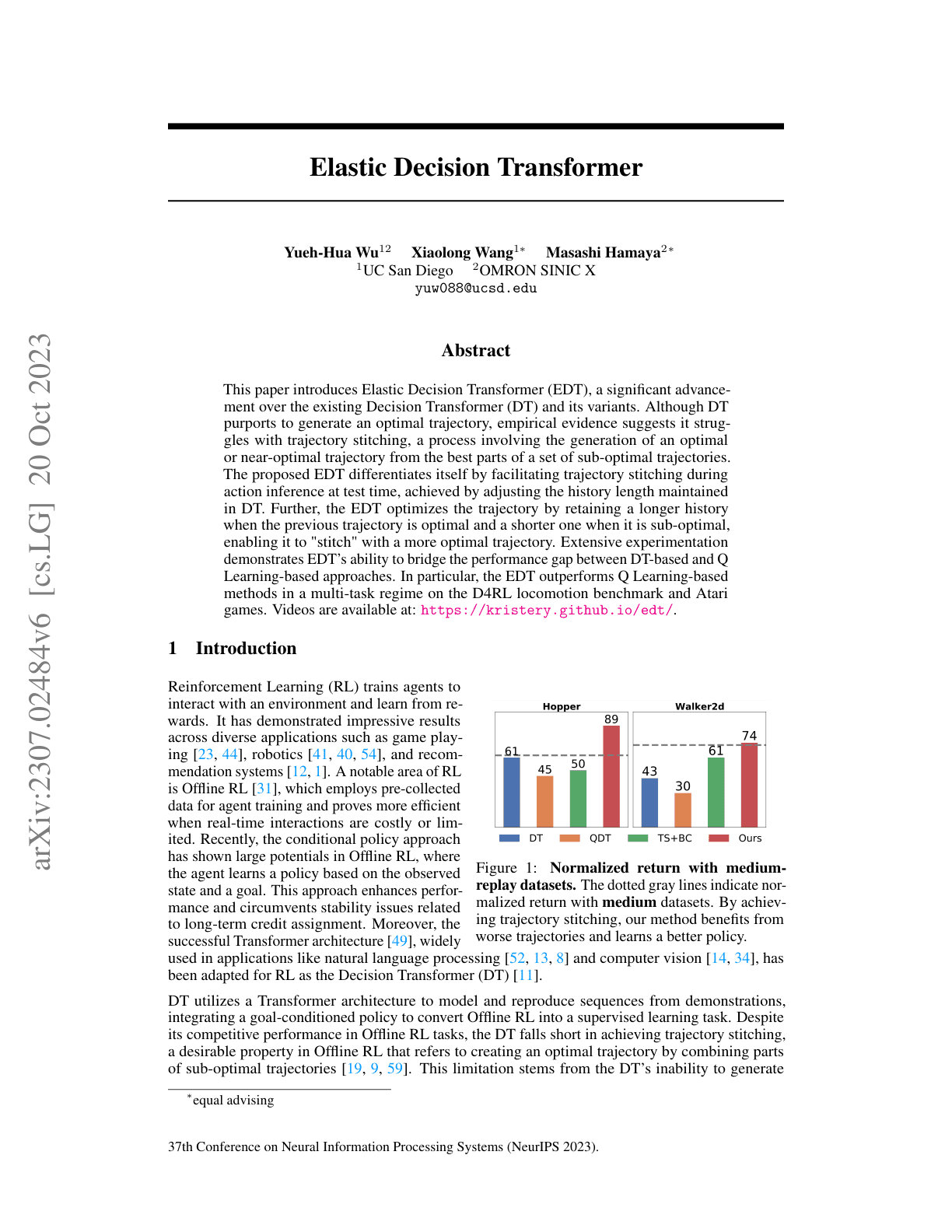
This paper introduces Elastic Decision Transformer (EDT), a significant advancement over the existing Decision Transformer (DT) and its variants. Although DT purports to generate an optimal trajectory, empirical evidence suggests it struggles with trajectory stitching, a process involving the generation of an optimal or near-optimal trajectory from the best parts of a set of sub-optimal trajectories. The proposed EDT differentiates itself by facilitating trajectory stitching during action inference at test time, achieved by adjusting the history length maintained in DT. Further, the EDT optimizes the trajectory by retaining a longer history when the previous trajectory is optimal and a shorter one when it is sub-optimal, enabling it to "stitch" with a more optimal trajectory. Extensive experimentation demonstrates EDT's ability to bridge the performance gap between DT-based and Q Learning-based approaches. In particular, the EDT outperforms Q Learning-based methods in a multi-task regime on the D4RL locomotion benchmark and Atari games. Videos are available at: https://kristery.github.io/edt/