Hallucination in LVLMs
A survey specifically scoped to hallucination in Large Vision-Language Models, a phenomenon that differs substantially from text-only LLM hallucination.
Ask this paper
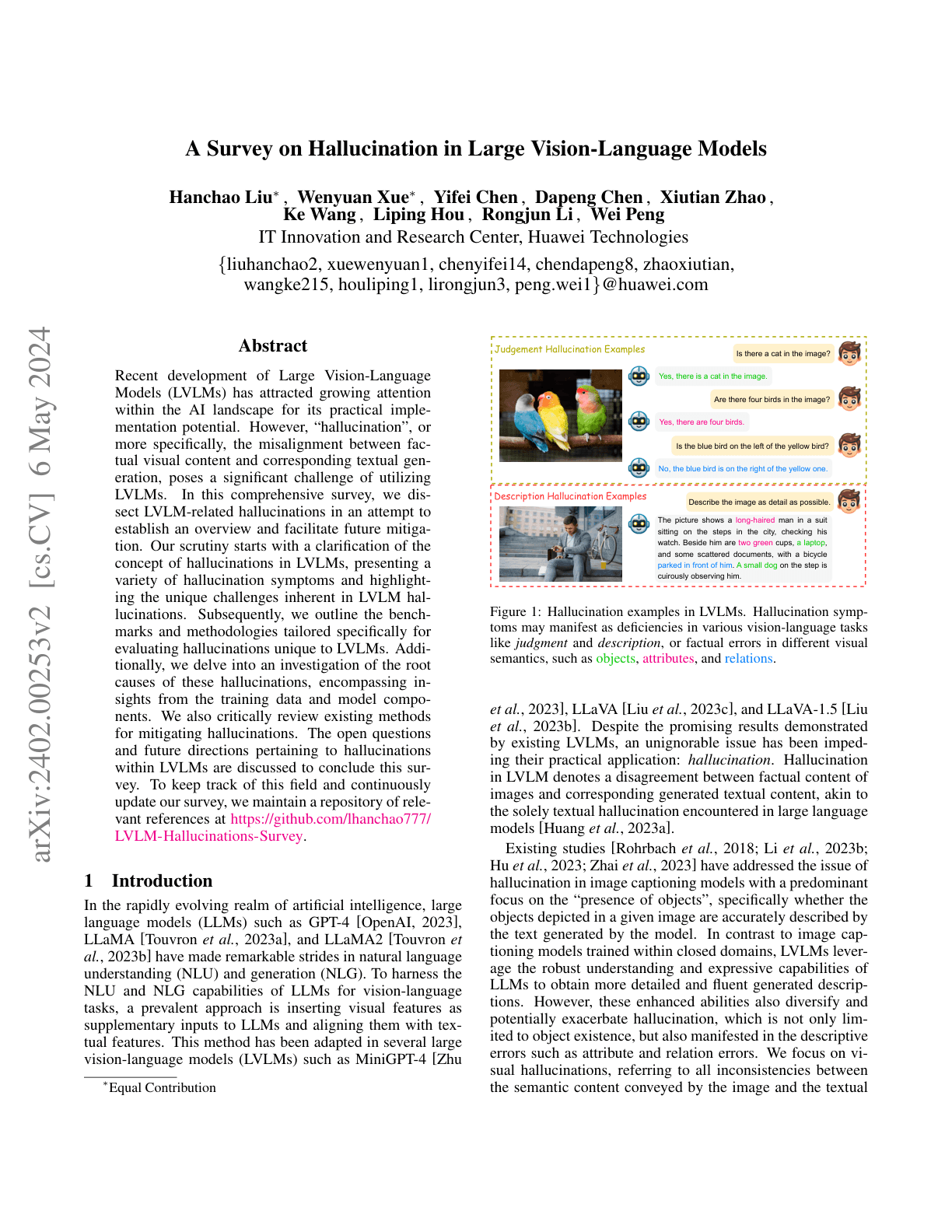
Hallucination taxonomy: Distinguishes object, attribute, and relation hallucinations in LVLMs and discusses how each arises from different architectural and data pressures.
Causes: Traces hallucinations to biased training data, weak visual grounding, language prior dominance, and weaknesses in the vision encoder.
Evaluation: Reviews benchmarks (POPE, MMHal-Bench, HallusionBench) and automatic evaluation metrics specific to visual hallucination.
Mitigation: Catalogs mitigation strategies including improved data curation, better visual alignment, decoding-time interventions, and RLHF-style preference optimization.
Abstract
Recent development of Large Vision-Language Models (LVLMs) has attracted growing attention within the AI landscape for its practical implementation potential. However, ``hallucination'', or more specifically, the misalignment between factual visual content and corresponding textual generation, poses a significant challenge of utilizing LVLMs. In this comprehensive survey, we dissect LVLM-related hallucinations in an attempt to establish an overview and facilitate future mitigation. Our scrutiny starts with a clarification of the concept of hallucinations in LVLMs, presenting a variety of hallucination symptoms and highlighting the unique challenges inherent in LVLM hallucinations. Subsequently, we outline the benchmarks and methodologies tailored specifically for evaluating hallucinations unique to LVLMs. Additionally, we delve into an investigation of the root causes of these hallucinations, encompassing insights from the training data and model components. We also critically review existing methods for mitigating hallucinations. The open questions and future directions pertaining to hallucinations within LVLMs are discussed to conclude this survey.