In-Context Learning with Long-Context Models
studies the behavior in-context learning of LLMs at extreme context lengths with long-context models; shows that performance increases as hundreds or thousands of demonstrations are used; demonstrates that long-context ICL is less sensitive to random input shuffling than short-context ICL; concludes that the effectiveness of long-context LLMs is not due to task learning but from attending to similar examples.
Ask this paper
Abstract
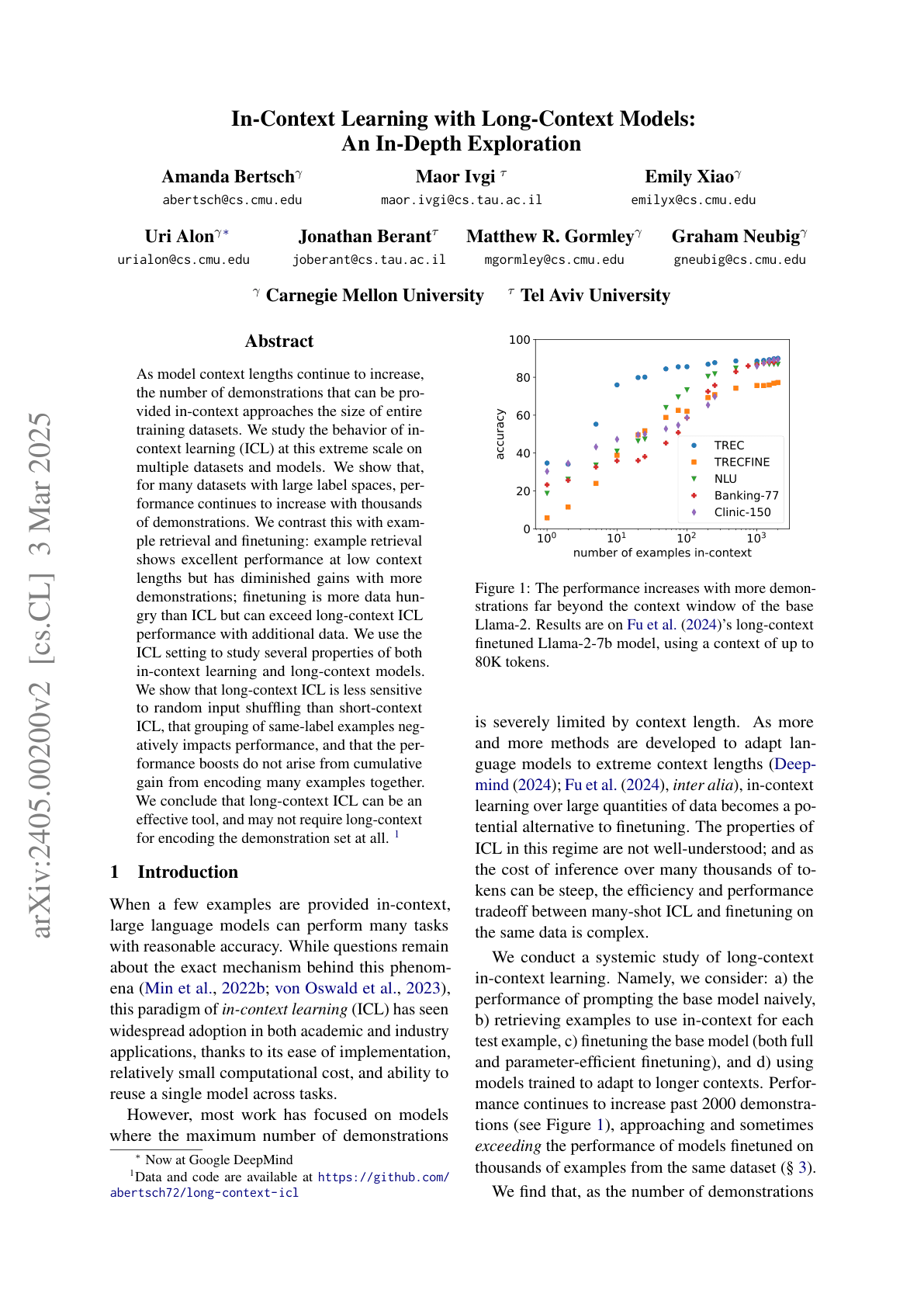
As model context lengths continue to increase, the number of demonstrations that can be provided in-context approaches the size of entire training datasets. We study the behavior of in-context learning (ICL) at this extreme scale on multiple datasets and models. We show that, for many datasets with large label spaces, performance continues to increase with thousands of demonstrations. We contrast this with example retrieval and finetuning: example retrieval shows excellent performance at low context lengths but has diminished gains with more demonstrations; finetuning is more data hungry than ICL but can exceed long-context ICL performance with additional data. We use the ICL setting to study several properties of both in-context learning and long-context models. We show that long-context ICL is less sensitive to random input shuffling than short-context ICL, that grouping of same-label examples negatively impacts performance, and that the performance boosts do not arise from cumulative gain from encoding many examples together. We conclude that long-context ICL can be an effective tool, and may not require long-context for encoding the demonstration set at all.