Learn to Reason without External Rewards
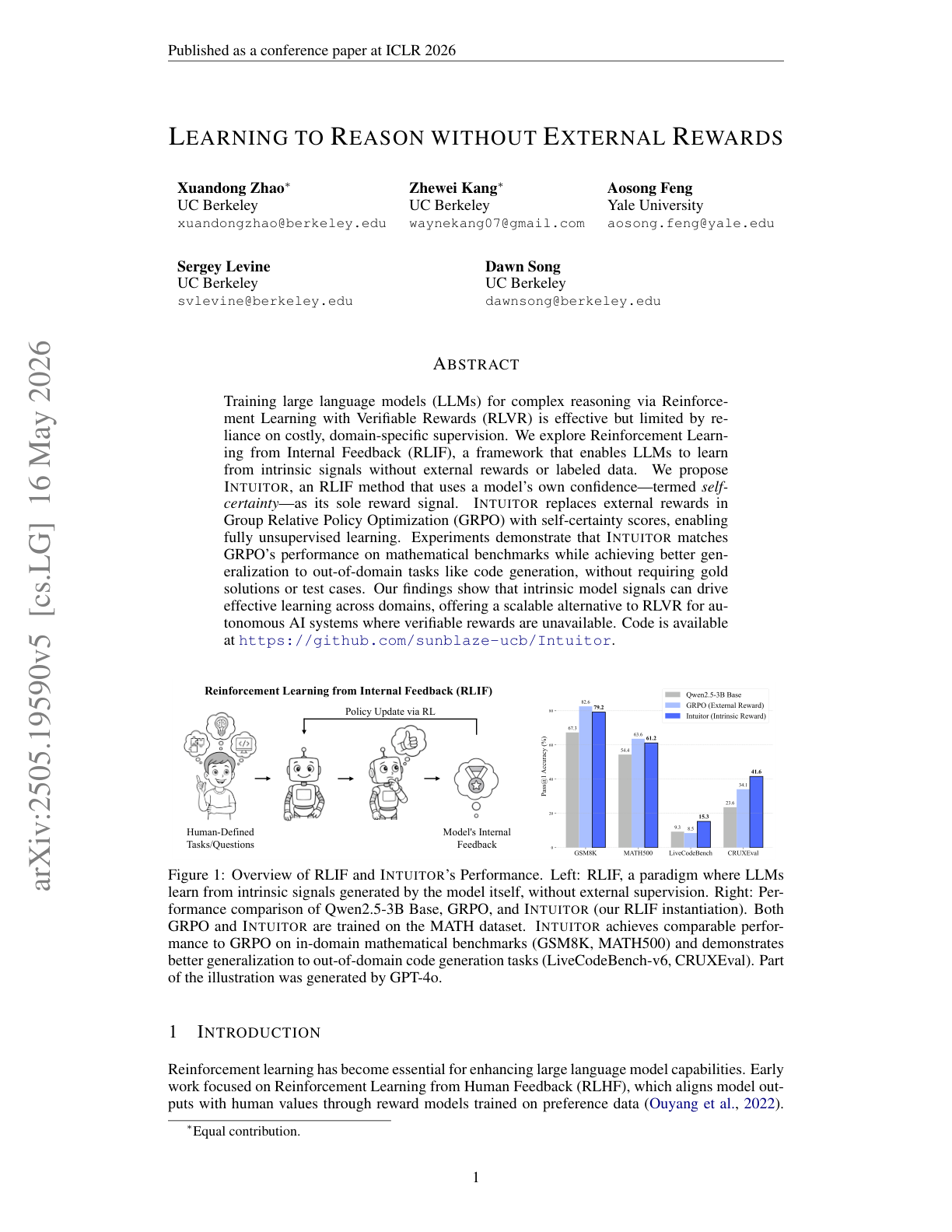
Proposes a method for training LLMs via reinforcement learning without any external rewards or labeled data. Instead, it uses the model’s own self-certainty, a confidence measure based on KL divergence from uniform, as the sole intrinsic reward. This self-improvement strategy, part of the broader Reinforcement Learning from Internal Feedback (RLIF) paradigm, bypasses the limitations of Reinforcement Learning with Verifiable Rewards (RLVR), which requires domain-specific verifiers and gold-standard outputs. Key highlights:
Ask this paper
INTUITOR matches GRPO without external supervision: When applied to mathematical reasoning tasks like GSM8K and MATH500, INTUITOR achieves performance on par with GRPO (a strong RLVR method), even without using gold solutions. On out-of-domain tasks such as LiveCodeBench and CRUXEval, INTUITOR generalizes better, achieving higher gains than GRPO (+65% vs. 0% and +76% vs. +44%, respectively).
Rapid early learning and enhanced instruction-following: INTUITOR significantly boosts early training performance, particularly on models like Qwen2.5-1.5B, and improves adherence to chat-style instructions, reducing repetitive or nonsensical output.
Emergent structured reasoning: Trained models display spontaneous reasoning even when not explicitly required, often generating explanations or planning steps before producing code or answers. This behavior correlates with better transfer performance to domains like code generation.
Self-certainty as a robust, hack-resistant signal: Unlike fixed reward models prone to exploitation, online self-certainty adapts with the model and avoids reward hacking. INTUITOR-trained models show the strongest correlation between self-certainty and correct answers, confirmed by statistical tests.