Learning Latent Action World Models In The Wild
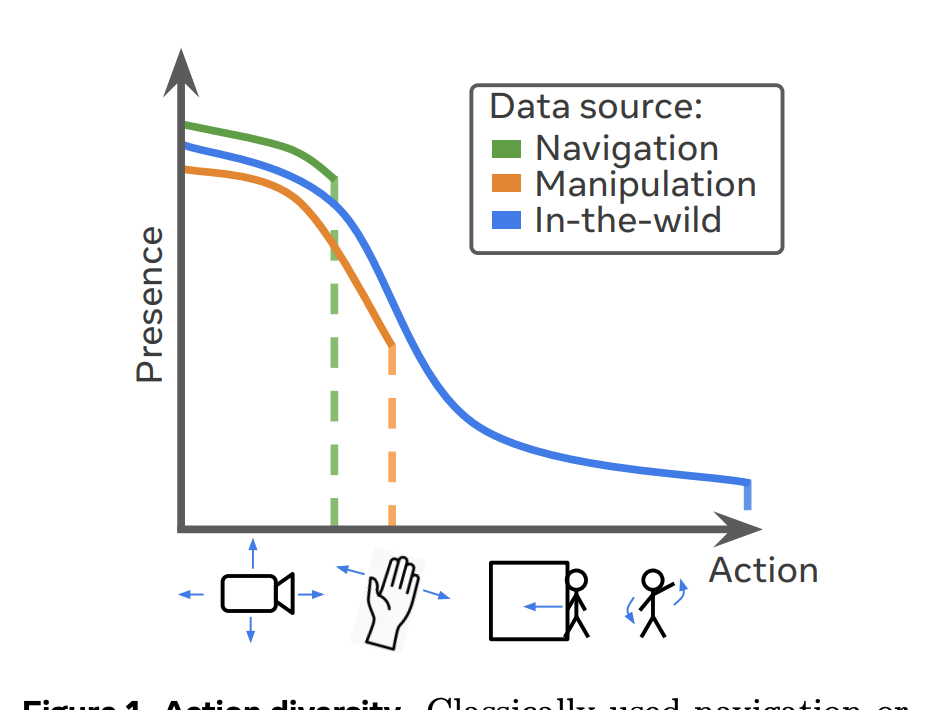
Meta AI researchers address learning world models from in-the-wild videos without requiring explicit action labels, expanding beyond simple robotics simulations and video games to real-world video data with diverse embodiments and uncontrolled conditions. - **Latent action learning:** The work demonstrates that continuous but constrained latent actions can capture the complexity of actions from in-the-wild videos, outperforming vector quantization approaches commonly used in prior work. - **Cross-video transfer:** Changes in the environment coming from agents, such as humans entering a room, can be transferred across different videos, indicating the learned latent actions capture meaningful and generalizable environmental interactions. - **Universal interface:** Despite challenges from diverse embodiments across videos, the researchers train a controller that maps known actions to latent ones, enabling latent actions to serve as a universal interface for downstream planning tasks. - **Comparable to action-conditioned baselines:** The latent action approach achieves comparable performance to action-conditioned baselines on planning tasks, demonstrating practical viability without requiring explicit action labels during training. - **Scaling to real-world data:** The work represents progress toward scaling latent action models to realistic video data, addressing fundamental challenges in learning from diverse, uncontrolled video sources that lack action annotations.
Ask this paper
Latent action learning: The work demonstrates that continuous but constrained latent actions can capture the complexity of actions from in-the-wild videos, outperforming vector quantization approaches commonly used in prior work.
Cross-video transfer: Changes in the environment coming from agents, such as humans entering a room, can be transferred across different videos, indicating that the learned latent actions capture meaningful and generalizable environmental interactions.
Universal interface: Despite challenges from diverse embodiments across videos, the researchers train a controller that maps known actions to latent ones, enabling latent actions to serve as a universal interface for downstream planning tasks.
Comparable to action-conditioned baselines: The latent action approach achieves comparable performance to action-conditioned baselines on planning tasks, demonstrating practical viability without requiring explicit action labels during training.
Scaling to real-world data: The work represents progress toward scaling latent action models to realistic video data, addressing fundamental challenges in learning from diverse, uncontrolled video sources that lack action annotations.
Abstract
Agents capable of reasoning and planning in the real world require the ability of predicting the consequences of their actions. While world models possess this capability, they most often require action labels, that can be complex to obtain at scale. This motivates the learning of latent action models, that can learn an action space from videos alone. Our work addresses the problem of learning latent actions world models on in-the-wild videos, expanding the scope of existing works that focus on simple robotics simulations, video games, or manipulation data. While this allows us to capture richer actions, it also introduces challenges stemming from the video diversity, such as environmental noise, or the lack of a common embodiment across videos. To address some of the challenges, we discuss properties that actions should follow as well as relevant architectural choices and evaluations. We find that continuous, but constrained, latent actions are able to capture the complexity of actions from in-the-wild videos, something that the common vector quantization does not. We for example find that changes in the environment coming from agents, such as humans entering the room, can be transferred across videos. This highlights the capability of learning actions that are specific to in-the-wild videos. In the absence of a common embodiment across videos, we are mainly able to learn latent actions that become localized in space, relative to the camera. Nonetheless, we are able to train a controller that maps known actions to latent ones, allowing us to use latent actions as a universal interface and solve planning tasks with our world model with similar performance as action-conditioned baselines. Our analyses and experiments provide a step towards scaling latent action models to the real world.