Active Context Compression for LLM Agents
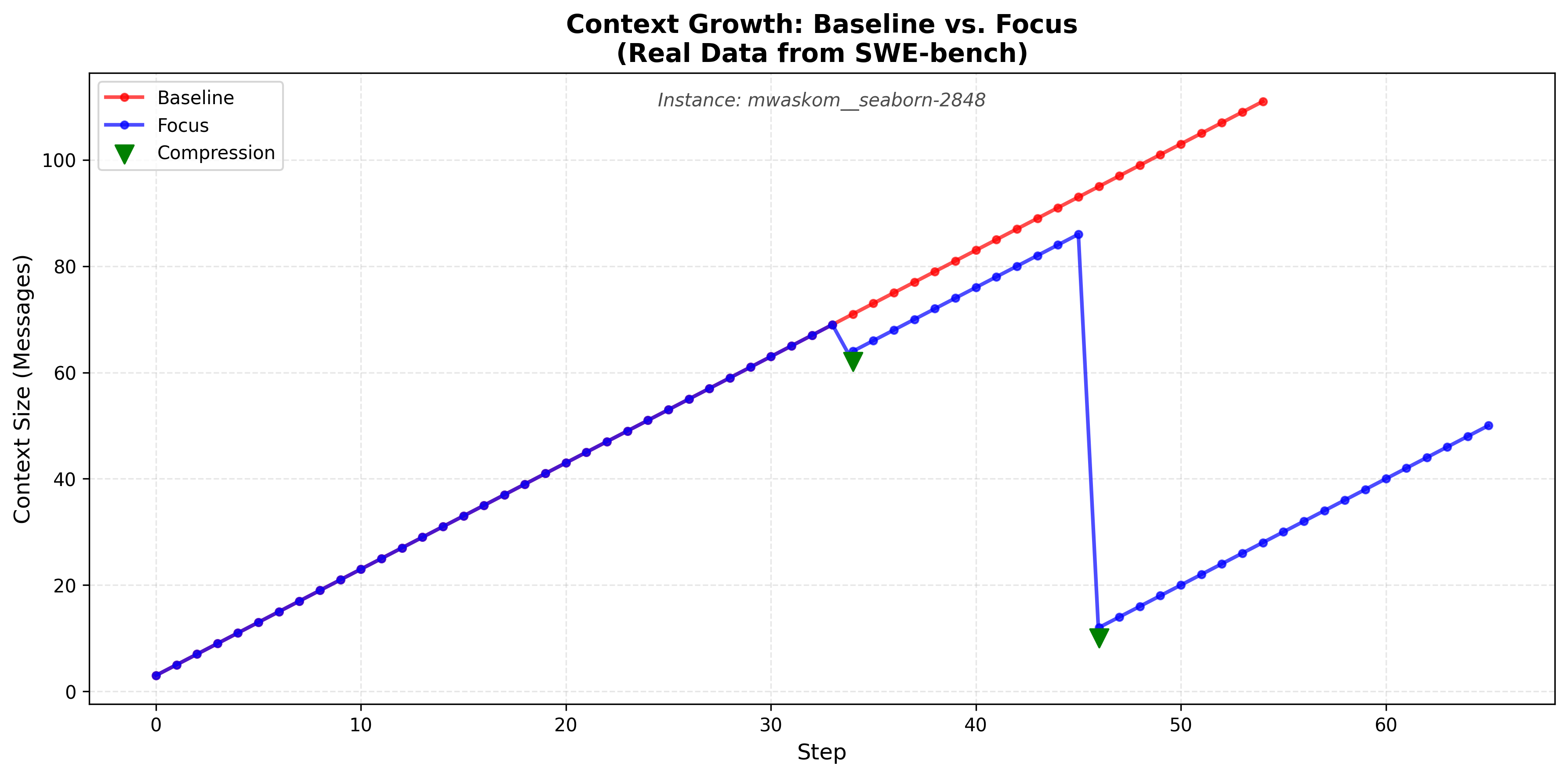
Focus introduces an agent-centered architecture that enables LLM agents to autonomously manage their own memory by deciding when to consolidate learnings into a persistent "Knowledge" block and actively prune raw interaction history. The design is inspired by the biological navigation patterns of Physarum polycephalum (slime mold). - **The context bloat problem:** LLM agents struggle with extended tasks as interaction history accumulates, causing computational expenses to increase, processing delays to worsen, and reasoning to deteriorate from distraction by irrelevant prior mistakes. - **Autonomous memory management:** Unlike passive external summarization, Focus agents autonomously choose when to store important discoveries and remove raw interaction records. The system performed 6.0 autonomous consolidations per assignment on average. - **Significant token reduction:** Tested on context-heavy SWE-bench Lite cases using Claude Haiku 4.5, Focus reduces token consumption by 22.7% (14.9M to 11.5M tokens) while preserving identical accuracy (60% for both agents), with reductions reaching 57% on particular instances. - **Bio-inspired optimization:** The architecture models biological navigation patterns where organisms efficiently manage resources and pathways, applying similar principles to context management in AI agents. - **Production-ready toolkit:** The system uses a refined toolkit matching production standards including persistent bash and string-replacement editor, demonstrating practical applicability for real-world software engineering tasks.
Ask this paper
The context bloat problem: LLM agents struggle with extended tasks as interaction history accumulates, causing computational expenses to increase, processing delays to worsen, and reasoning to deteriorate from distraction by irrelevant prior mistakes.
Autonomous memory management: Unlike passive external summarization, Focus agents autonomously choose when to store important discoveries and remove raw interaction records. The system performed 6.0 autonomous consolidations per assignment on average.
Significant token reduction: Tested on context-heavy SWE-bench Lite cases using Claude Haiku 4.5, Focus reduces token consumption by 22.7% (14.9M to 11.5M tokens) while preserving identical accuracy (60% for both agents), with reductions reaching 57% on particular instances.
Bio-inspired optimization: The architecture models biological navigation patterns where organisms efficiently manage resources and pathways, applying similar principles to context management in AI agents.
Production-ready toolkit: The system uses a refined toolkit matching production standards, including a persistent bash and string-replacement editor, demonstrating practical applicability for real-world software engineering tasks.
Abstract
Large Language Model (LLM) agents struggle with long-horizon software engineering tasks due to "Context Bloat." As interaction history grows, computational costs explode, latency increases, and reasoning capabilities degrade due to distraction by irrelevant past errors. Existing solutions often rely on passive, external summarization mechanisms that the agent cannot control. This paper proposes Focus, an agent-centric architecture inspired by the biological exploration strategies of Physarum polycephalum (slime mold). The Focus Agent autonomously decides when to consolidate key learnings into a persistent "Knowledge" block and actively withdraws (prunes) the raw interaction history. Using an optimized scaffold matching industry best practices (persistent bash + string-replacement editor), we evaluated Focus on N=5 context-intensive instances from SWE-bench Lite using Claude Haiku 4.5. With aggressive prompting that encourages frequent compression, Focus achieves 22.7% token reduction (14.9M -> 11.5M tokens) while maintaining identical accuracy (3/5 = 60% for both agents). Focus performed 6.0 autonomous compressions per task on average, with token savings up to 57% on individual instances. We demonstrate that capable models can autonomously self-regulate their context when given appropriate tools and prompting, opening pathways for cost-aware agentic systems without sacrificing task performance.