Unified Long-Term and Short-Term Memory for LLM Agents
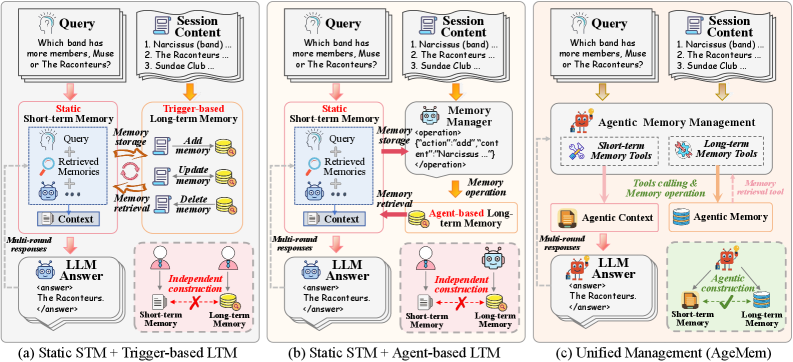
AgeMem introduces a unified framework that integrates both long-term and short-term memory operations into an LLM agent's decision-making policy. The system enables agents to autonomously determine what and when to store, retrieve, update, summarize, or discard information by exposing memory operations as tool-based actions. - **Unified memory management:** Unlike existing solutions that treat long-term and short-term memory separately with inflexible heuristics, AgeMem combines both into a single learnable policy that adapts to task requirements dynamically. - **Memory as tool actions:** The framework exposes memory operations (store, retrieve, update, summarize, discard) as callable tools, allowing the agent to learn optimal memory strategies through interaction rather than relying on predefined rules. - **Progressive reinforcement learning:** A three-stage training approach with a specialized "step-wise GRPO" algorithm handles the sparse and discontinuous rewards created by memory operations, enabling stable learning of complex memory policies. - **Strong benchmark performance:** Testing across five long-horizon benchmarks demonstrates AgeMem outperforms comparable systems by improving task performance, memory quality, and context efficiency simultaneously. - **Architecture agnostic:** The approach works with multiple LLM architectures, suggesting the learned memory management strategies transfer across different base models and task domains.
Ask this paper
Unified memory management: Unlike existing solutions that treat long-term and short-term memory separately with inflexible heuristics, AgeMem combines both into a single learnable policy that adapts to task requirements dynamically.
Memory as tool actions: The framework exposes memory operations (store, retrieve, update, summarize, discard) as callable tools, allowing the agent to learn optimal memory strategies through interaction rather than relying on predefined rules.
Progressive reinforcement learning: A three-stage training approach with a specialized “step-wise GRPO” algorithm handles the sparse and discontinuous rewards created by memory operations, enabling stable learning of complex memory policies.
Strong benchmark performance: Testing across five long-horizon benchmarks demonstrates that AgeMem outperforms comparable systems by improving task performance, memory quality, and context efficiency simultaneously.
Architecture agnostic: The approach works with multiple LLM architectures, suggesting the learned memory management strategies transfer across different base models and task domains.
Abstract
Large language model (LLM) agents face fundamental limitations in long-horizon reasoning due to finite context windows, making effective memory management critical. Existing methods typically handle long-term memory (LTM) and short-term memory (STM) as separate components, relying on heuristics or auxiliary controllers, which limits adaptability and end-to-end optimization. In this paper, we propose Agentic Memory (AgeMem), a unified framework that integrates LTM and STM management directly into the agent's policy. AgeMem exposes memory operations as tool-based actions, enabling the LLM agent to autonomously decide what and when to store, retrieve, update, summarize, or discard information. To train such unified behaviors, we propose a three-stage progressive reinforcement learning strategy and design a step-wise GRPO to address sparse and discontinuous rewards induced by memory operations. Experiments on five long-horizon benchmarks demonstrate that AgeMem consistently outperforms strong memory-augmented baselines across multiple LLM backbones, achieving improved task performance, higher-quality long-term memory, and more efficient context usage.