Learning Latent Action World Models In The Wild
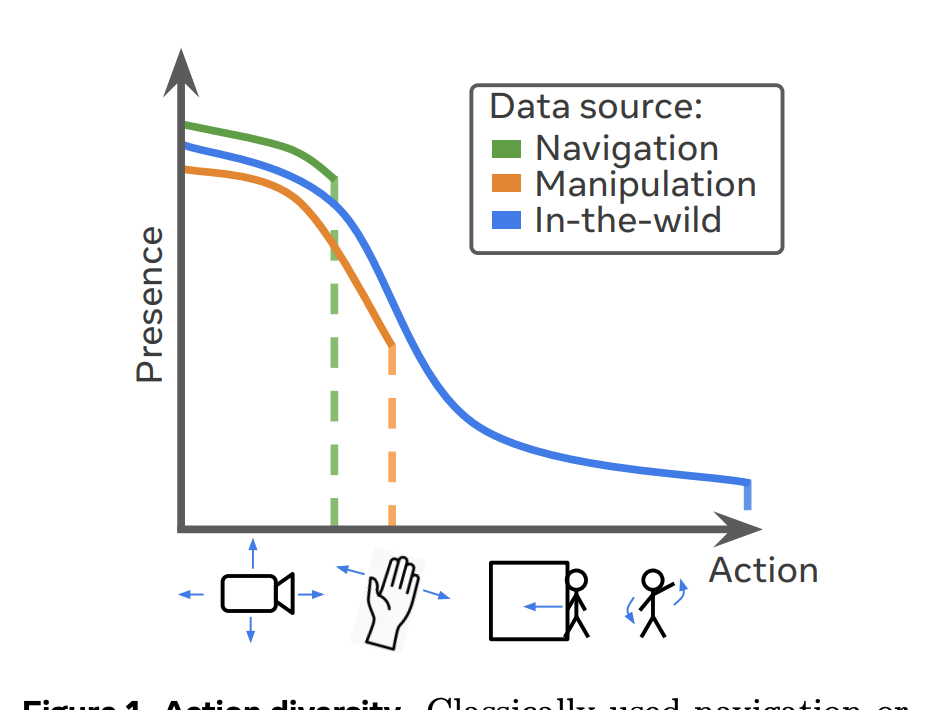
Meta AI researchers address learning world models from in-the-wild videos without requiring explicit action labels, expanding beyond simple robotics simulations and video games to real-world video data with diverse embodiments and uncontrolled conditions.
Extending Context by Dropping Positional Embeddings
DroPE introduces a method for extending a language model’s context window after pretraining without expensive long-context fine-tuning. The approach involves removing positional embeddings from a pretrained model and performing brief recalibration at the original context length.

Self-Evolving Search Agents Without Training Data
Dr. Zero introduces a framework for developing multi-turn search agents that improve themselves autonomously without labeled training data. A proposer generates diverse questions to train a solver initialized from the same base model, creating a self-evolution loop with automated curriculum difficulty scaling.
Unified Long-Term and Short-Term Memory for LLM Agents
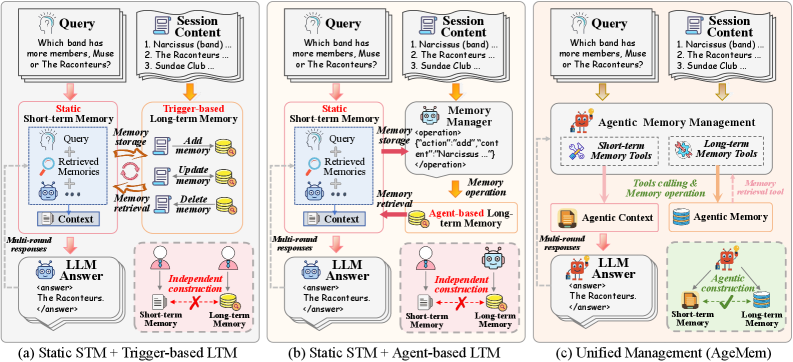
AgeMem introduces a unified framework that integrates both long-term and short-term memory operations into an LLM agent’s decision-making policy. The system enables agents to autonomously determine what and when to store, retrieve, update, summarize, or discard information by exposing memory operations as tool-based actions.
Active Context Compression for LLM Agents
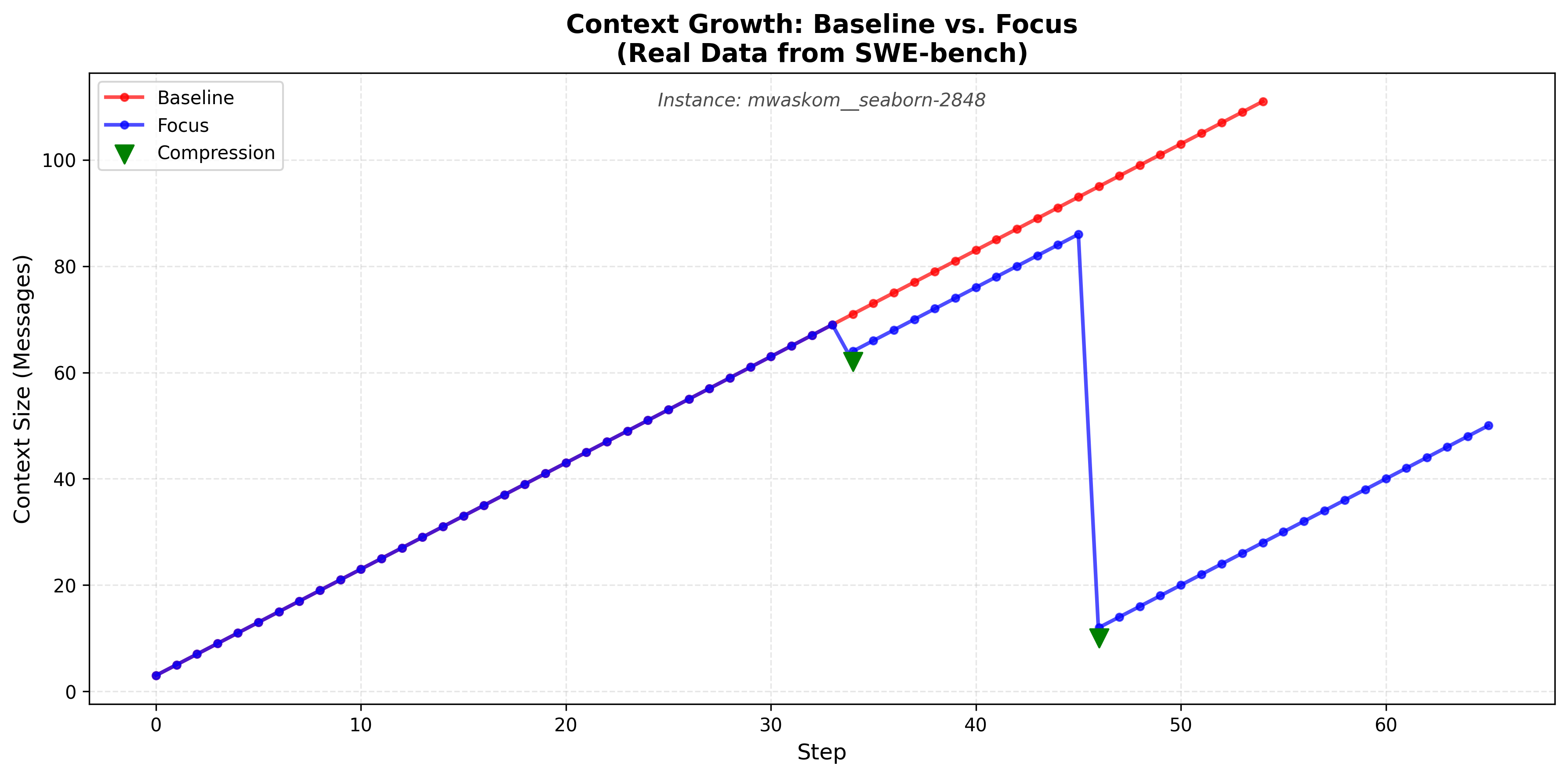
Focus introduces an agent-centered architecture that enables LLM agents to autonomously manage their own memory by deciding when to consolidate learnings into a persistent “Knowledge” block and actively prune raw interaction history. The design is inspired by the biological navigation patterns of Physarum polycephalum (slime mold).
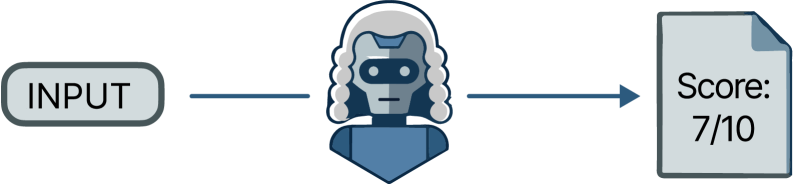
Agent-as-a-Judge
This comprehensive survey traces the evolution from LLM-based evaluation to agentic evaluation approaches, establishing the first taxonomy for this paradigm shift. As evaluation tasks grow more intricate and specialized, traditional single-pass language model judges become insufficient.
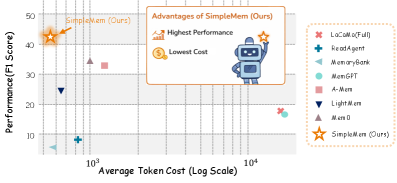
Efficient Lifelong Memory for LLM Agents
SimpleMem introduces a memory framework built on semantic lossless compression that addresses the tension between maintaining comprehensive long-term memory and minimizing token overhead for LLM agents. The approach achieves a 26.4% F1 improvement over baselines while reducing token consumption by up to 30-fold during inference.

Ministral 3
Mistral AI releases Ministral 3, a family of compact language models (3B, 8B, 14B parameters) designed for compute and memory-constrained applications from mobile to edge deployments. Created through Cascade Distillation (iterative pruning with continued training), each size offers pretrained, instruction-finetuned, and reasoning variants with integrated image understanding, released under Apache 2.0.
UniversalRAG
UniversalRAG introduces a RAG system that handles knowledge retrieval from heterogeneous sources containing multiple data types (text, images, videos) with varying granularities. Rather than forcing diverse modalities into a single embedding space where embeddings cluster by modality rather than meaning, it uses modality-aware routing to dynamically select appropriate corpus and granularity for each query, outperforming both unimodal and unified multimodal RAG baselines across 10 benchmarks.
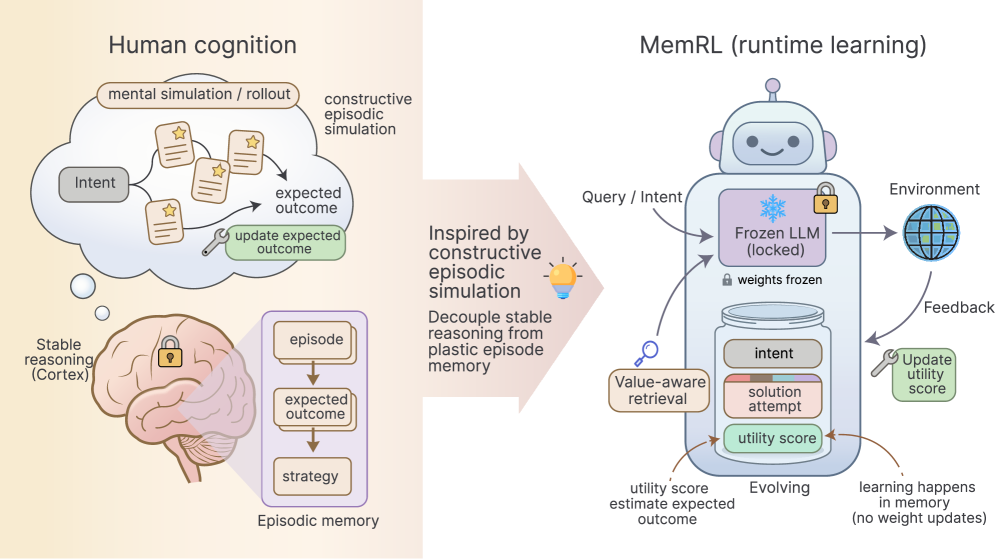
MemRL
MemRL enables LLM agents to improve continuously without retraining by separating a frozen model’s reasoning from an evolving memory system. A Two-Phase Retrieval mechanism filters candidates by semantic relevance, then ranks them using learned Q-values that improve through trial-and-error, outperforming existing methods on HLE, BigCodeBench, ALFWorld, and Lifelong Agent Bench.