LM-Guided Chain-of-Thought
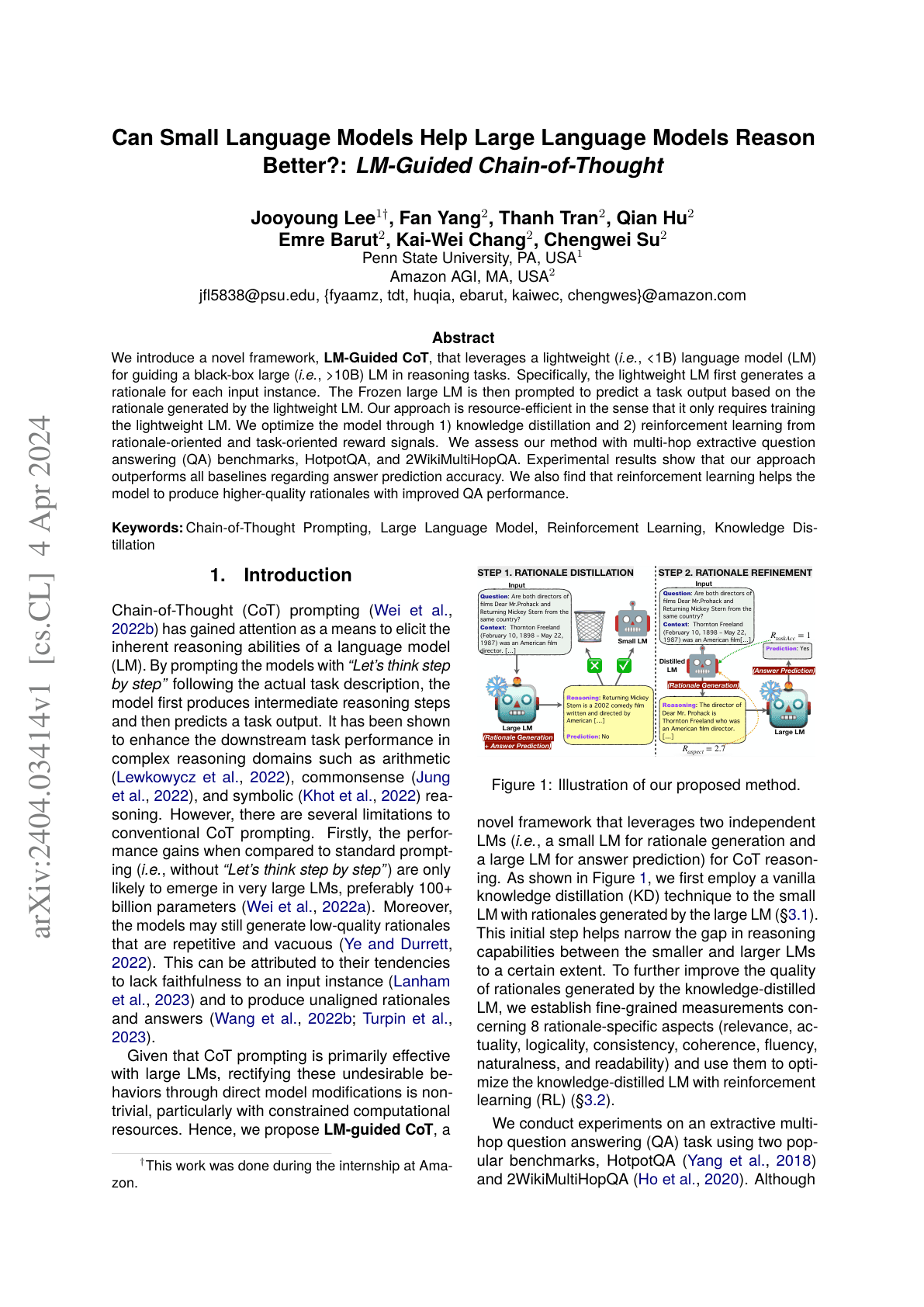
This paper offloads rationale generation to a small, trained LM while keeping a frozen large LM as the answer predictor. The small model is optimized with knowledge distillation and reinforcement learning so it produces rationales that steer the large model more effectively.
Ask this paper
Split responsibilities: A small (<1B) LM writes the chain-of-thought rationale; a frozen large (>10B) LM reads the rationale and produces the final answer. Only the small LM is trained, cutting cost sharply.
Two-stage training: First, distill rationales from the large LM into the small one (knowledge distillation). Then fine-tune the small LM with RL using rationale-oriented and task-oriented reward signals.
Multi-hop QA gains: Evaluated on HotpotQA and 2WikiMultiHopQA, LM-guided CoT outperforms standard prompting and vanilla CoT prompting on answer-prediction accuracy; self-consistency decoding compounds the gains.
Cost-aware reasoning: The recipe is a pragmatic template for teams that cannot fine-tune frontier models - train a tiny rationale generator instead and leave the big model frozen as an API.
Abstract
We introduce a novel framework, LM-Guided CoT, that leverages a lightweight (i.e., <1B) language model (LM) for guiding a black-box large (i.e., >10B) LM in reasoning tasks. Specifically, the lightweight LM first generates a rationale for each input instance. The Frozen large LM is then prompted to predict a task output based on the rationale generated by the lightweight LM. Our approach is resource-efficient in the sense that it only requires training the lightweight LM. We optimize the model through 1) knowledge distillation and 2) reinforcement learning from rationale-oriented and task-oriented reward signals. We assess our method with multi-hop extractive question answering (QA) benchmarks, HotpotQA, and 2WikiMultiHopQA. Experimental results show that our approach outperforms all baselines regarding answer prediction accuracy. We also find that reinforcement learning helps the model to produce higher-quality rationales with improved QA performance.