OpenEQA
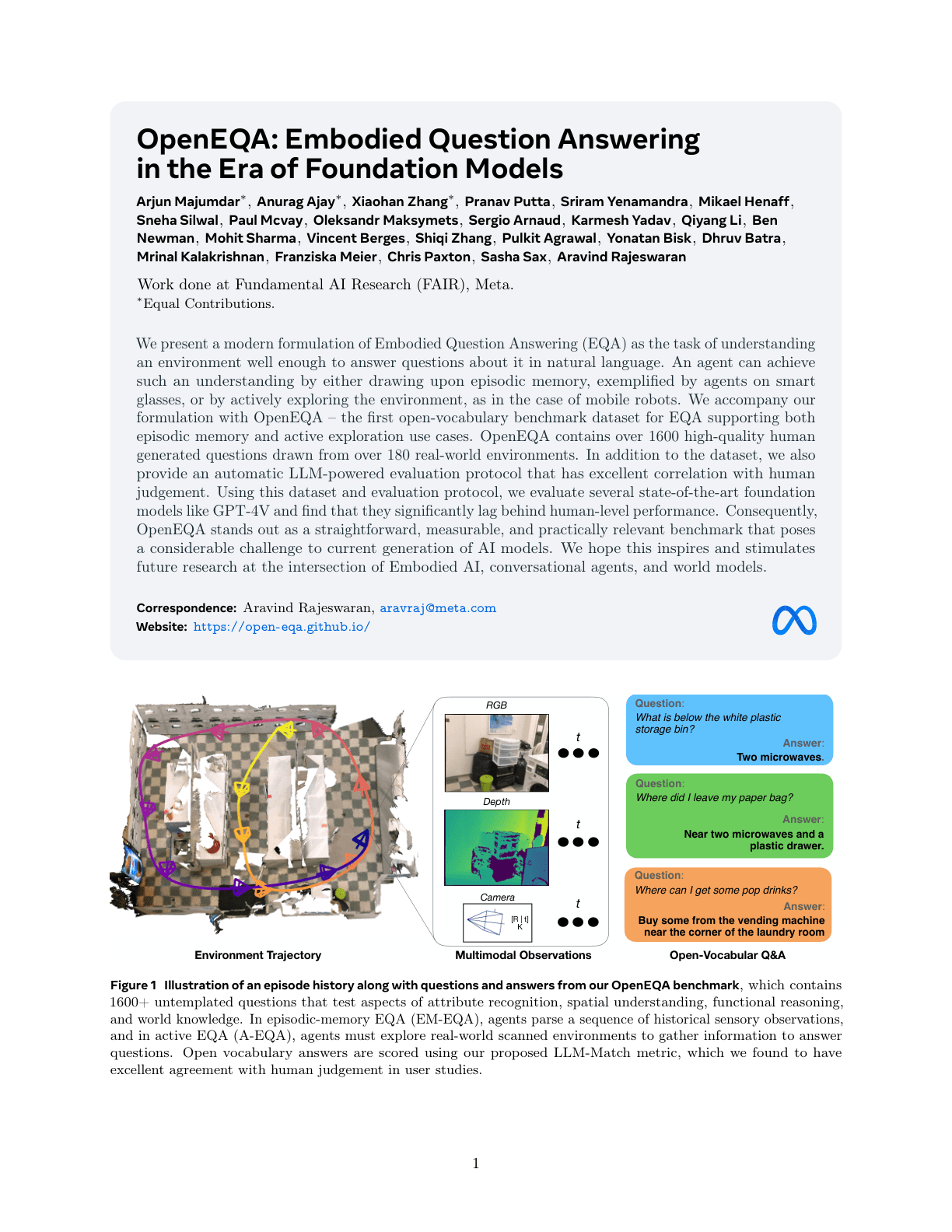
Meta's OpenEQA is an open-vocabulary benchmark for embodied question answering: 1,600+ human-written questions across 180+ real-world environments, with a calibrated LLM-as-judge metric that tracks human agreement closely.
Ask this paper
Benchmark setup: Questions cover episodic-memory use cases (smart glasses) and active-exploration use cases (mobile robots), demanding that agents reason about the environment they occupy rather than just a single image.
LLM-as-judge scoring: The paper introduces an automatic LLM-powered evaluation protocol with strong correlation to human judgment, solving the open-vocabulary scoring problem that blocks most EQA benchmarks from scaling.
Frontier-model performance: GPT-4V, Claude 3, and Gemini Pro significantly outperform text-only baselines, but their gains come mostly from object recognition - for several question categories, they barely beat a blind-LLM baseline.
Gap to humans: Across the board, state-of-the-art multimodal LLMs lag well behind human performance on OpenEQA, positioning the benchmark as a concrete target for embodied-agent research.
Abstract
We present a modern formulation of Embodied Question Answering (EQA) as the task of understanding an environment well enough to answer questions about it in natural language. An agent can achieve such an understanding by either drawing upon episodic memory, exemplified by agents on smart glasses, or by actively exploring the environment, as in the case of mobile robots. We accompany our formulation with OpenEQA – the first open-vocabulary benchmark dataset for EQA supporting both episodic memory and active exploration use cases. OpenEQA contains over 1600 high-quality human generated questions drawn from over 180 real-world environments. In addition to the dataset, we also provide an automatic LLM-powered evaluation protocol that has excellent correlation with human judgement. Using this dataset and evaluation protocol, we evaluate several state-of-the-art foundation models like GPT-4V and find that they significantly lag behind human-level performance. Consequently, OpenEQA stands out as a straightforward, measurable, and practically relevant benchmark that poses a considerable challenge to current generation of AI models. We hope this inspires and stimulates future research at the intersection of Embodied AI, conversational agents, and world models.