Lookahead Sparse Attention
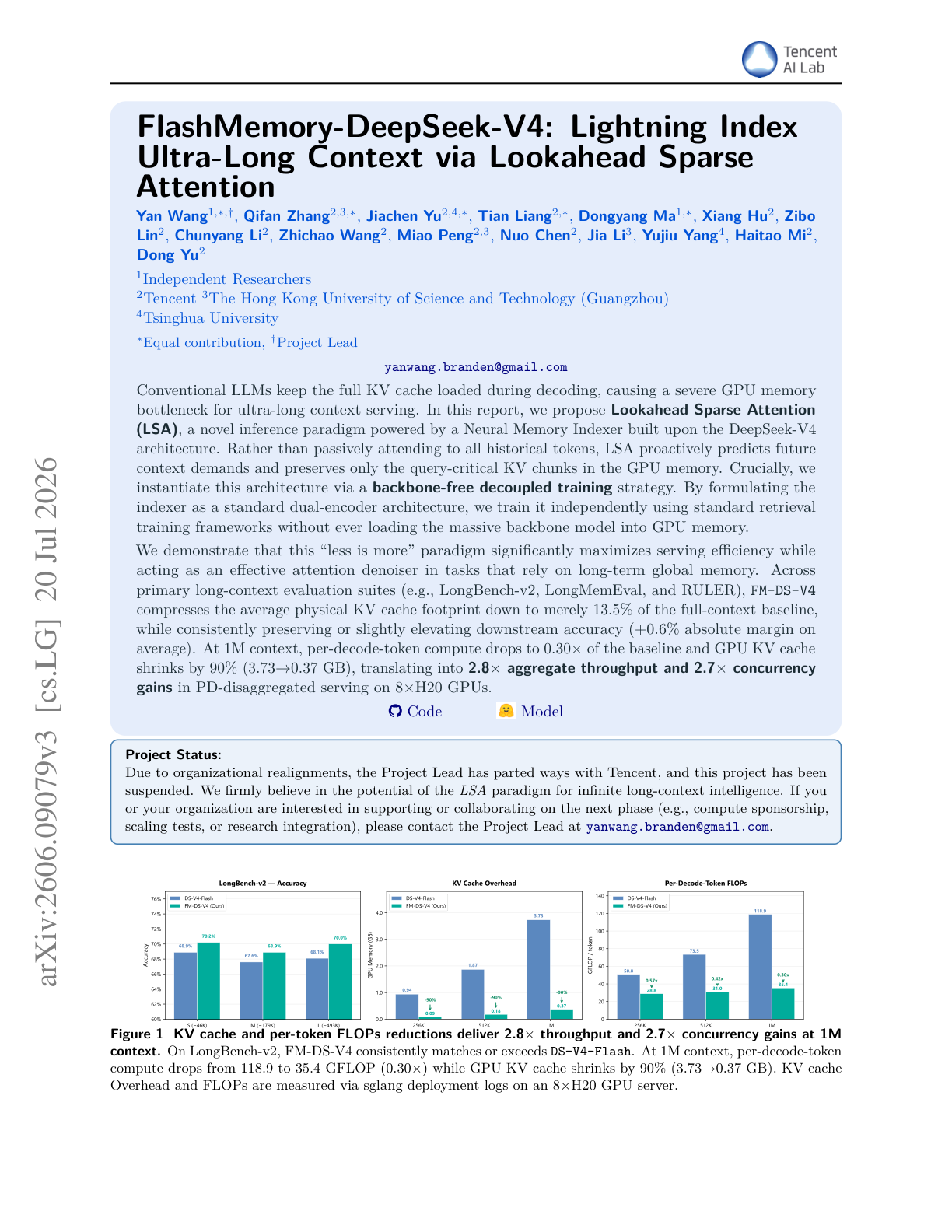
Long-context decoding is bottlenecked by the KV cache, which grows with every token and quickly dominates memory at extreme context lengths. This work, branded around DeepSeek-V4, introduces Lookahead Sparse Attention (LSA), which avoids storing the full KV cache by predicting which parts of the context future decoding will actually need and retaining only those query-critical chunks.
Ask this paper
A learned, lightweight indexer: Instead of keeping everything, a small indexer proactively selects the KV chunks that matter for upcoming generation, so the physical cache stays small without discarding information the model will need.
Backbone-free training: A decoupled training strategy lets the indexer be trained on its own without loading the full backbone model, cutting the cost of adding the mechanism to a large model.
Big cache savings, no quality loss: LSA shrinks the physical KV cache to 13.5% of the full-context baseline while slightly improving accuracy by 0.6% on average, and at 500K-token contexts it suppresses more than 90% of KV-cache overhead without destabilizing reasoning.
Why it matters: Ultra-long context is increasingly the difference between a toy demo and a usable system, and memory is the wall. Predicting what context you will need, rather than keeping all of it, is a practical route to long context that fits in real hardware budgets.