Matryoshka Diffusion Models
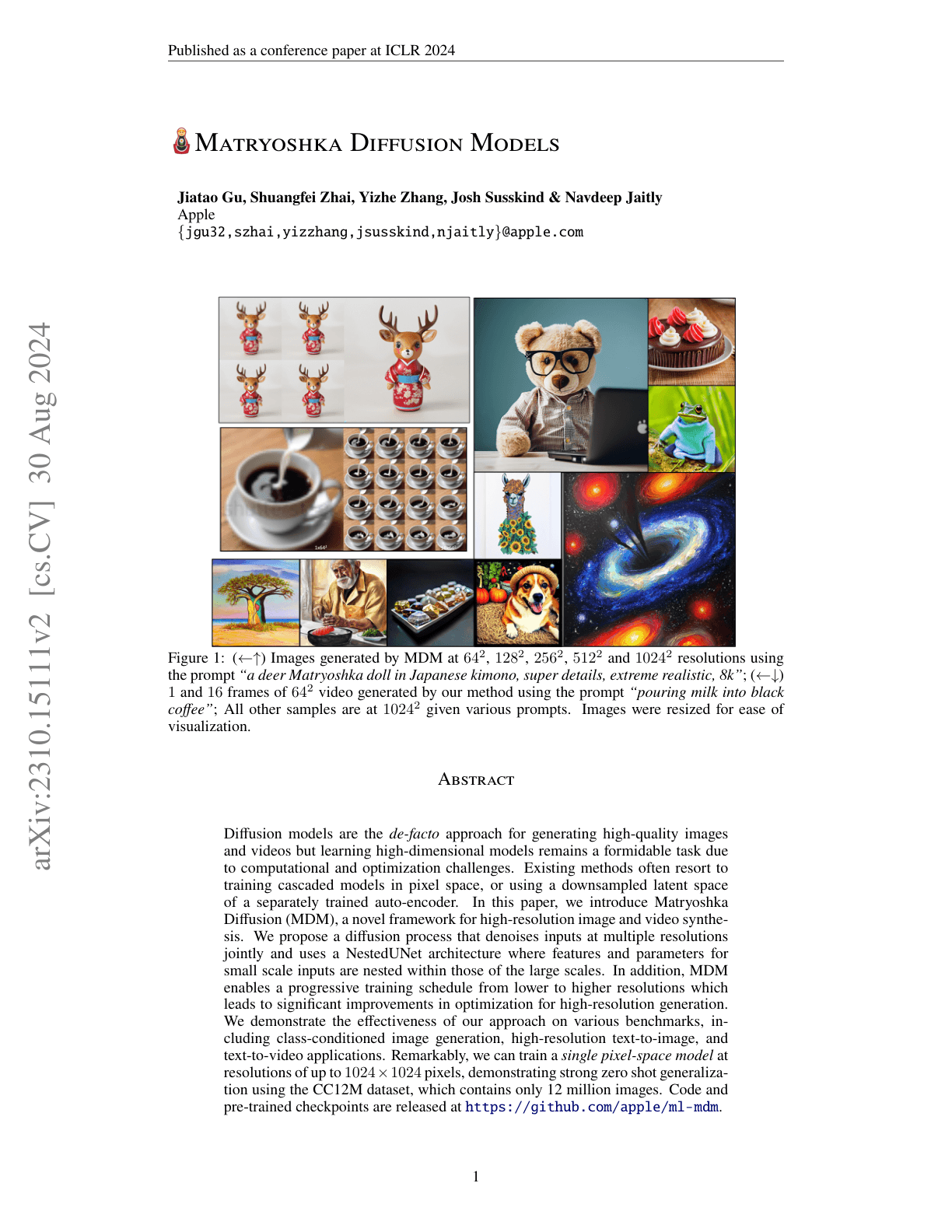
Apple introduces an end-to-end framework for high-resolution image and video synthesis that denoises across multiple resolutions jointly.
Ask this paper
Joint multi-resolution diffusion: Runs the diffusion process at multiple resolutions simultaneously, sharing representations across scales in a single unified model.
NestedUNet: Uses a NestedUNet architecture so that higher-resolution branches build on lower-resolution features without a separate cascade.
Progressive training: Trains progressively from low to high resolution, dramatically improving optimization stability for high-resolution generation.
Unified model: Eliminates the typical cascaded-diffusion pipeline used in prior high-resolution generation, simplifying training and serving.
Abstract
Diffusion models are the de facto approach for generating high-quality images and videos, but learning high-dimensional models remains a formidable task due to computational and optimization challenges. Existing methods often resort to training cascaded models in pixel space or using a downsampled latent space of a separately trained auto-encoder. In this paper, we introduce Matryoshka Diffusion Models(MDM), an end-to-end framework for high-resolution image and video synthesis. We propose a diffusion process that denoises inputs at multiple resolutions jointly and uses a NestedUNet architecture where features and parameters for small-scale inputs are nested within those of large scales. In addition, MDM enables a progressive training schedule from lower to higher resolutions, which leads to significant improvements in optimization for high-resolution generation. We demonstrate the effectiveness of our approach on various benchmarks, including class-conditioned image generation, high-resolution text-to-image, and text-to-video applications. Remarkably, we can train a single pixel-space model at resolutions of up to 1024x1024 pixels, demonstrating strong zero-shot generalization using the CC12M dataset, which contains only 12 million images. Our code is released at https://github.com/apple/ml-mdm