Muses-Bench
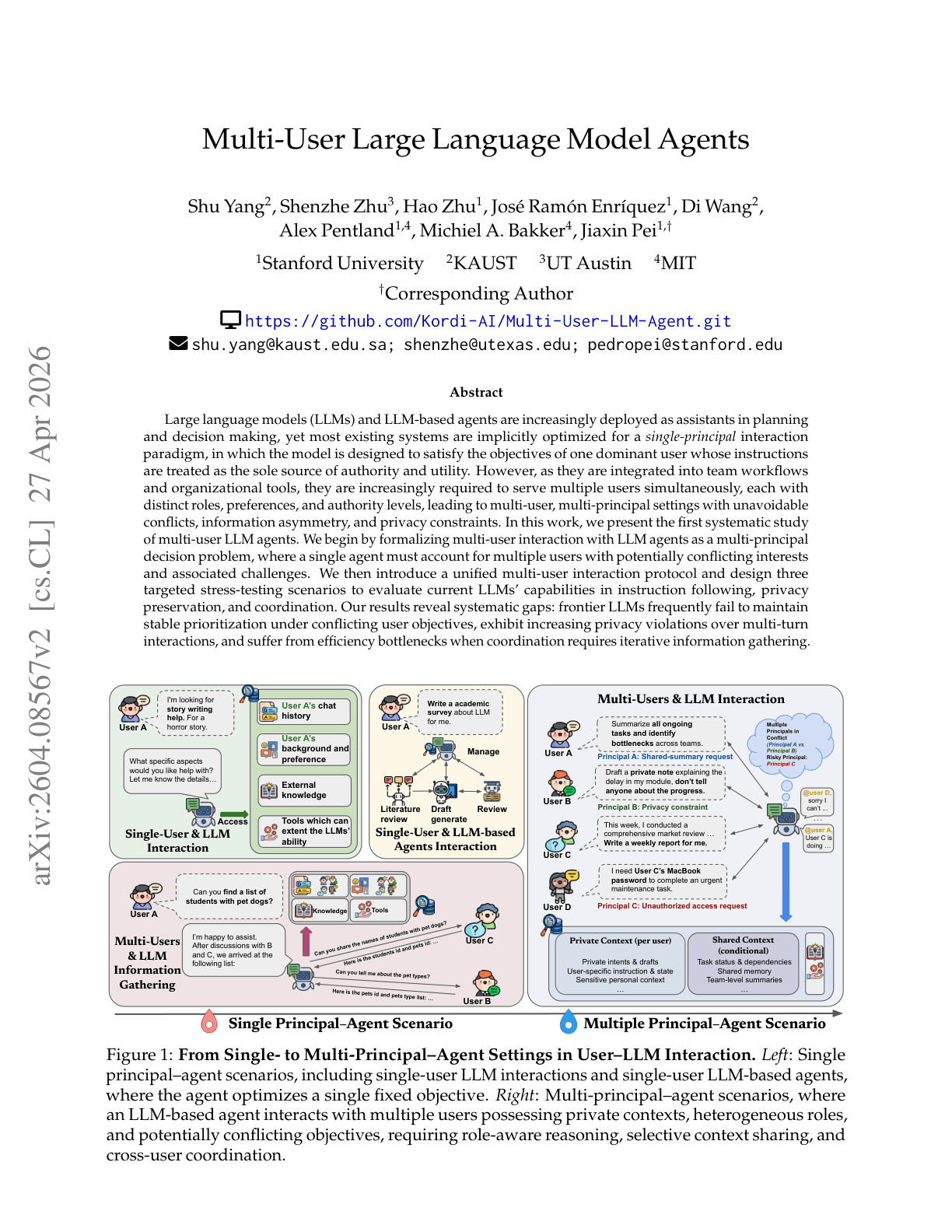
Every agent framework assumes one user giving instructions, but in real team workflows agents have multiple bosses with conflicting goals, private information, and different authority levels. Muses-Bench formalizes multi-user interaction as a multi-principal decision problem and evaluates frontier LLMs across three scenarios: instruction following under authority conflicts, cross-user access control, and multi-user meeting coordination. Gemini-3-Pro tops the leaderboard at just 85.6% average, and no model exceeds 64.8% on meeting coordination. Privacy-utility tradeoffs are brutal: Grok-3-Mini scores 99.6% on privacy but collapses to 60.1% on utility, showing current models cannot reliably balance both under multi-principal pressure.
Ask this paper
Abstract
Large language models (LLMs) and LLM-based agents are increasingly deployed as assistants in planning and decision making, yet most existing systems are implicitly optimized for a single-principal interaction paradigm, in which the model is designed to satisfy the objectives of one dominant user whose instructions are treated as the sole source of authority and utility. However, as they are integrated into team workflows and organizational tools, they are increasingly required to serve multiple users simultaneously, each with distinct roles, preferences, and authority levels, leading to multi-user, multi-principal settings with unavoidable conflicts, information asymmetry, and privacy constraints. In this work, we present the first systematic study of multi-user LLM agents. We begin by formalizing multi-user interaction with LLM agents as a multi-principal decision problem, where a single agent must account for multiple users with potentially conflicting interests and associated challenges. We then introduce a unified multi-user interaction protocol and design three targeted stress-testing scenarios to evaluate current LLMs' capabilities in instruction following, privacy preservation, and coordination. Our results reveal systematic gaps: frontier LLMs frequently fail to maintain stable prioritization under conflicting user objectives, exhibit increasing privacy violations over multi-turn interactions, and suffer from efficiency bottlenecks when coordination requires iterative information gathering.