Reasoning Models Generate Societies of Thought
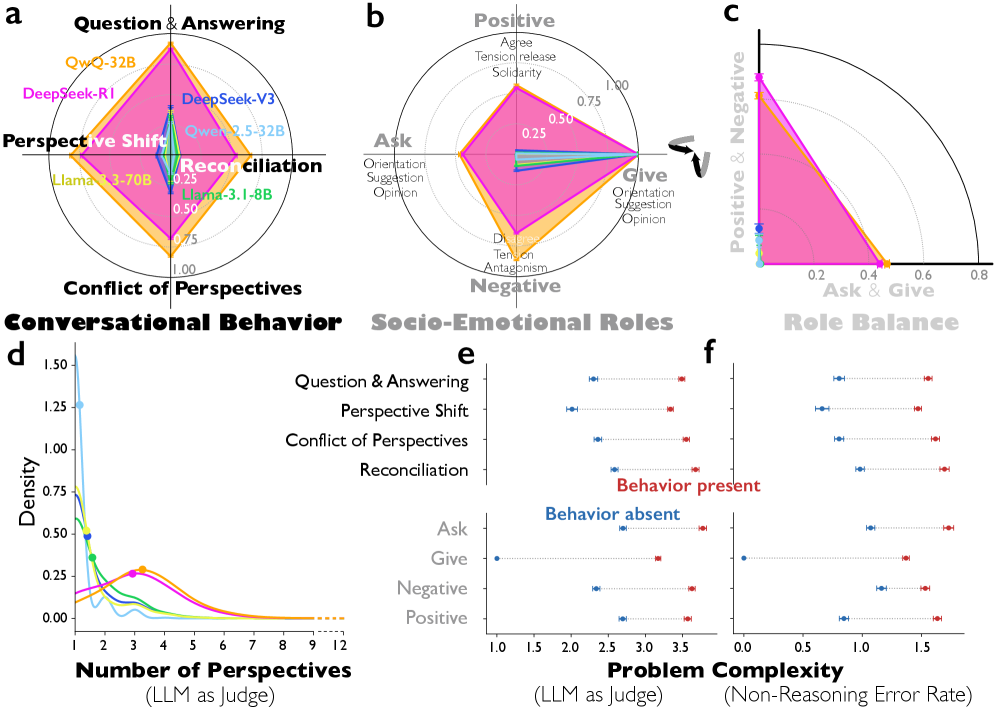
This paper reveals that enhanced reasoning in models like DeepSeek-R1 and QwQ-32B emerges not from extended computation alone, but from simulating multi-agent-like interactions - a "society of thought" - enabling diversification and debate among internal cognitive perspectives with distinct personality traits and domain expertise. - **Multi-agent internal dynamics:** Through mechanistic interpretability analysis, reasoning models exhibit much greater perspective diversity than instruction-tuned models, activating broader conflict between heterogeneous personality and expertise-related features during reasoning. - **Conversational behaviors drive accuracy:** The multi-agent structure manifests in question-answering, perspective shifts, and reconciliation of conflicting views. These socio-emotional roles characterizing back-and-forth conversations account for the accuracy advantage in reasoning tasks. - **Emergent from accuracy rewards:** Controlled reinforcement learning experiments reveal that base models naturally increase conversational behaviors when rewarded solely for reasoning accuracy, suggesting this structure emerges organically from optimization pressure. - **Accelerated improvement through scaffolding:** Fine-tuning models with conversational scaffolding accelerates reasoning improvement over base models, providing a practical pathway to enhance reasoning capabilities. - **Parallel to collective intelligence:** The findings suggest reasoning models establish a computational parallel to human collective intelligence, where diversity enables superior problem-solving when systematically structured, opening new opportunities for agent organization.
Ask this paper
Multi-agent internal dynamics: Through mechanistic interpretability analysis, reasoning models exhibit much greater perspective diversity than instruction-tuned models, activating broader conflict between heterogeneous personality and expertise-related features during reasoning.
Conversational behaviors drive accuracy: The multi-agent structure manifests in question-answering, perspective shifts, and reconciliation of conflicting views. These socio-emotional roles characterizing back-and-forth conversations account for the accuracy advantage in reasoning tasks.
Emergent from accuracy rewards: Controlled reinforcement learning experiments reveal that base models naturally increase conversational behaviors when rewarded solely for reasoning accuracy, suggesting this structure emerges organically from optimization pressure.
Accelerated improvement through scaffolding: Fine-tuning models with conversational scaffolding accelerates reasoning improvement over base models, providing a practical pathway to enhance reasoning capabilities.
Parallel to collective intelligence: The findings suggest reasoning models establish a computational parallel to human collective intelligence, where diversity enables superior problem-solving when systematically structured, opening new opportunities for agent organization.
Abstract
Large language models have achieved remarkable capabilities across domains, yet mechanisms underlying sophisticated reasoning remain elusive. Recent reasoning models outperform comparable instruction-tuned models on complex cognitive tasks, attributed to extended computation through longer chains of thought. Here we show that enhanced reasoning emerges not from extended computation alone, but from simulating multi-agent-like interactions -- a society of thought -- which enables diversification and debate among internal cognitive perspectives characterized by distinct personality traits and domain expertise. Through quantitative analysis and mechanistic interpretability methods applied to reasoning traces, we find that reasoning models like DeepSeek-R1 and QwQ-32B exhibit much greater perspective diversity than instruction-tuned models, activating broader conflict between heterogeneous personality- and expertise-related features during reasoning. This multi-agent structure manifests in conversational behaviors, including question-answering, perspective shifts, and the reconciliation of conflicting views, and in socio-emotional roles that characterize sharp back-and-forth conversations, together accounting for the accuracy advantage in reasoning tasks. Controlled reinforcement learning experiments reveal that base models increase conversational behaviors when rewarded solely for reasoning accuracy, and fine-tuning models with conversational scaffolding accelerates reasoning improvement over base models. These findings indicate that the social organization of thought enables effective exploration of solution spaces. We suggest that reasoning models establish a computational parallel to collective intelligence in human groups, where diversity enables superior problem-solving when systematically structured, which suggests new opportunities for agent organization to harness the wisdom of crowds.