TTT-Discover: Learning to Discover at Test Time
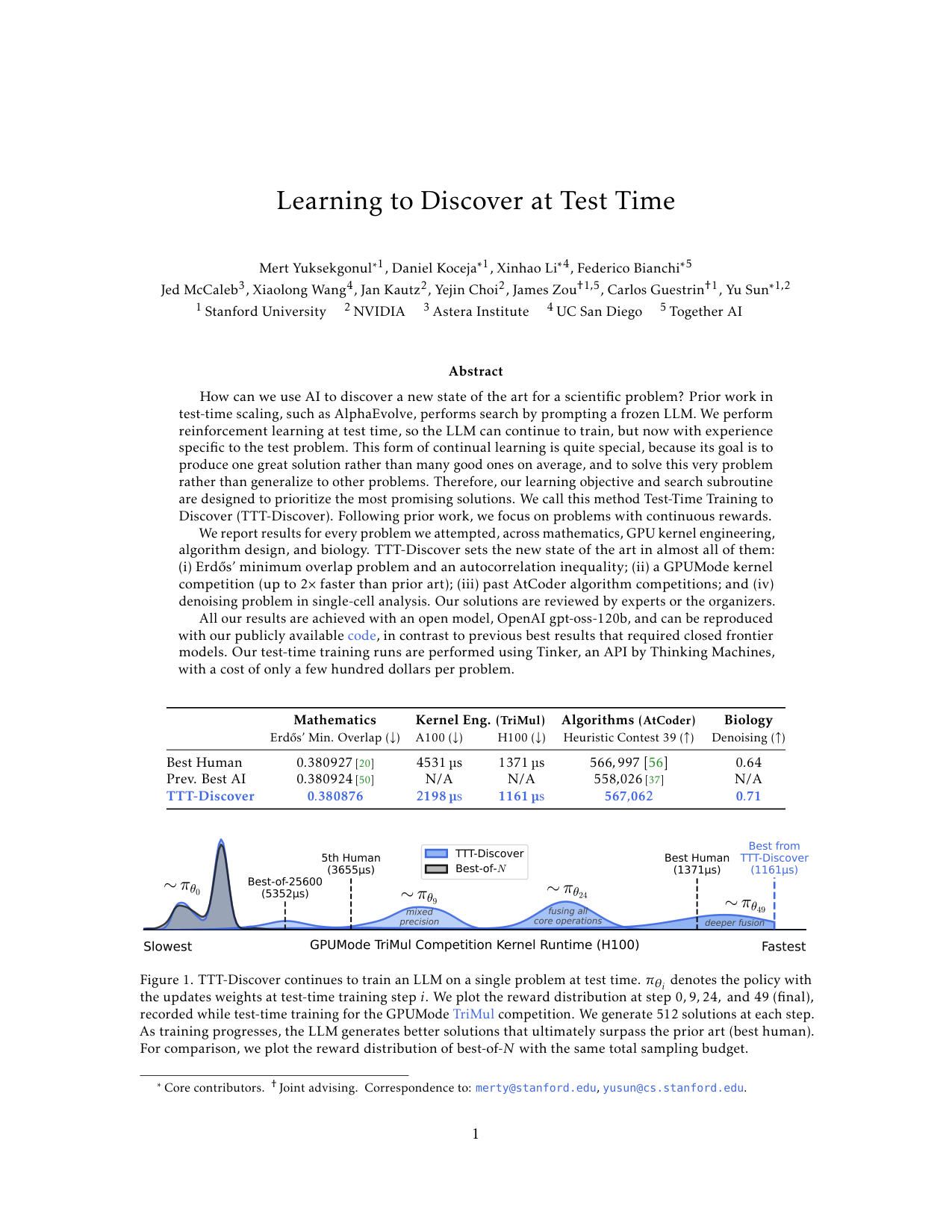
TTT-Discover introduces test-time training for scientific discovery, performing reinforcement learning at test time so the LLM can continue to train with experience specific to the test problem. Unlike prior work like AlphaEvolve that prompts a frozen LLM, this approach enables the model itself to improve while attempting to solve hard problems. - **Test-time reinforcement learning:** The method performs RL in an environment defined by a single test problem, with a learning objective and search subroutine designed to prioritize the most promising solutions rather than maximizing average reward across attempts. - **State-of-the-art across domains:** TTT-Discover sets new records on Erdős' minimum overlap problem, an autocorrelation inequality, GPUMode kernel competitions (up to 2x faster than prior art), AtCoder algorithm competitions, and single-cell denoising in biology. - **Open model results:** All results are achieved with OpenAI gpt-oss-120b, an open model, and can be reproduced with publicly available code, in contrast to previous best results requiring closed frontier models. - **Cost-effective discovery:** Test-time training runs cost only a few hundred dollars per problem using Tinker API, making scientific discovery accessible without massive compute budgets. - **Learning over search:** While both learning and search scale with compute, the authors argue learning has historically superseded search for hard problems (Go, protein folding), and this observation extends to test-time compute scaling for discovery.
Ask this paper
Test-time reinforcement learning: The method performs RL in an environment defined by a single test problem, with a learning objective and search subroutine designed to prioritize the most promising solutions rather than maximizing average reward across attempts.
State-of-the-art across domains: TTT-Discover sets new records on Erdős’ minimum overlap problem, an autocorrelation inequality, GPUMode kernel competitions (up to 2x faster than prior art), AtCoder algorithm competitions, and single-cell denoising in biology.
Open model results: All results are achieved with OpenAI gpt-oss-120b, an open model, and can be reproduced with publicly available code, in contrast to previous best results requiring closed frontier models.
Cost-effective discovery: Test-time training runs cost only a few hundred dollars per problem using Tinker API, making scientific discovery accessible without massive compute budgets.
Learning over search: While both learning and search scale with compute, the authors argue learning has historically superseded search for hard problems (Go, protein folding), and this observation extends to test-time compute scaling for discovery.