AdaptEvolve
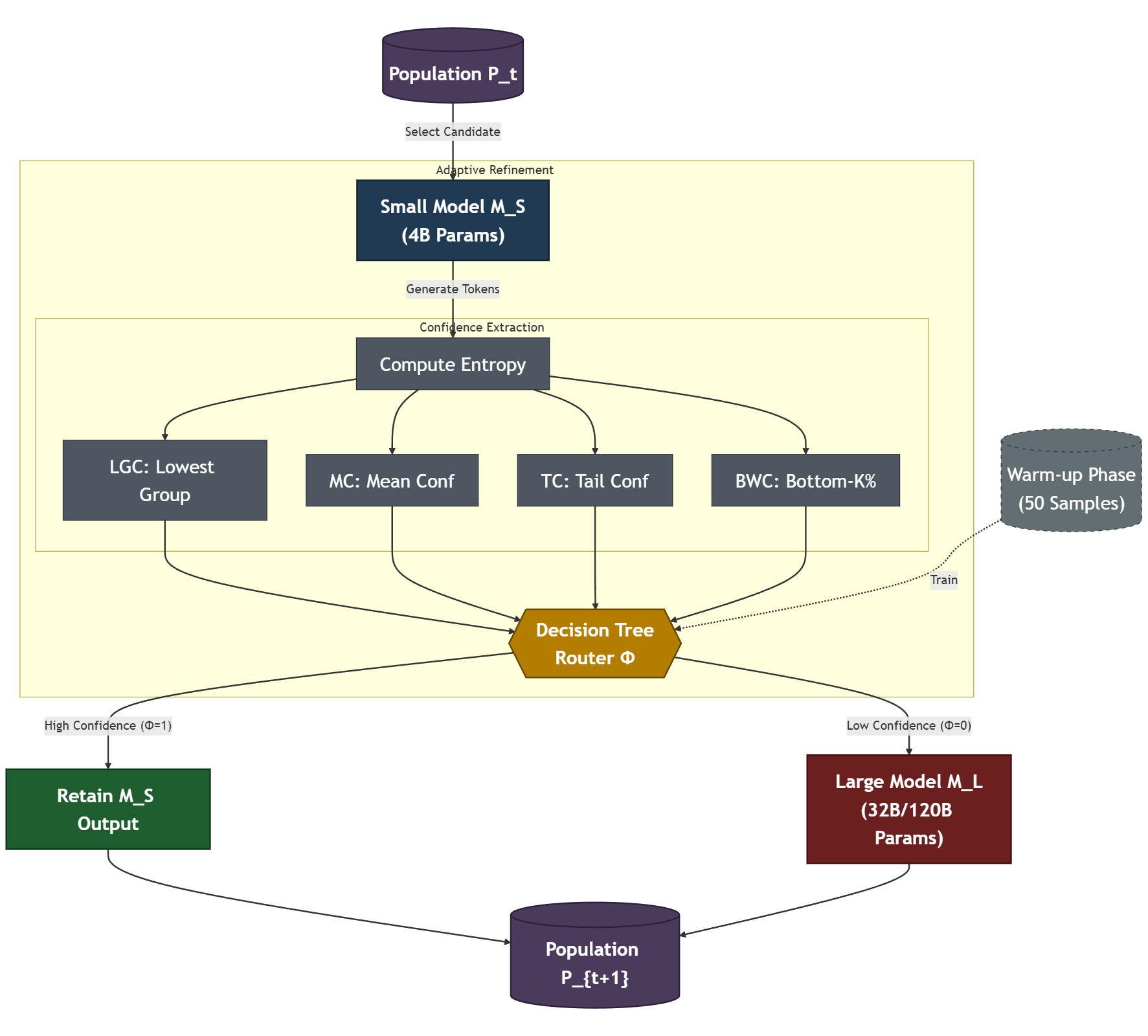
AdaptEvolve tackles a key efficiency bottleneck in evolutionary agentic systems: the repeated invocation of large LLMs during iterative refinement loops. The method uses intrinsic generation confidence to dynamically select which model to invoke at each step, routing easy sub-problems to smaller models and reserving expensive frontier models for genuinely hard decisions. - **Confidence-driven model routing:** Instead of static heuristics or external controllers, AdaptEvolve monitors real-time generation confidence scores to estimate task solvability at each evolutionary step. When the smaller model is confident, it proceeds without escalation; when uncertainty is high, the system routes to a larger, more capable model. - **Favorable cost-accuracy trade-off:** Across benchmarks, AdaptEvolve cuts inference costs by approximately 38% while retaining roughly 97.5% of the upper-bound accuracy achieved by always using the largest model. This creates a Pareto-optimal frontier that static single-model or naive cascade approaches cannot match. - **Practical for deployed agent loops:** Evolutionary and iterative refinement workflows often require dozens of LLM calls per task. Reducing per-call cost by nearly 40% without meaningful accuracy loss makes these workflows viable for production deployment where cost compounds rapidly. - **Generalizable routing signal:** The confidence-based selection mechanism is model-agnostic and does not require task-specific tuning, making it applicable across different evolutionary agent architectures and domain-specific refinement pipelines.
Ask this paper
Confidence-driven model routing: Instead of static heuristics or external controllers, AdaptEvolve monitors real-time generation confidence scores to estimate task solvability at each evolutionary step. When the smaller model is confident, it proceeds without escalation; when uncertainty is high, the system routes to a larger, more capable model.
Favorable cost-accuracy trade-off: Across benchmarks, AdaptEvolve cuts inference costs by approximately 38% while retaining roughly 97.5% of the upper-bound accuracy achieved by always using the largest model. This creates a Pareto-optimal frontier that static single-model or naive cascade approaches cannot match.
Practical for deployed agent loops: Evolutionary and iterative refinement workflows often require dozens of LLM calls per task. Reducing per-call cost by nearly 40% without meaningful accuracy loss makes these workflows viable for production deployment, where cost compounds rapidly.
Generalizable routing signal: The confidence-based selection mechanism is model-agnostic and does not require task-specific tuning, making it applicable across different evolutionary agent architectures and domain-specific refinement pipelines.
Abstract
Evolutionary agentic systems intensify the trade-off between computational efficiency and reasoning capability by repeatedly invoking large language models (LLMs) during inference. This setting raises a central question: how can an agent dynamically select an LLM that is sufficiently capable for the current generation step while remaining computationally efficient? While model cascades offer a practical mechanism for balancing this trade-off, existing routing strategies typically rely on static heuristics or external controllers and do not explicitly account for model uncertainty. We introduce AdaptEvolve: Adaptive LLM Selection for Multi-LLM Evolutionary Refinement within an evolutionary sequential refinement framework that leverages intrinsic generation confidence to estimate real-time solvability. Empirical results show that confidence-driven selection yields a favourable Pareto frontier, reducing total inference cost by an average of 37.9% across benchmarks while retaining 97.5% of the upper-bound accuracy of static large-model baselines. Our code is available at this https URL.