LLaDA 2.1
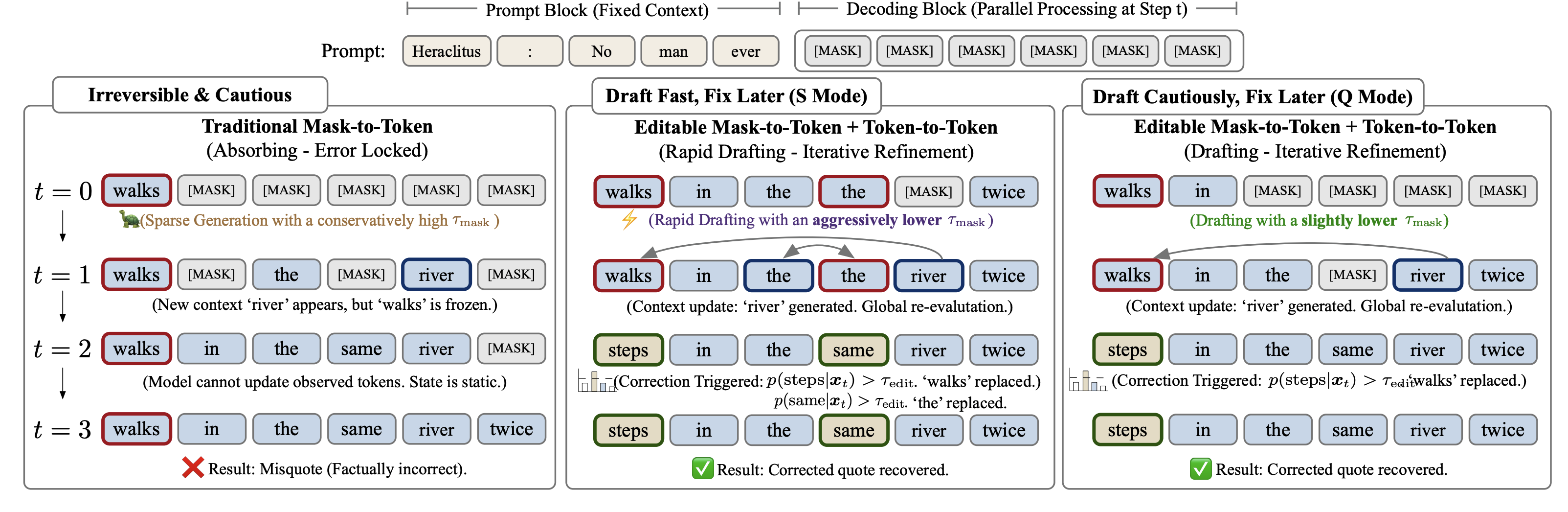
Ant Group releases LLaDA 2.1, a major upgrade to discrete diffusion language models that breaks the speed-quality trade-off through Token-to-Token (T2T) editing. By weaving token editing into the conventional Mask-to-Token decoding scheme, LLaDA 2.1 introduces two configurable modes: Speedy Mode for aggressive throughput and Quality Mode for benchmark-leading accuracy. The release also includes the first large-scale RL framework for diffusion LLMs. - **Editable state evolution:** Unlike standard diffusion models that only unmask tokens, LLaDA 2.1 can also edit already-generated tokens. This dual action space (unmasking + correction) lets the model aggressively draft with low-confidence thresholds and then refine errors in subsequent passes, fundamentally changing the speed-quality trade-off. - **Two operating modes:** Speedy Mode lowers the mask-to-token threshold for maximum throughput, relying on T2T passes to fix errors. Quality Mode uses conservative thresholds for superior benchmark scores. This gives practitioners a configurable knob between speed and accuracy without swapping models. - **Extreme decoding speed:** LLaDA 2.1-Flash (100B) hits 892 tokens per second on HumanEval+ and 801 TPS on BigCodeBench. The Mini variant (16B) reaches a peak of 1,587 TPS. These speeds dramatically outpace autoregressive models of comparable quality. - **First RL for diffusion LLMs:** The paper introduces EBPO (Evidence-Based Policy Optimization), an RL framework that uses block-causal masking and parallel likelihood estimation to enable stable policy optimization at scale for diffusion models. RL training sharpens reasoning and instruction-following across 33 benchmarks.
Ask this paper
Editable state evolution: Unlike standard diffusion models that only unmask tokens, LLaDA 2.1 can also edit already-generated tokens. This dual action space (unmasking + correction) lets the model aggressively draft with low-confidence thresholds and then refine errors in subsequent passes, fundamentally changing the speed-quality trade-off.
Two operating modes: Speedy Mode lowers the mask-to-token threshold for maximum throughput, relying on T2T passes to fix errors. Quality Mode uses conservative thresholds for superior benchmark scores. This gives practitioners a configurable knob between speed and accuracy without swapping models.
Extreme decoding speed: LLaDA 2.1-Flash (100B) hits 892 tokens per second on HumanEval+ and 801 TPS on BigCodeBench. The Mini variant (16B) reaches a peak of 1,587 TPS. These speeds dramatically outpace autoregressive models of comparable quality.
First RL for diffusion LLMs: The paper introduces EBPO (Evidence-Based Policy Optimization), an RL framework that uses block-causal masking and parallel likelihood estimation to enable stable policy optimization at scale for diffusion models. RL training sharpens reasoning and instruction-following across 33 benchmarks.
Abstract
While LLaDA2.0 showcased the scaling potential of 100B-level block-diffusion models and their inherent parallelization, the delicate equilibrium between decoding speed and generation quality has remained an elusive frontier. Today, we unveil LLaDA2.1, a paradigm shift designed to transcend this trade-off. By seamlessly weaving Token-to-Token (T2T) editing into the conventional Mask-to-Token (M2T) scheme, we introduce a joint, configurable threshold-decoding scheme. This structural innovation gives rise to two distinct personas: the Speedy Mode (S Mode), which audaciously lowers the M2T threshold to bypass traditional constraints while relying on T2T to refine the output; and the Quality Mode (Q Mode), which leans into conservative thresholds to secure superior benchmark performances with manageable efficiency degrade. Furthering this evolution, underpinned by an expansive context window, we implement the first large-scale Reinforcement Learning (RL) framework specifically tailored for dLLMs, anchored by specialized techniques for stable gradient estimation. This alignment not only sharpens reasoning precision but also elevates instruction-following fidelity, bridging the chasm between diffusion dynamics and complex human intent. We culminate this work by releasing LLaDA2.1-Mini (16B) and LLaDA2.1-Flash (100B). Across 33 rigorous benchmarks, LLaDA2.1 delivers strong task performance and lightning-fast decoding speed. Despite its 100B volume, on coding tasks it attains an astounding 892 TPS on HumanEval+, 801 TPS on BigCodeBench, and 663 TPS on LiveCodeBench.