Agyn
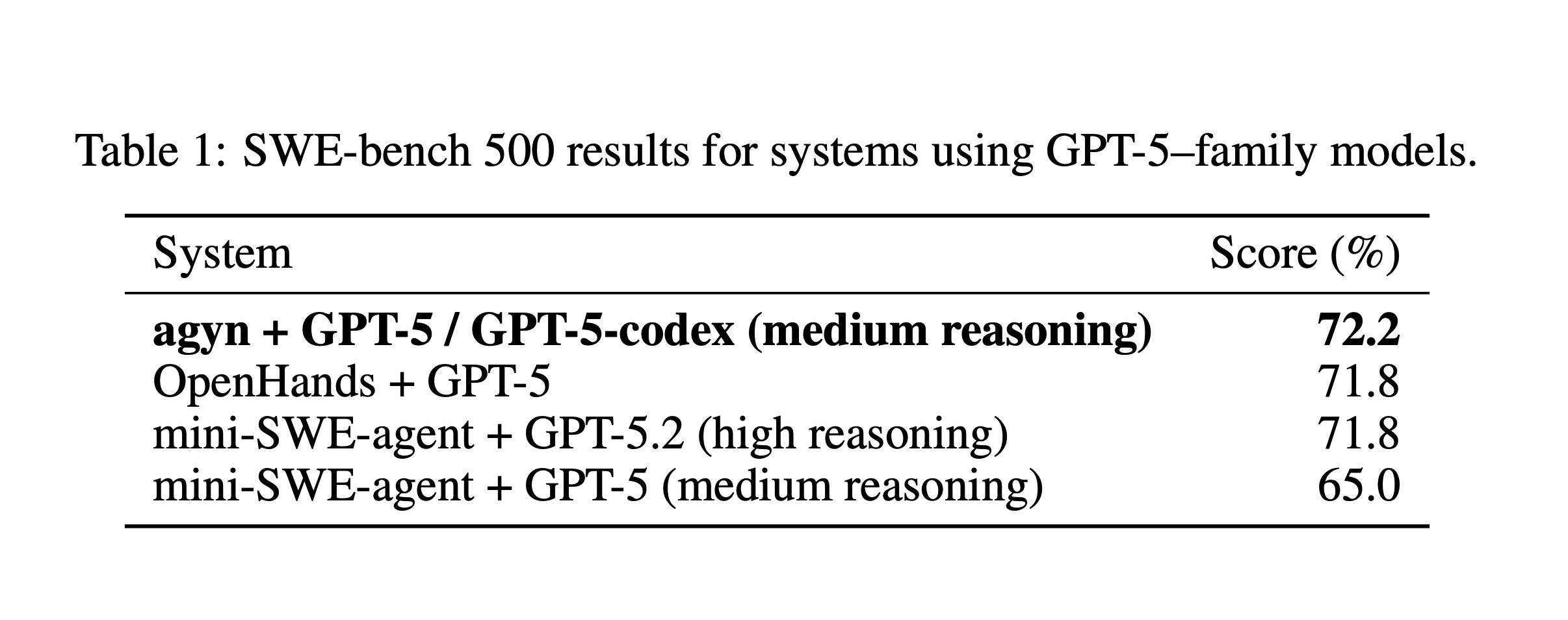
Agyn is a fully automated multi-agent system that models software engineering as an organizational process rather than a monolithic code generation task. Built on an open-source platform for configuring agent teams, the system assigns specialized agents to distinct roles and follows a structured development methodology - all without human intervention. Notably, Agyn was designed for real production use and was not tuned for SWE-bench. - **Team-based architecture:** Four specialized agents (manager, researcher, engineer, reviewer) operate with distinct responsibilities, tools, and model configurations. The manager coordinates using a high-level methodology inspired by real development practice, while the engineer and reviewer work through GitHub-native pull requests and inline code reviews. - **Role-specific model routing:** Reasoning-heavy agents like the manager and researcher use larger general-purpose models, while implementation agents use smaller, code-specialized models. This mirrors real team structure where different roles need different capabilities and reduces overall cost without sacrificing quality. - **Dynamic workflow, not a fixed pipeline:** Unlike prior multi-agent SWE systems that encode a predetermined number of stages, Agyn's coordination evolves dynamically. The manager decides when additional research, specification refinement, implementation, or review cycles are needed based on intermediate outcomes, enabling flexible iteration. - **Strong benchmark performance without tuning:** Agyn resolves 72.2% of tasks on SWE-bench 500, outperforming single-agent baselines by 7.4% under comparable model configurations. The key insight is that organizational design and agent infrastructure may matter as much as model improvements for autonomous software engineering.
Ask this paper
Team-based architecture: Four specialized agents (manager, researcher, engineer, reviewer) operate with distinct responsibilities, tools, and model configurations. The manager coordinates using a high-level methodology inspired by real development practice, while the engineer and reviewer work through GitHub-native pull requests and inline code reviews.
Role-specific model routing: Reasoning-heavy agents like the manager and researcher use larger general-purpose models, while implementation agents use smaller, code-specialized models. This mirrors real team structure, where different roles need different capabilities, and reduces overall cost without sacrificing quality.
Dynamic workflow, not a fixed pipeline: Unlike prior multi-agent SWE systems that encode a predetermined number of stages, Agyn’s coordination evolves dynamically. The manager decides when additional research, specification refinement, implementation, or review cycles are needed based on intermediate outcomes, enabling flexible iteration.
Strong benchmark performance without tuning: Agyn resolves 72.2% of tasks on SWE-bench 500, outperforming single-agent baselines by 7.4% under comparable model configurations. The key insight is that organizational design and agent infrastructure may matter as much as model improvements for autonomous software engineering.
Abstract
Large language models have demonstrated strong capabilities in individual software engineering tasks, yet most autonomous systems still treat issue resolution as a monolithic or pipeline-based process. In contrast, real-world software development is organized as a collaborative activity carried out by teams following shared methodologies, with clear role separation, communication, and review. In this work, we present a fully automated multi-agent system that explicitly models software engineering as an organizational process, replicating the structure of an engineering team. Built on top of agyn, an open-source platform for configuring agent teams, our system assigns specialized agents to roles such as coordination, research, implementation, and review, provides them with isolated sandboxes for experimentation, and enables structured communication. The system follows a defined development methodology for working on issues, including analysis, task specification, pull request creation, and iterative review, and operates without any human intervention. Importantly, the system was designed for real production use and was not tuned for SWE-bench. When evaluated post hoc on SWE-bench 500, it resolves 72.2% of tasks, outperforming single-agent baselines using comparable language models. Our results suggest that replicating team structure, methodology, and communication is a powerful paradigm for autonomous software engineering, and that future progress may depend as much on organizational design and agent infrastructure as on model improvements.