ALMA
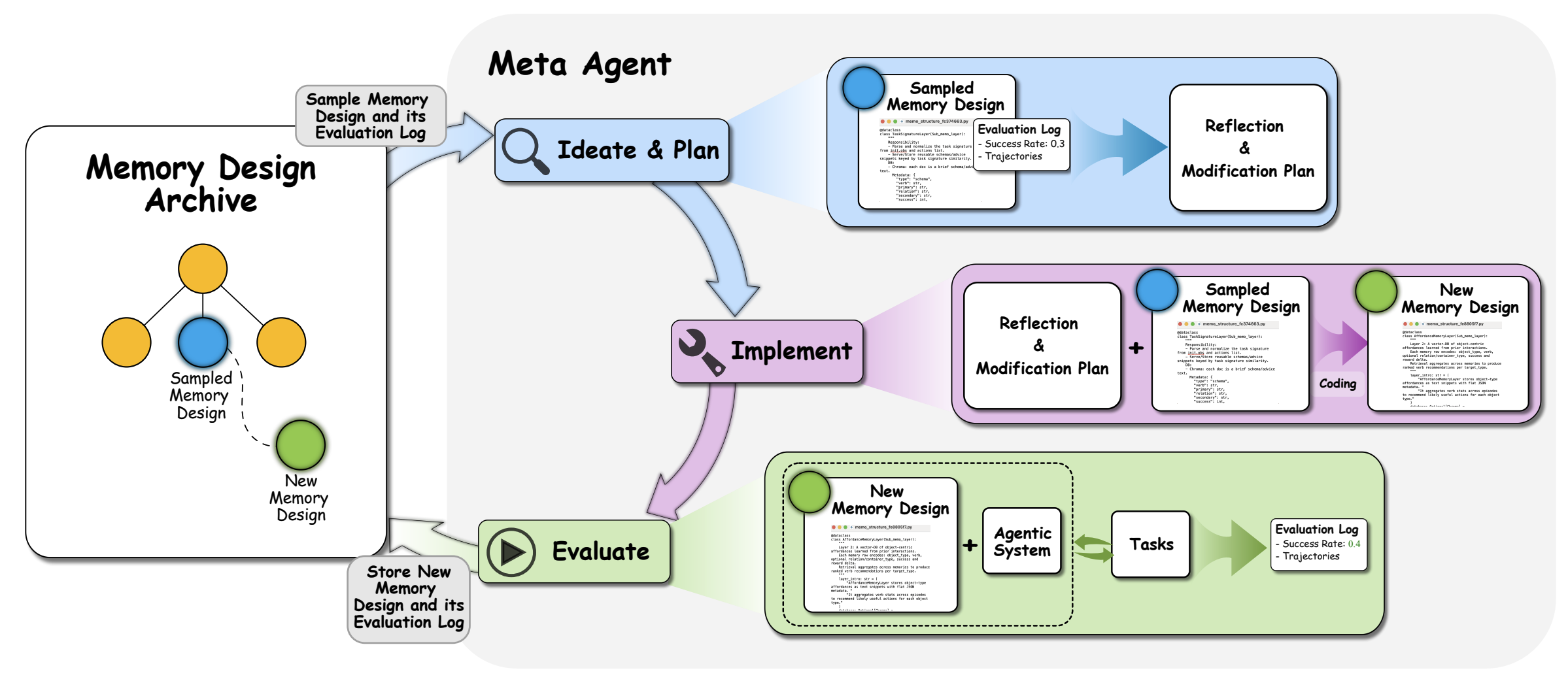
ALMA (Automated meta-Learning of Memory designs for Agentic systems) from Jeff Clune's group introduces a Meta Agent that automatically discovers memory designs for agentic systems through open-ended exploration in code space. Instead of relying on hand-engineered memory modules, ALMA searches over database schemas, retrieval mechanisms, and update strategies expressed as executable code, consistently outperforming all human-designed memory baselines across four sequential decision-making benchmarks. - **Open-ended code search:** A Meta Agent samples previously explored memory designs from an archive, reflects on their code and evaluation logs, proposes new designs, and implements them as executable code. This gives ALMA the theoretical potential to discover arbitrary memory architectures, from graph databases to strategy libraries, unconstrained by human design intuitions. - **Domain-adaptive memory discovery:** ALMA discovers fundamentally different memory structures for different domains: affordance graphs for ALFWorld, task signature databases for TextWorld, strategy libraries with rule prediction for Baba Is AI, and risk-interaction schemas for MiniHack. This specialization emerges automatically from the search process. - **Consistent gains over human baselines:** Learned memory designs achieve 12.3% average success rate with GPT-5-nano (vs 8.6% for the best human baseline) and 53.9% with GPT-5-mini (vs 48.6%). The designs also scale better with more collected experience and transfer robustly across different foundation models. - **Toward self-improving agentic systems:** ALMA represents a step toward AI systems that learn to be continual learners. The progressive discovery process shows that moderate-performing designs serve as stepping stones toward optimal solutions, with the archive enabling cumulative innovation across exploration iterations.
Ask this paper
Open-ended code search: A Meta Agent samples previously explored memory designs from an archive, reflects on their code and evaluation logs, proposes new designs, and implements them as executable code. This gives ALMA the theoretical potential to discover arbitrary memory architectures, from graph databases to strategy libraries, unconstrained by human design intuitions.
Domain-adaptive memory discovery: ALMA discovers fundamentally different memory structures for different domains: affordance graphs for ALFWorld, task signature databases for TextWorld, strategy libraries with rule prediction for Baba Is AI, and risk-interaction schemas for MiniHack. This specialization emerges automatically from the search process.
Consistent gains over human baselines: Learned memory designs achieve 12.3% average success rate with GPT-5-nano (vs 8.6% for the best human baseline) and 53.9% with GPT-5-mini (vs 48.6%). The designs also scale better with more collected experience and transfer robustly across different foundation models.
Toward self-improving agentic systems: ALMA represents a step toward AI systems that learn to be continual learners. The progressive discovery process shows that moderate-performing designs serve as stepping stones toward optimal solutions, with the archive enabling cumulative innovation across exploration iterations.
Abstract
The statelessness of foundation models bottlenecks agentic systems' ability to continually learn, a core capability for long-horizon reasoning and adaptation. To address this limitation, agentic systems commonly incorporate memory modules to retain and reuse past experience, aiming for continual learning during test time. However, most existing memory designs are human-crafted and fixed, which limits their ability to adapt to the diversity and non-stationarity of real-world tasks. In this paper, we introduce ALMA (Automated meta-Learning of Memory designs for Agentic systems), a framework that meta-learns memory designs to replace hand-engineered memory designs, therefore minimizing human effort and enabling agentic systems to be continual learners across diverse domains. Our approach employs a Meta Agent that searches over memory designs expressed as executable code in an open-ended manner, theoretically allowing the discovery of arbitrary memory designs, including database schemas as well as their retrieval and update mechanisms. Extensive experiments across four sequential decision-making domains demonstrate that the learned memory designs enable more effective and efficient learning from experience than state-of-the-art human-crafted memory designs on all benchmarks. When developed and deployed safely, ALMA represents a step toward self-improving AI systems that learn to be adaptive, continual learners.