AgentConductor
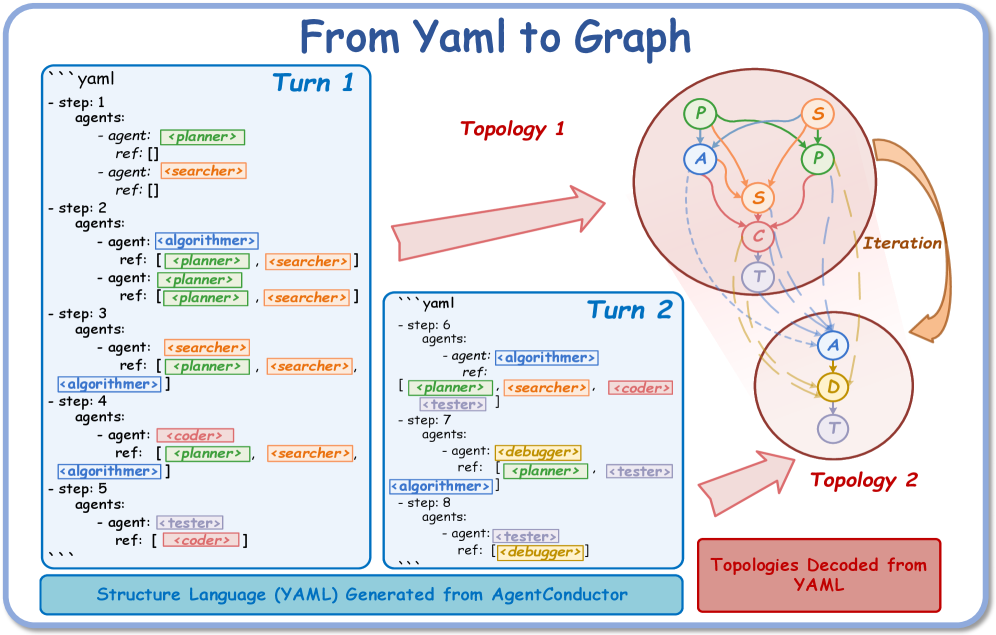
AgentConductor introduces a reinforcement learning-enhanced multi-agent system for code generation that dynamically generates interaction topologies based on task characteristics. Rather than using fixed communication patterns between agents, an LLM-based orchestrator adapts the topology to match problem complexity, achieving state-of-the-art accuracy across five code generation datasets. - **Task-adapted topologies:** The orchestrator constructs density-aware layered directed acyclic graph (DAG) topologies tailored to problem difficulty. Simple problems get sparse topologies with minimal communication overhead, while complex problems get denser multi-agent collaboration. - **Topological density control:** A novel density function and difficulty interval partitioning mechanism controls how much agents communicate. This directly addresses the problem of redundant interactions that waste tokens without improving solution quality. - **Strong performance gains:** AgentConductor outperforms the strongest baseline by up to 14.6% in pass@1 accuracy with 13% density reduction and 68% token cost reduction. The system achieves better results while using significantly fewer computational resources. - **Execution feedback refinement:** Topologies are refined using execution feedback from code tests. When initial solutions fail, the orchestrator adjusts the collaboration structure based on error patterns, enabling adaptive recovery.
Ask this paper
Task-adapted topologies: The orchestrator constructs density-aware layered directed acyclic graph (DAG) topologies tailored to problem difficulty. Simple problems get sparse topologies with minimal communication overhead, while complex problems get denser multi-agent collaboration.
Topological density control: A novel density function and difficulty interval partitioning mechanism controls how much agents communicate. This directly addresses the problem of redundant interactions that waste tokens without improving solution quality.
Strong performance gains: AgentConductor outperforms the strongest baseline by up to 14.6% in pass@1 accuracy with 13% density reduction and 68% token cost reduction. The system achieves better results while using significantly fewer computational resources.
Execution feedback refinement: Topologies are refined using execution feedback from code tests. When initial solutions fail, the orchestrator adjusts the collaboration structure based on error patterns, enabling adaptive recovery.
Abstract
Large language model(LLM)-driven multi-agent systems(MAS) coordinate specialized agents through predefined interaction topologies and have shown promise for complex tasks such as competition-level code generation. Recent studies demonstrate that carefully designed multi-agent workflows and communication graphs can significantly improve code generation performance by leveraging collaborative reasoning. However, existing methods neither adapt topology density to task difficulty nor iteratively refine the topology within an instance using execution feedback, which leads to redundant communication and performance bottlenecks. To address these issues, we propose AgentConductor: a reinforcement learning-optimized MAS with an LLM-based orchestrator agent as its core, which enables end-to-end feedback-driven dynamic generation of interaction topologies. For each query, AgentConductor infers agent roles and task difficulty, then constructs a task-adapted, density-aware layered directed acyclic graph (DAG) topology, underpinned by two key innovations. First, we design a novel topological density function that captures communication-aware mathematical characterizations of multi-agent interactions. Second, we adopt difficulty interval partitioning to avoid excessive pruning for precise topological density upper bound measurement per difficulty level and finer-grained control. Empirically, across three competition-level and two foundational code datasets, AgentConductor achieves state-of-the-art accuracy, outperforming the strongest baseline by up to 14.6% in pass@1 accuracy, 13% in density reduction, and 68% in token cost reduction.