Deep-Thinking Tokens
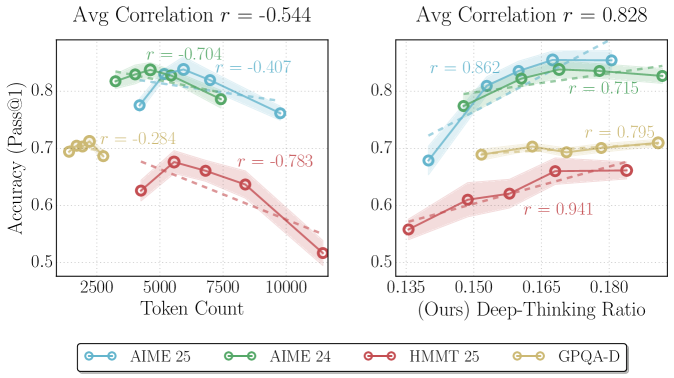
Google researchers challenge the assumption that longer outputs indicate better reasoning. They introduce deep-thinking tokens, a metric that identifies tokens where internal model predictions shift significantly across layers before stabilizing. Unlike raw token count, which negatively correlates with accuracy (r = -0.59), the deep-thinking ratio shows a robust positive correlation (r = 0.683). - **Deep-thinking ratio as a reasoning signal:** For each generated token, intermediate-layer distributions are compared to the final-layer distribution using Jensen-Shannon divergence. A token qualifies as deep-thinking if its prediction only stabilizes in the final 15% of layers. This captures genuine computational effort rather than surface-level verbosity. - **Think@n test-time scaling:** The authors introduce Think@n, a strategy that prioritizes samples with high deep-thinking ratios. It matches or exceeds standard self-consistency performance while cutting inference costs by approximately 50% through early rejection of unpromising generations based on just 50-token prefixes. - **Benchmark validation:** Evaluated across AIME 24/25, HMMT 25, and GPQA-diamond with reasoning models including GPT-OSS, DeepSeek-R1, and Qwen3. The deep-thinking ratio consistently outperforms length-based and confidence-based baselines as a predictor of correctness. - **Practical implications:** This reframes how we think about test-time compute. Instead of generating more tokens, we should focus on generating tokens that require deeper internal computation, enabling more efficient and accurate reasoning.
Ask this paper
Deep-thinking ratio as a reasoning signal: For each generated token, intermediate-layer distributions are compared to the final-layer distribution using Jensen-Shannon divergence. A token qualifies as deep-thinking if its prediction only stabilizes in the final 15% of layers. This captures genuine computational effort rather than surface-level verbosity.
Think@n test-time scaling: The authors introduce Think@n, a strategy that prioritizes samples with high deep-thinking ratios. It matches or exceeds standard self-consistency performance while cutting inference costs by approximately 50% through early rejection of unpromising generations based on just 50-token prefixes.
Benchmark validation: Evaluated across AIME 24/25, HMMT 25, and GPQA-diamond with reasoning models including GPT-OSS, DeepSeek-R1, and Qwen3. The deep-thinking ratio consistently outperforms length-based and confidence-based baselines as a predictor of correctness.
Practical implications: This reframes how we think about test-time compute. Instead of generating more tokens, we should focus on generating tokens that require deeper internal computation, enabling more efficient and accurate reasoning.
Abstract
Large language models (LLMs) have demonstrated impressive reasoning capabilities by scaling test-time compute via long Chain-of-Thought (CoT). However, recent findings suggest that raw token counts are unreliable proxies for reasoning quality: increased generation length does not consistently correlate with accuracy and may instead signal "overthinking," leading to performance degradation. In this work, we quantify inference-time effort by identifying deep-thinking tokens -- tokens where internal predictions undergo significant revisions in deeper model layers prior to convergence. Across four challenging mathematical and scientific benchmarks (AIME 24/25, HMMT 25, and GPQA-diamond) and a diverse set of reasoning-focused models (GPT-OSS, DeepSeek-R1, and Qwen3), we show that deep-thinking ratio (the proportion of deep-thinking tokens in a generated sequence) exhibits a robust and consistently positive correlation with accuracy, substantially outperforming both length-based and confidence-based baselines. Leveraging this insight, we introduce Think@n, a test-time scaling strategy that prioritizes samples with high deep-thinking ratios. We demonstrate that Think@n matches or exceeds standard self-consistency performance while significantly reducing inference costs by enabling the early rejection of unpromising generations based on short prefixes.