Discovering Multi-Agent Learning Algorithms with LLMs
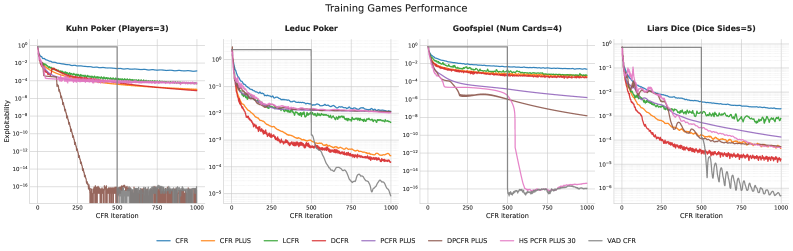
Google DeepMind uses AlphaEvolve, an evolutionary coding agent powered by LLMs, to automatically discover new multi-agent learning algorithms for imperfect-information games. Rather than relying on manual algorithm design, the system navigates vast algorithmic design spaces and discovers non-intuitive mechanisms that outperform state-of-the-art baselines. - **VAD-CFR discovery:** The system discovers a novel variant of iterative regret minimization featuring volatility-sensitive discounting and consistency-enforced optimism. VAD-CFR outperforms existing baselines like Discounted Predictive CFR+ on standard imperfect-information game benchmarks. - **SHOR-PSRO discovery:** A population-based training algorithm variant that introduces a hybrid meta-solver blending Optimistic Regret Matching with temperature-controlled strategy distributions. This automates the transition from diversity exploration to equilibrium convergence. - **LLM-driven algorithmic evolution:** AlphaEvolve generates candidate algorithm modifications, evaluates them on game-theoretic benchmarks, and iteratively refines the best variants. The discovered algorithms contain novel design choices that human researchers had not previously considered. - **Broader implications:** This demonstrates that LLMs can serve as algorithmic designers, not just code generators. The approach could extend to discovering algorithms in other domains like optimization, scheduling, and resource allocation.
Ask this paper
VAD-CFR discovery: The system discovers a novel variant of iterative regret minimization featuring volatility-sensitive discounting and consistency-enforced optimism. VAD-CFR outperforms existing baselines like Discounted Predictive CFR+ on standard imperfect-information game benchmarks.
SHOR-PSRO discovery: A population-based training algorithm variant that introduces a hybrid meta-solver blending Optimistic Regret Matching with temperature-controlled strategy distributions. This automates the transition from diversity exploration to equilibrium convergence.
LLM-driven algorithmic evolution: AlphaEvolve generates candidate algorithm modifications, evaluates them on game-theoretic benchmarks, and iteratively refines the best variants. The discovered algorithms contain novel design choices that human researchers had not previously considered.
Broader implications: This demonstrates that LLMs can serve as algorithmic designers, not just code generators. The approach could extend to discovering algorithms in other domains like optimization, scheduling, and resource allocation.
Abstract
Much of the advancement of Multi-Agent Reinforcement Learning (MARL) in imperfect-information games has historically depended on manual iterative refinement of baselines. While foundational families like Counterfactual Regret Minimization (CFR) and Policy Space Response Oracles (PSRO) rest on solid theoretical ground, the design of their most effective variants often relies on human intuition to navigate a vast algorithmic design space. In this work, we propose the use of AlphaEvolve, an evolutionary coding agent powered by large language models, to automatically discover new multiagent learning algorithms. We demonstrate the generality of this framework by evolving novel variants for two distinct paradigms of game-theoretic learning. First, in the domain of iterative regret minimization, we evolve the logic governing regret accumulation and policy derivation, discovering a new algorithm, Volatility-Adaptive Discounted (VAD-)CFR. VAD-CFR employs novel, non-intuitive mechanisms-including volatility-sensitive discounting, consistency-enforced optimism, and a hard warm-start policy accumulation schedule-to outperform state-of-the-art baselines like Discounted Predictive CFR+. Second, in the regime of population based training algorithms, we evolve training-time and evaluation-time meta strategy solvers for PSRO, discovering a new variant, Smoothed Hybrid Optimistic Regret (SHOR-)PSRO. SHOR-PSRO introduces a hybrid meta-solver that linearly blends Optimistic Regret Matching with a smoothed, temperature-controlled distribution over best pure strategies. By dynamically annealing this blending factor and diversity bonuses during training, the algorithm automates the transition from population diversity to rigorous equilibrium finding, yielding superior empirical convergence compared to standard static meta-solvers.