Evaluating AGENTS.md
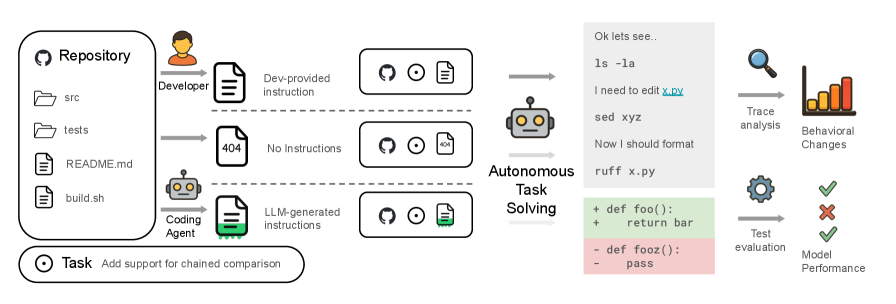
This research evaluates whether AGENTS.md files actually improve AI coding agent performance. Testing four coding agents (Claude Code with Sonnet-4.5, Codex with GPT-5.2 and GPT-5.1 mini, and Qwen Code with Qwen3-30b-coder), the findings show that human-written AGENTS.md files provide only a modest +4% improvement while LLM-generated ones hurt performance by -2%. Both consistently increase inference cost by over 20%. Context files cause agents to explore more code paths but this expansive behavior makes tasks harder, suggesting lean and minimal context files focused on critical constraints are most effective.
Ask this paper
Context files reduce success rates: Human-written AGENTS.md files provide a modest +4% improvement in some cases, but LLM-generated ones actually hurt performance by -2%. Both consistently increase inference cost by over 20%, making the cost-benefit tradeoff questionable.
Broader exploration, worse outcomes: Context files cause agents to explore more code paths and consider more files, but this expansive behavior makes tasks harder rather than easier. The additional context introduces noise that dilutes task-relevant information.
Lean is better: The study recommends that developer-written context files should contain only essential information. Unnecessary requirements, coding style preferences, and broad architectural descriptions complicate agent task completion without improving results.
Practical guidance: For developers maintaining AGENTS.md files, the key takeaway is to keep them minimal and focused on critical constraints. Information density matters more than comprehensiveness for current coding agents.
Abstract
A widespread practice in software development is to tailor coding agents to repositories using context files, such as AGENTS.md, by either manually or automatically generating them. Although this practice is strongly encouraged by agent developers, there is currently no rigorous investigation into whether such context files are actually effective for real-world tasks. In this work, we study this question and evaluate coding agents' task completion performance in two complementary settings: established SWE-bench tasks from popular repositories, with LLM-generated context files following agent-developer recommendations, and a novel collection of issues from repositories containing developer-committed context files. Across multiple coding agents and LLMs, we find that context files tend to reduce task success rates compared to providing no repository context, while also increasing inference cost by over 20%. Behaviorally, both LLM-generated and developer-provided context files encourage broader exploration (e.g., more thorough testing and file traversal), and coding agents tend to respect their instructions. Ultimately, we conclude that unnecessary requirements from context files make tasks harder, and human-written context files should describe only minimal requirements.