Codified Context
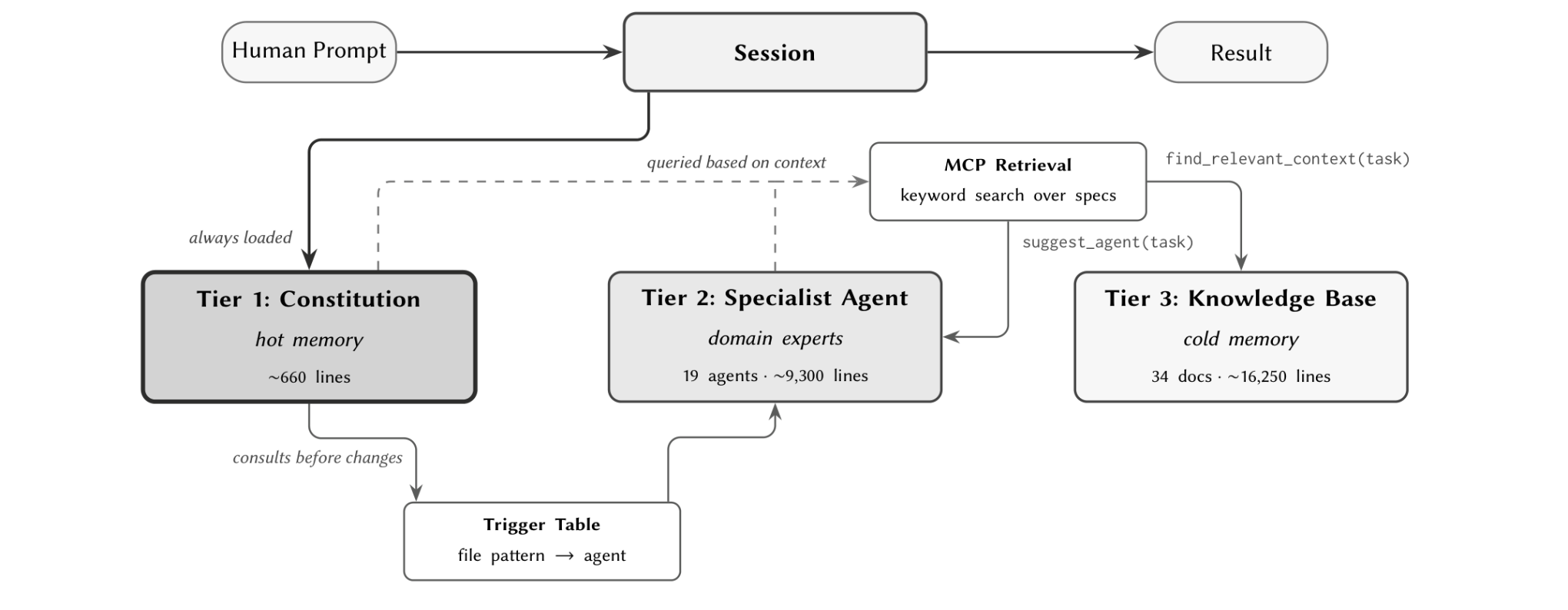
This paper presents a three-component codified context infrastructure for scaling AI coding agents beyond single-file AGENTS.md manifests. Developed during construction of a 108,000-line C# distributed system and evaluated across 283 development sessions, it introduces hot-memory constitutions for session-start awareness, 19 domain-expert agents each owning bounded codebase domains, and 34 cold-memory specification documents retrieved on demand. The tiered approach keeps active context lean while ensuring detailed specifications remain accessible for complex implementation decisions.
Ask this paper
Hot-memory constitution: A living document encoding conventions, retrieval hooks, and orchestration protocols that the agent consults at the start of every session. This provides immediate awareness of project standards without requiring the agent to rediscover them through exploration.
Domain-expert agents: 19 specialized agents, each owning a bounded domain of the codebase with its own context slice. Instead of one generalist agent trying to hold the entire project in context, tasks are routed to the agent with the deepest knowledge of the relevant subsystem.
Cold-memory knowledge base: 34 on-demand specification documents that agents retrieve only when needed. This tiered approach keeps the active context lean while ensuring detailed specifications are always accessible for complex implementation decisions.
Session continuity results: Across 283 sessions, the infrastructure demonstrates how context propagates between sessions, preventing the common pattern where agents forget conventions, repeat known mistakes, and lose coherence on long-running projects.
Abstract
LLM-based agentic coding assistants lack persistent memory: they lose coherence across sessions, forget project conventions, and repeat known mistakes. Recent studies characterize how developers configure agents through manifest files, but an open challenge remains how to scale such configurations for large, multi-agent projects. This paper presents a three-component codified context infrastructure developed during construction of a 108,000-line C# distributed system: (1) a hot-memory constitution encoding conventions, retrieval hooks, and orchestration protocols; (2) 19 specialized domain-expert agents; and (3) a cold-memory knowledge base of 34 on-demand specification documents. Quantitative metrics on infrastructure growth and interaction patterns across 283 development sessions are reported alongside four observational case studies illustrating how codified context propagates across sessions to prevent failures and maintain consistency. The framework is published as an open-source companion repository.