Agentic AI Adaptation Survey
Researchers from UIUC, Stanford, Berkeley, and other institutions present the first comprehensive taxonomy of adaptation strategies for agentic AI systems. The survey organizes recent advances into a unified framework covering how agents and their tools can be modified to achieve higher task performance, improved reliability, and better generalization across diverse scenarios. - **Four adaptation paradigms:** The framework categorizes methods into A1 (tool execution signaled agent adaptation using verifiable outcomes like code sandbox results), A2 (agent output signaled adaptation from evaluations of final answers), T1 (agent-agnostic tool adaptation where tools train independently), and T2 (agent-supervised tool adaptation where tools adapt using frozen agent feedback). - **Key trade-offs identified:** Agent adaptation (A1/A2) requires substantial compute for training billion-parameter models but offers maximal flexibility. Tool adaptation (T1/T2) optimizes external components at lower cost but may be constrained by frozen agent capabilities. T1 tools generalize well across agents while A1 methods may overfit without regularization. - **RLVR emergence:** The survey traces the evolution from early SFT and DPO methods to reinforcement learning with verifiable rewards (RLVR), where models learn directly from online interaction with tools and environments - marking a shift from pre-collected trajectories to dynamic, context-aware adaptation. - **Domain applications:** Demonstrates how adaptation strategies apply across deep research, software development, computer use, and drug discovery - with state-of-the-art systems increasingly combining multiple paradigms in cascaded architectures.
Ask this paper
Four adaptation paradigms: The framework categorizes methods into A1 (tool execution signaled agent adaptation using verifiable outcomes like code sandbox results), A2 (agent output signaled adaptation from evaluations of final answers), T1 (agent-agnostic tool adaptation where tools train independently), and T2 (agent-supervised tool adaptation where tools adapt using frozen agent feedback).
Key trade-offs identified: Agent adaptation (A1/A2) requires substantial compute for training billion-parameter models but offers maximal flexibility. Tool adaptation (T1/T2) optimizes external components at lower cost but may be constrained by frozen agent capabilities. T1 tools generalize well across agents, while A1 methods may overfit without regularization.
RLVR emergence: The survey traces the evolution from early SFT and DPO methods to reinforcement learning with verifiable rewards (RLVR), where models learn directly from online interaction with tools and environments - marking a shift from pre-collected trajectories to dynamic, context-aware adaptation.
Domain applications: Demonstrates how adaptation strategies apply across deep research, software development, computer use, and drug discovery - with state-of-the-art systems increasingly combining multiple paradigms in cascaded architectures.
Abstract
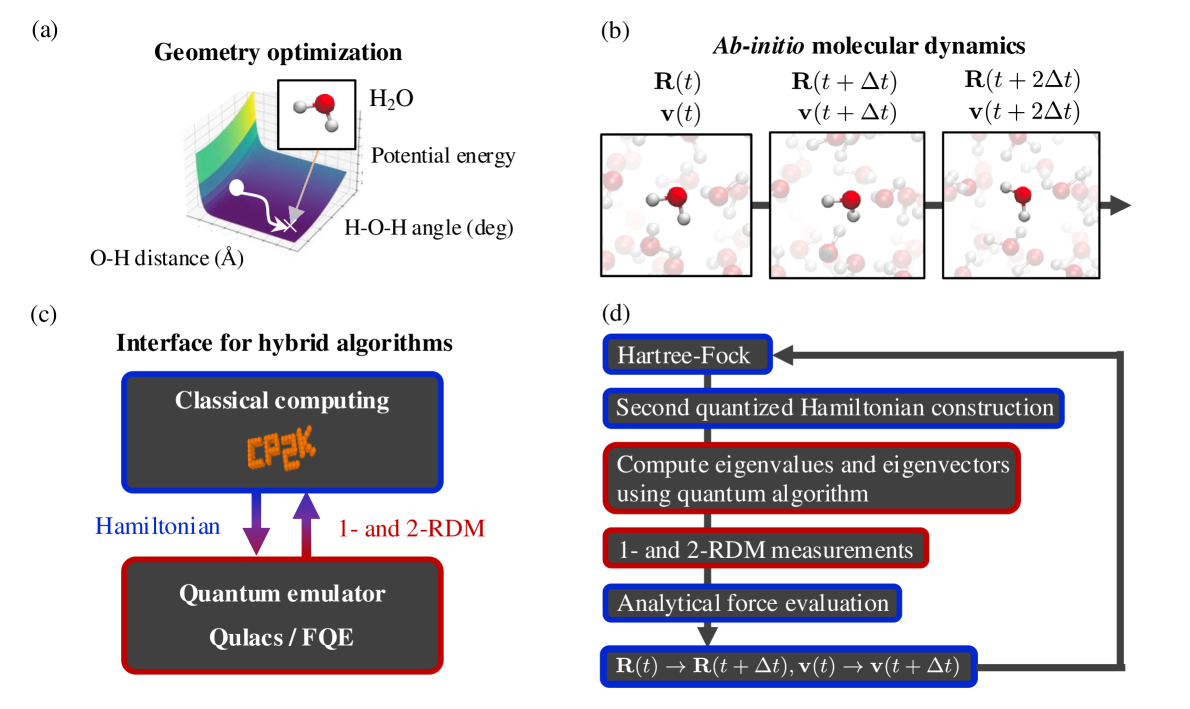
We demonstrate the feasibility of quantum computing for large-scale, realistic chemical systems through the development of a new interface using a quantum circuit simulator and CP2K, a highly efficient first-principles calculation software. Quantum chemistry calculations using quantum computers require Hamiltonians prepared on classical computers. Moreover, to compute forces beyond just single-point energy calculations, one- and two-electron integral derivatives and response equations are also to be computed on classical computers. Our developed interface allows for efficient evaluation of forces with the quantum-classical hybrid framework for large chemical systems. We performed geometry optimizations and first-principles molecular dynamics calculations on typical condensed-phase systems. These included liquid water, molecular adsorption on solid surfaces, and biological enzymes. In water benchmarks with periodic boundary conditions, we confirmed that the cost of preparing second-quantized Hamiltonians and evaluating forces scales almost linearly with the simulation box size. This research marks a step towards the practical application of quantum-classical hybrid calculations, expanding the scope of quantum computing to realistic and complex chemical phenomena.