Pre-Training, Mid-Training, and RL Interplay
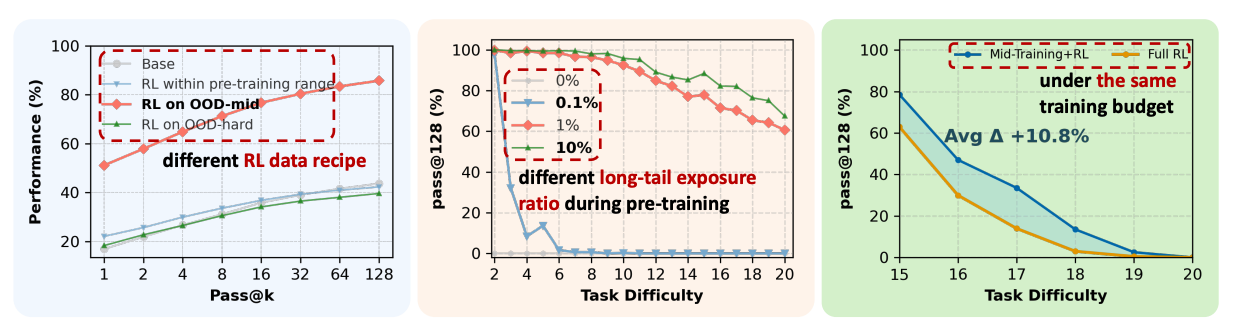
CMU researchers develop a controlled experimental framework using synthetic reasoning tasks to isolate how pre-training, mid-training, and RL-based post-training each contribute to reasoning capabilities in language models. The study reconciles conflicting views on whether RL truly extends reasoning beyond what models learn during pre-training. - **Edge of competence:** RL produces true capability gains (pass@128) only when pre-training leaves sufficient headroom and when RL data targets the model's edge of competence - tasks that are difficult but not yet out of reach. When tasks are already covered or too out-of-distribution, gains vanish. - **Minimal exposure threshold:** Contextual generalization requires minimal yet sufficient pre-training exposure. RL fails with near-zero exposure but generalizes robustly with sparse exposure of at least 1%, yielding up to +60% pass@128 improvements. - **Mid-training impact:** A mid-training stage bridging pre-training and RL substantially improves out-of-distribution reasoning under fixed compute budgets, with mid-training + RL outperforming RL alone by +10.8% on OOD-hard tasks. - **Process rewards:** Incorporating process-level rewards reduces reward hacking and improves reasoning fidelity by aligning reinforcement signals with valid reasoning behavior rather than just final answers.
Ask this paper
Edge of competence: RL produces true capability gains (pass@128) only when pre-training leaves sufficient headroom and when RL data targets the model’s edge of competence - tasks that are difficult but not yet out of reach. When tasks are already covered or too out-of-distribution, gains vanish.
Minimal exposure threshold: Contextual generalization requires minimal yet sufficient pre-training exposure. RL fails with near-zero exposure but generalizes robustly with sparse exposure of at least 1%, yielding up to +60% pass@128 improvements.
Mid-training impact: A mid-training stage bridging pre-training and RL substantially improves out-of-distribution reasoning under fixed compute budgets, with mid-training + RL outperforming RL alone by +10.8% on OOD-hard tasks.
Process rewards: Incorporating process-level rewards reduces reward hacking and improves reasoning fidelity by aligning reinforcement signals with valid reasoning behavior rather than just final answers.
Abstract
Recent reinforcement learning (RL) techniques have yielded impressive reasoning improvements in language models, yet it remains unclear whether post-training truly extends a model's reasoning ability beyond what it acquires during pre-training. A central challenge is the lack of control in modern training pipelines: large-scale pre-training corpora are opaque, mid-training is often underexamined, and RL objectives interact with unknown prior knowledge in complex ways. To resolve this ambiguity, we develop a fully controlled experimental framework that isolates the causal contributions of pre-training, mid-training, and RL-based post-training. Our approach employs synthetic reasoning tasks with explicit atomic operations, parseable step-by-step reasoning traces, and systematic manipulation of training distributions. We evaluate models along two axes: extrapolative generalization to more complex compositions and contextual generalization across surface contexts. Using this framework, we reconcile competing views on RL's effectiveness. We show that: 1) RL produces true capability gains (pass@128) only when pre-training leaves sufficient headroom and when RL data target the model's edge of competence, tasks at the boundary that are difficult but not yet out of reach. 2) Contextual generalization requires minimal yet sufficient pre-training exposure, after which RL can reliably transfer. 3) Mid-training significantly enhances performance under fixed compute compared with RL only, demonstrating its central but underexplored role in training pipelines. 4) Process-level rewards reduce reward hacking and improve reasoning fidelity. Together, these results clarify the interplay between pre-training, mid-training, and RL, offering a foundation for understanding and improving reasoning LM training strategies.