AI and Human Co-Improvement
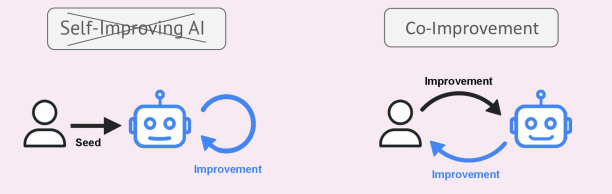
Meta FAIR researchers Jason Weston and Jakob Foerster argue that fully autonomous self-improving AI is neither the fastest nor safest path to superintelligence. Instead, they advocate for co-improvement: building AI that collaborates with human researchers to conduct AI research together, from ideation to experimentation. - **Core thesis:** Self-improvement seeks to eliminate humans from the loop as quickly as possible. Co-improvement keeps humans involved, providing steering capability toward positive outcomes while leveraging complementary skill sets. Because AI is not yet mature enough to fully self-improve and is susceptible to misalignment, co-improvement will get us there faster and more safely. - **Research collaboration skills:** The authors propose measuring and training AI on research collaboration abilities across problem identification, benchmark creation, method innovation, experiment design, collaborative execution, evaluation, scientific communication, and safety/alignment development. - **Bidirectional augmentation:** Unlike self-improvement which focuses on autonomous model updates, co-improvement centers on joint progress where humans help AI achieve greater abilities while AI augments human cognition and research capabilities. The goal is co-superintelligence through symbiosis. - **Paradigm shift acceleration:** Major AI advances came from human researchers finding combinations of training data and method changes. Co-research with strong collaborative AI should accelerate finding unknown new paradigm shifts while maintaining transparency and human-centered safety.
Ask this paper
Core thesis: Self-improvement seeks to eliminate humans from the loop as quickly as possible. Co-improvement keeps humans involved, providing steering capability toward positive outcomes while leveraging complementary skill sets. Because AI is not yet mature enough to fully self-improve and is susceptible to misalignment, co-improvement will get us there faster and more safely.
Research collaboration skills: The authors propose measuring and training AI on research collaboration abilities across problem identification, benchmark creation, method innovation, experiment design, collaborative execution, evaluation, scientific communication, and safety/alignment development.
Bidirectional augmentation: Unlike self-improvement, which focuses on autonomous model updates, co-improvement centers on joint progress where humans help AI achieve greater abilities while AI augments human cognition and research capabilities. The goal is co-superintelligence through symbiosis.
Paradigm shift acceleration: Major AI advances came from human researchers finding combinations of training data and method changes. Co-research with strong collaborative AI should accelerate finding unknown new paradigm shifts while maintaining transparency and human-centered safety.
Abstract
Self-improvement is a goal currently exciting the field of AI, but is fraught with danger, and may take time to fully achieve. We advocate that a more achievable and better goal for humanity is to maximize co-improvement: collaboration between human researchers and AIs to achieve co-superintelligence. That is, specifically targeting improving AI systems' ability to work with human researchers to conduct AI research together, from ideation to experimentation, in order to both accelerate AI research and to generally endow both AIs and humans with safer superintelligence through their symbiosis. Focusing on including human research improvement in the loop will both get us there faster, and more safely.