Towards a Science of Scaling Agent Systems
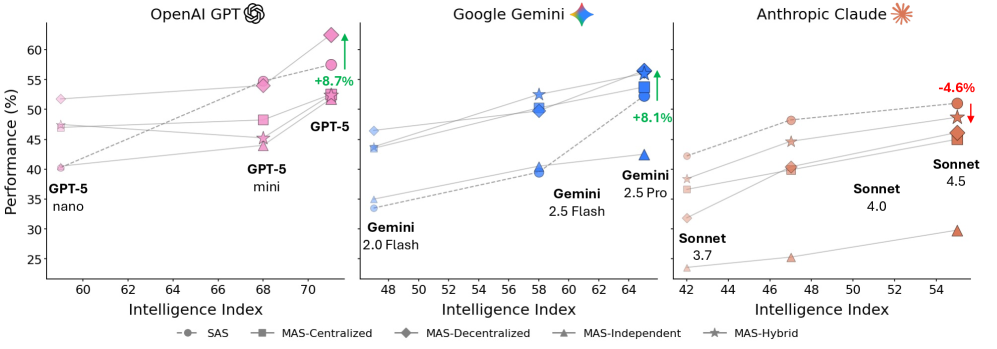
Researchers from Google present a controlled evaluation framework for agent systems, challenging the assumption that "more agents is all you need." Across 180 configurations spanning three LLM families and four agentic benchmarks, the study establishes quantitative principles for when multi-agent coordination helps versus hurts performance. - **Predictive framework:** The study derives a mixed-effects model achieving R-squared of 0.513 using coordination metrics like efficiency, error amplification, and redundancy. Leave-one-domain-out cross-validation achieves R-squared of 0.89 and correctly predicts optimal architectures for 87% of held-out task configurations. - **Tool-coordination trade-off:** Tool-heavy tasks suffer from multi-agent coordination overhead, with efficiency penalties compounding as environmental complexity increases. Tasks where single-agent performance exceeds 45% accuracy experience negative returns from additional agents. - **Error amplification patterns:** Independent multi-agent systems amplify errors 17.2x versus single-agent baselines through unchecked error propagation. Centralized coordination achieves 4.4x containment via validation bottlenecks that catch errors before they propagate. - **Architecture-task alignment:** Performance spans +81% relative improvement (structured financial reasoning under centralized coordination) to -70% degradation (sequential planning under independent coordination). The key finding is that architecture-task alignment, not number of agents, determines collaborative success.
Ask this paper
Predictive framework: The study derives a mixed-effects model achieving an R-squared of 0.513 using coordination metrics like efficiency, error amplification, and redundancy. Leave-one-domain-out cross-validation achieves R^2 of 0.89 and correctly predicts optimal architectures for 87% of held-out task configurations.
Tool-coordination trade-off: Tool-heavy tasks suffer from multi-agent coordination overhead, with efficiency penalties compounding as environmental complexity increases. Tasks where single-agent performance exceeds 45% accuracy experience negative returns from additional agents.
Error amplification patterns: Independent multi-agent systems amplify errors 17.2x versus single-agent baselines through unchecked error propagation. Centralized coordination achieves 4.4x containment via validation bottlenecks that catch errors before they propagate.
Architecture-task alignment: Performance spans +81% relative improvement (structured financial reasoning under centralized coordination) to -70% degradation (sequential planning under independent coordination). The key finding is that architecture-task alignment, not the number of agents, determines collaborative success.
Abstract
Agents, language model-based systems that are capable of reasoning, planning, and acting are becoming the dominant paradigm for real-world AI applications. Despite this widespread adoption, the principles that determine their performance remain underexplored. We address this by deriving quantitative scaling principles for agent systems. We first formalize a definition for agentic evaluation and characterize scaling laws as the interplay between agent quantity, coordination structure, model capability, and task properties. We evaluate this across four benchmarks: Finance-Agent, BrowseComp-Plus, PlanCraft, and Workbench. With five canonical agent architectures (Single-Agent and four Multi-Agent Systems: Independent, Centralized, Decentralized, Hybrid), instantiated across three LLM families, we perform a controlled evaluation spanning 180 configurations. We derive a predictive model using coordination metrics, that achieves cross-validated R^2=0.524, enabling prediction on unseen task domains. We identify three effects: (1) a tool-coordination trade-off: under fixed computational budgets, tool-heavy tasks suffer disproportionately from multi-agent overhead. (2) a capability saturation: coordination yields diminishing or negative returns once single-agent baselines exceed ~45%. (3) topology-dependent error amplification: independent agents amplify errors 17.2x, while centralized coordination contains this to 4.4x. Centralized coordination improves performance by 80.8% on parallelizable tasks, while decentralized coordination excels on web navigation (+9.2% vs. +0.2%). Yet for sequential reasoning tasks, every multi-agent variants degraded performance by 39-70%. The framework predicts the optimal coordination strategy for 87% of held-out configurations. Out-of-sample validation on GPT-5.2, achieves MAE=0.071 and confirms four of five scaling principles generalize to unseen frontier models.