EchoJEPA
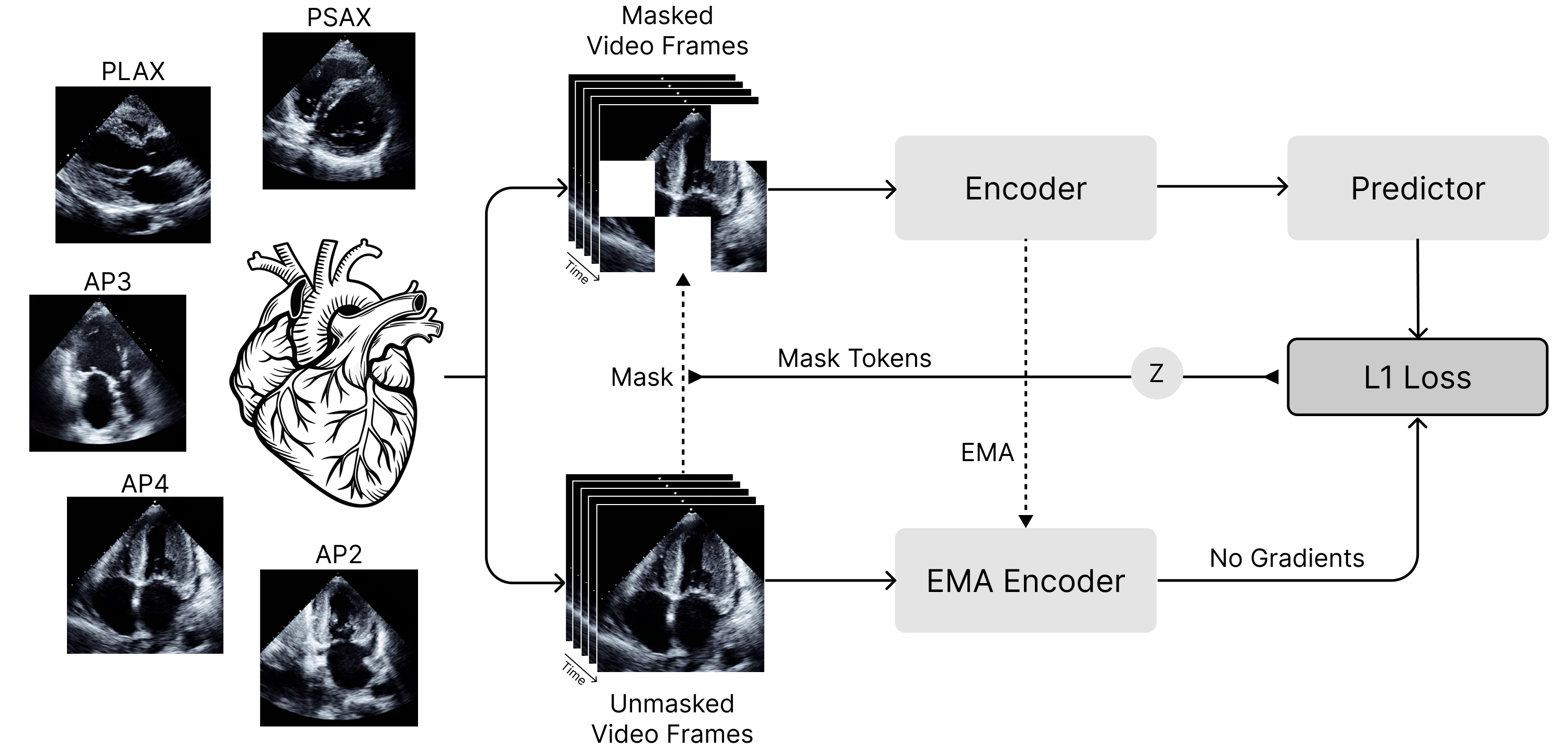
EchoJEPA is a latent predictive foundation model for echocardiography trained on 18 million echocardiograms from 300,000 patients. By learning to predict in latent space rather than pixel space, the model separates clinically meaningful anatomical signals from ultrasound noise and artifacts, producing representations that dramatically outperform existing approaches on cardiac assessment tasks. - **Massive scale and latent prediction:** Trained on 18 million echocardiograms using a JEPA-style objective that predicts masked spatiotemporal regions in latent space. This approach learns to ignore speckle noise and acoustic artifacts that plague pixel-level methods, producing representations focused on anatomically meaningful features. - **Strong improvements on clinical tasks:** EchoJEPA improves left ventricular ejection fraction estimation by approximately 20% and right ventricular systolic pressure estimation by approximately 17% over leading baselines. For view classification, it reaches 79% accuracy using only 1% of labeled data, while the best baseline achieves just 42% with the full labeled dataset. - **Exceptional robustness:** Under acoustic perturbations that degrade competitor models by 17%, EchoJEPA degrades only 2%. This robustness extends to population shift: zero-shot performance on pediatric patients exceeds fully fine-tuned baseline models, demonstrating genuine generalization rather than memorization. - **Clinical foundation model potential:** The combination of scale, label efficiency, and robustness across patient populations positions EchoJEPA as a practical foundation for clinical echocardiography applications where labeled data is scarce and acoustic conditions vary widely.
Ask this paper
Massive scale and latent prediction: Trained on 18 million echocardiograms using a JEPA-style objective that predicts masked spatiotemporal regions in latent space. This approach learns to ignore speckle noise and acoustic artifacts that plague pixel-level methods, producing representations focused on anatomically meaningful features.
Strong improvements on clinical tasks: EchoJEPA improves left ventricular ejection fraction estimation by approximately 20% and right ventricular systolic pressure estimation by approximately 17% over leading baselines. For view classification, it reaches 79% accuracy using only 1% of labeled data, while the best baseline achieves just 42% with the full labeled dataset.
Exceptional robustness: Under acoustic perturbations that degrade competitor models by 17%, EchoJEPA degrades only 2%. This robustness extends to population shift: zero-shot performance on pediatric patients exceeds fully fine-tuned baseline models, demonstrating genuine generalization rather than memorization.
Clinical foundation model potential: The combination of scale, label efficiency, and robustness across patient populations positions EchoJEPA as a practical foundation for clinical echocardiography applications where labeled data is scarce and acoustic conditions vary widely.
Abstract
Foundation models for echocardiography often struggle to disentangle anatomical signal from the stochastic speckle and acquisition artifacts inherent to ultrasound. We present EchoJEPA, a foundation model trained on 18 million echocardiograms across 300K patients, representing the largest pretraining corpus for this modality to date. By leveraging a latent predictive objective, EchoJEPA learns robust anatomical representations that ignore speckle noise. We validate this using a novel multi-view probing framework with frozen backbones, where EchoJEPA outperforms leading baselines by approximately 20% in left ventricular ejection fraction (LVEF) estimation and 17% in right ventricular systolic pressure (RVSP) estimation. The model also exhibits remarkable sample efficiency, reaching 79% view classification accuracy with only 1% of labeled data versus 42% for the best baseline trained on 100%. Crucially, EchoJEPA demonstrates superior generalization, degrading by only 2% under physics-informed acoustic perturbations compared to 17% for competitors. Most remarkably, its zero-shot performance on pediatric patients surpasses fully fine-tuned baselines, establishing latent prediction as a superior paradigm for robust, generalizable medical AI.