AI IDEs vs Autonomous Agents
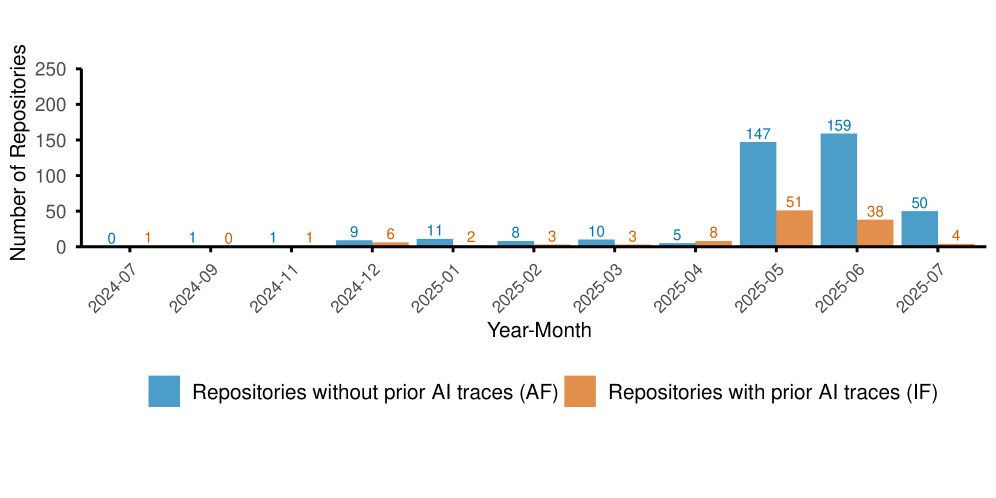
This empirical study investigates how LLM-based coding agents that autonomously generate and merge pull requests affect open-source projects compared to IDE-integrated AI assistants. Using longitudinal causal analysis with matched controls, the researchers measure development velocity and software quality outcomes. - **Methodology:** The study employs staggered difference-in-differences with matched controls, analyzing monthly metrics spanning development velocity and quality indicators like static-analysis warnings, code complexity, and duplication rates. - **Velocity gains are conditional:** Substantial upfront acceleration occurs only when autonomous agents are a project's first AI tool. Projects already using IDE assistants see minimal additional productivity benefits from adding autonomous agents. - **Persistent quality concerns:** Across all contexts, static-analysis warnings rise roughly 18% and cognitive complexity increases approximately 35% when autonomous agents are deployed, suggesting tensions between speed and maintainability. - **Diminishing returns:** Layering multiple AI assistance types produces limited additional productivity improvements, challenging the assumption that more AI tools always means better outcomes. - **First-mover effects:** The research differentiates effects based on whether agents represent a project's first exposure to AI tooling versus augmenting existing assistance, finding the sequence of adoption matters significantly.
Ask this paper
Methodology: The study employs staggered difference-in-differences with matched controls, analyzing monthly metrics spanning development velocity and quality indicators like static-analysis warnings, code complexity, and duplication rates.
Velocity gains are conditional: Substantial upfront acceleration occurs only when autonomous agents are a project’s first AI tool. Projects already using IDE assistants see minimal additional productivity benefits from adding autonomous agents.
Persistent quality concerns: Across all contexts, static-analysis warnings rise roughly 18% and cognitive complexity increases approximately 35% when autonomous agents are deployed, suggesting tensions between speed and maintainability.
Diminishing returns: Layering multiple AI assistance types produces limited additional productivity improvements, challenging the assumption that more AI tools always mean better outcomes.
First-mover effects: The research differentiates effects based on whether agents represent a project’s first exposure to AI tooling versus augmenting existing assistance, finding that the sequence of adoption matters significantly.
Abstract
Large language model (LLM) based coding agents increasingly act as autonomous contributors that generate and merge pull requests, yet their real-world effects on software projects are unclear-especially compared with widely adopted IDE-based AI assistants. We present a longitudinal causal study of agent adoption in open-source repositories using staggered difference-in-differences with matched controls. Using the AIDev dataset, we define adoption as the first agent-generated pull request and analyze monthly repository-level outcomes spanning development velocity (commits, lines added) and software quality (static-analysis warnings, cognitive complexity, duplication, and comment density). Results show large, front-loaded velocity gains only when agents are the first observable AI tool in a project; repositories with prior AI IDE usage experience minimal or short-lived throughput increases. In contrast, quality risks are persistent across settings, with static-analysis warnings and cognitive complexity rising by roughly 18% and 39%, indicating sustained agent-induced technical debt even when velocity advantages fade. These heterogeneous effects suggest diminishing returns to AI assistance and highlight the need for quality safeguards, provenance tracking, and selective deployment of autonomous agents. Our findings establish an empirical basis for understanding how agentic and IDE-based tools interact, and motivate research on balancing acceleration with maintainability in AI-integrated development workflows. The replication package for this study is publicly available at this https URL.