Multi-Agent Collaboration for Multimodal LLMs
Microsoft and USC researchers introduce a framework where vision models serve as "eyes" for language models through multi-agent collaboration, enabling modular upgrades without retraining expensive joint vision-language architectures. Specialized vision agents analyze images and communicate findings to language agents through natural language, achieving competitive results on MMMU, MMMU-Pro, and video understanding benchmarks while maintaining full flexibility to swap in improved components independently.
Ask this paper
Abstract
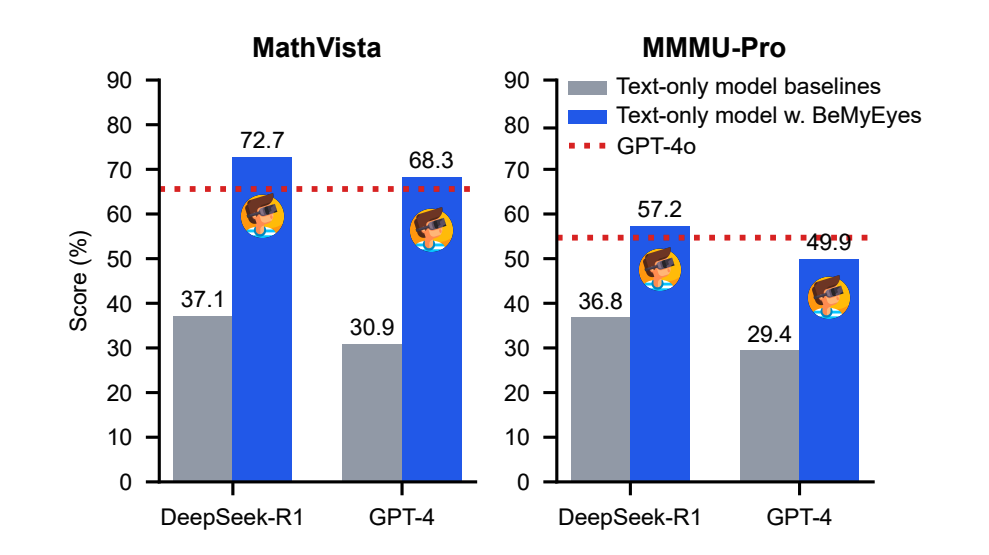
Large Language Models (LLMs) have demonstrated remarkable capabilities in challenging, knowledge-intensive reasoning tasks. However, extending LLMs to perceive and reason over a new modality (e.g., vision), often requires costly development of large-scale vision language models (VLMs) with LLMs as backbones. Smaller VLMs are more efficient and adaptable but often lack the broad knowledge and reasoning capabilities of frontier LLMs. In this work, we propose BeMyEyes, a modular, multi-agent framework for extending LLMs to multimodal reasoning by orchestrating collaboration between efficient, adaptable VLMs as perceivers and powerful LLMs as reasoners through conversations. We then introduce a data synthesis and supervised fine-tuning pipeline to train the perceiver agent to effectively collaborate with the reasoner agent. By combining the complementary strengths of perception and reasoning agents, BeMyEyes avoids the need for training large-scale multimodal models, preserves the generalization and reasoning capabilities of LLMs, and allows flexible extension to new domains and modalities. Experiments show that our framework unlocks the multimodal reasoning capabilities for LLMs, enabling a lightweight and fully open-source solution, i.e. equipping text-only DeepSeek-R1 with Qwen2.5-VL-7B perceiver, to outperform large-scale proprietary VLMs such as GPT-4o on a wide range of knowledge-intensive multimodal tasks. These results demonstrate the effectiveness, modularity, and scalability of our multi-agent approach for building future multimodal reasoning systems.