InfCode
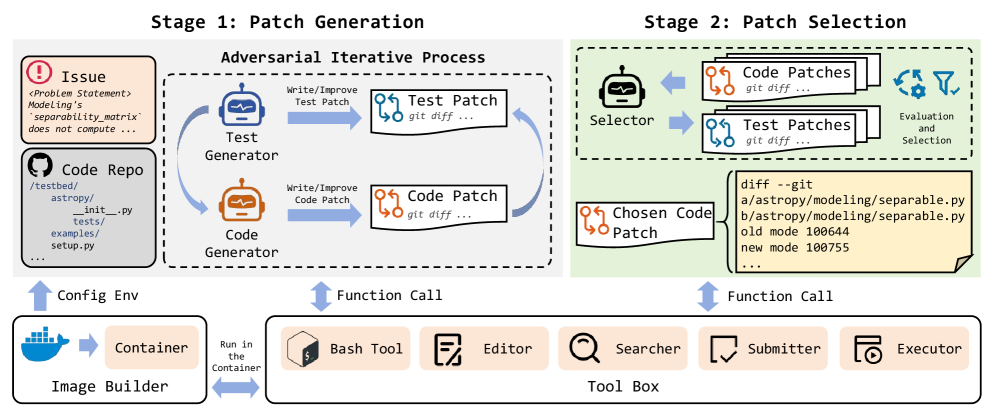
InfCode introduces an adversarial framework for software bug fixing that treats test generation and patch creation as mutually reinforcing processes. Rather than generating patches that simply pass existing tests, the system creates challenging test cases designed to expose patch weaknesses, then iteratively refines patches to handle these adversarial tests. - **Adversarial game-theoretic loop**: The framework employs an iterative cycle where LLMs first generate tests specifically designed to reveal vulnerabilities in candidate patches, then patches are refined to pass both original and adversarial tests. This cycle repeats until convergence, fundamentally differing from traditional test-driven development with static test suites. - **Dynamic edge case discovery**: By continuously challenging patches with new adversarial tests, the system achieves superior coverage of potential failure modes. Each iteration exposes corner cases and edge scenarios that single-pass approaches miss, producing solutions more likely to handle real-world complexity. - **SWE-Bench Verified evaluation**: Testing on the realistic software engineering benchmark using Claude Sonnet 4.5 and DeepSeek models demonstrates measurable improvements in patch reliability. Successive refinement rounds show clear convergence patterns with higher success rates on adversarial test cases compared to baseline methods. - **Robust patch generation**: The iterative adversarial approach produces more reliable patches than static test-first methodologies. The mutual refinement between tests and patches creates a virtuous cycle where each component strengthens the other, resulting in solutions that better handle unexpected inputs and edge conditions.
Ask this paper
Adversarial game-theoretic loop: The framework employs an iterative cycle where LLMs first generate tests specifically designed to reveal vulnerabilities in candidate patches, then patches are refined to pass both original and adversarial tests. This cycle repeats until convergence, fundamentally differing from traditional test-driven development with static test suites.
Dynamic edge case discovery: By continuously challenging patches with new adversarial tests, the system achieves superior coverage of potential failure modes. Each iteration exposes corner cases and edge scenarios that single-pass approaches miss, producing solutions more likely to handle real-world complexity.
SWE-Bench Verified evaluation: Testing on the realistic software engineering benchmark using Claude Sonnet 4.5 and DeepSeek models demonstrates measurable improvements in patch reliability. Successive refinement rounds show clear convergence patterns with higher success rates on adversarial test cases compared to baseline methods.
Robust patch generation: The iterative adversarial approach produces more reliable patches than static test-first methodologies. The mutual refinement between tests and patches creates a virtuous cycle where each component strengthens the other, resulting in solutions that better handle unexpected inputs and edge conditions.
Abstract
Large language models have advanced software engineering automation, yet resolving real-world software issues remains difficult because it requires repository-level reasoning, accurate diagnostics, and strong verification signals. Existing agent-based and pipeline-based methods often rely on insufficient tests, which can lead to patches that satisfy verification but fail to fix the underlying defect. We present InfCode, an adversarial multi-agent framework for automated repository-level issue resolution. InfCode iteratively refines both tests and patches through adversarial interaction between a Test Patch Generator and a Code Patch Generator, while a Selector agent identifies the most reliable fix. The framework runs inside a containerized environment that supports realistic repository inspection, modification, and validation. Experiments on SWE-bench Lite and SWE-bench Verified using models such as DeepSeek-V3 and Claude 4.5 Sonnet show that InfCode consistently outperforms strong baselines. It achieves 79.4% performance on SWE-bench Verified, establishing a new state-of-the-art. We have released InfCode as an open-source project at this https URL.