LatentMAS
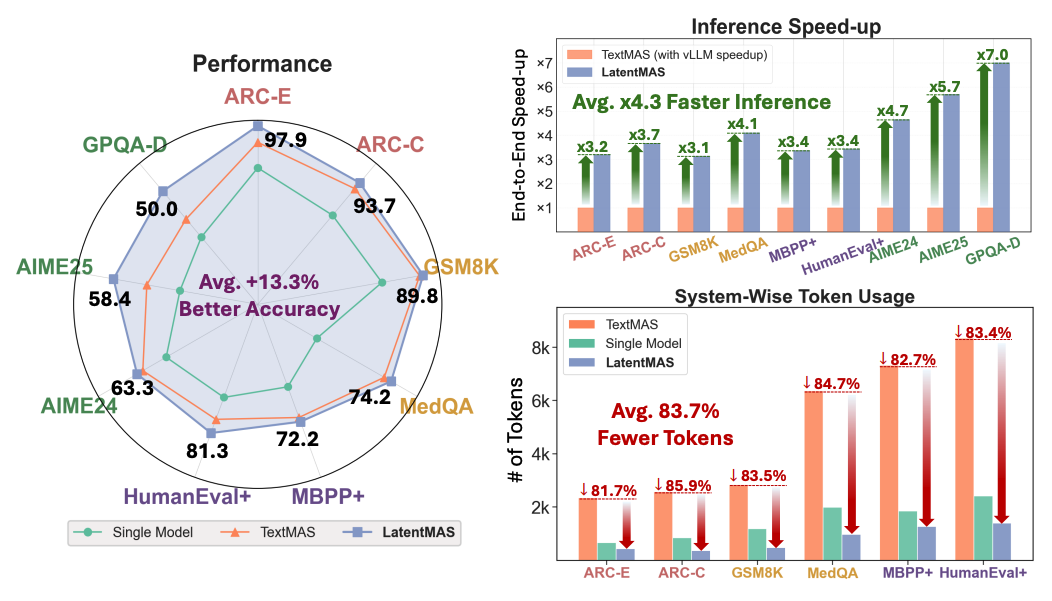
LatentMAS introduces a framework enabling language model agents to collaborate directly within continuous latent space rather than relying on text-based communication. By using last-layer hidden embeddings and a shared latent working memory, agents preserve and transfer internal representations without information loss from text serialization. - **Latent thought generation**: Agents perform auto-regressive generation using continuous hidden embeddings instead of discrete tokens. A shared latent working memory stores and transfers internal representations across agents, enabling direct access to each other's reasoning states without text conversion bottlenecks. - **Training-free deployment**: The framework requires no additional training or fine-tuning. It works with existing language models by intercepting and sharing hidden states at inference time, making it immediately applicable to current multi-agent systems without retraining costs. - **Substantial efficiency gains**: Achieves 70.8-83.7% reduction in output token usage and 4x-4.3x faster end-to-end inference speed compared to text-based multi-agent approaches. The latent communication eliminates redundant encoding and decoding cycles that dominate traditional agent collaboration. - **Accuracy improvements across benchmarks**: Testing across 9 comprehensive benchmarks spanning math and science reasoning, commonsense tasks, and code generation shows up to 14.6% higher accuracy. The lossless information preservation in latent space enables agents to share nuanced reasoning that gets lost in text summarization.
Ask this paper
Latent thought generation: Agents perform auto-regressive generation using continuous hidden embeddings instead of discrete tokens. A shared latent working memory stores and transfers internal representations across agents, enabling direct access to each other’s reasoning states without text conversion bottlenecks.
Training-free deployment: The framework requires no additional training or fine-tuning. It works with existing language models by intercepting and sharing hidden states at inference time, making it immediately applicable to current multi-agent systems without retraining costs.
Substantial efficiency gains: Achieves 70.8-83.7% reduction in output token usage and 4x-4.3x faster end-to-end inference speed compared to text-based multi-agent approaches. The latent communication eliminates redundant encoding and decoding cycles that dominate traditional agent collaboration.
Accuracy improvements across benchmarks: Testing across 9 comprehensive benchmarks spanning math and science reasoning, commonsense tasks, and code generation shows up to 14.6% higher accuracy. The lossless information preservation in latent space enables agents to share nuanced reasoning that gets lost in text summarization.
Abstract
Multi-agent systems (MAS) extend large language models (LLMs) from independent single-model reasoning to coordinative system-level intelligence. While existing LLM agents depend on text-based mediation for reasoning and communication, we take a step forward by enabling models to collaborate directly within the continuous latent space. We introduce LatentMAS, an end-to-end training-free framework that enables pure latent collaboration among LLM agents. In LatentMAS, each agent first performs auto-regressive latent thoughts generation through last-layer hidden embeddings. A shared latent working memory then preserves and transfers each agent's internal representations, ensuring lossless information exchange. We provide theoretical analyses establishing that LatentMAS attains higher expressiveness and lossless information preservation with substantially lower complexity than vanilla text-based MAS. In addition, empirical evaluations across 9 comprehensive benchmarks spanning math and science reasoning, commonsense understanding, and code generation show that LatentMAS consistently outperforms strong single-model and text-based MAS baselines, achieving up to 14.6% higher accuracy, reducing output token usage by 70.8%-83.7%, and providing 4x-4.3x faster end-to-end inference. These results demonstrate that our new latent collaboration framework enhances system-level reasoning quality while offering substantial efficiency gains without any additional training. Code and data are fully open-sourced at this https URL.