CogRouter
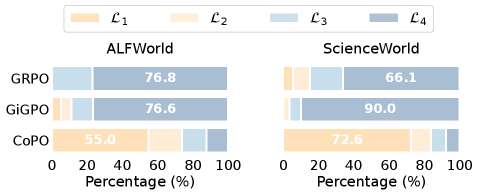
CogRouter enables adaptive reasoning depth for LLM agents by dynamically selecting from four hierarchical cognitive levels at each step, from instinctive responses to strategic planning. Using confidence-aware advantage reweighting during training, Qwen2.5-7B with CogRouter achieves 82.3% success rate on agentic benchmarks, substantially outperforming larger models while consuming fewer tokens by skipping heavy reasoning on routine steps.
Ask this paper
Abstract
Large language models (LLMs) are increasingly deployed as autonomous agents for multi-turn decision-making tasks. However, current agents typically rely on fixed cognitive patterns: non-thinking models generate immediate responses, while thinking models engage in deep reasoning uniformly. This rigidity is inefficient for long-horizon tasks, where cognitive demands vary significantly from step to step, with some requiring strategic planning and others only routine execution. In this paper, we introduce CogRouter, a framework that trains agents to dynamically adapt cognitive depth at each step. Grounded in ACT-R theory, we design four hierarchical cognitive levels ranging from instinctive responses to strategic planning. Our two-stage training approach includes Cognition-aware Supervised Fine-tuning (CoSFT) to instill stable level-specific patterns, and Cognition-aware Policy Optimization (CoPO) for step-level credit assignment via confidence-aware advantage reweighting. The key insight is that appropriate cognitive depth should maximize the confidence of the resulting action. Experiments on ALFWorld and ScienceWorld demonstrate that CogRouter achieves state-of-the-art performance with superior efficiency. With Qwen2.5-7B, it reaches an 82.3% success rate, outperforming GPT-4o (+40.3%), OpenAI-o3 (+18.3%), and GRPO (+14.0%), while using 62% fewer tokens.