Emergent Socialization in AI Agent Society
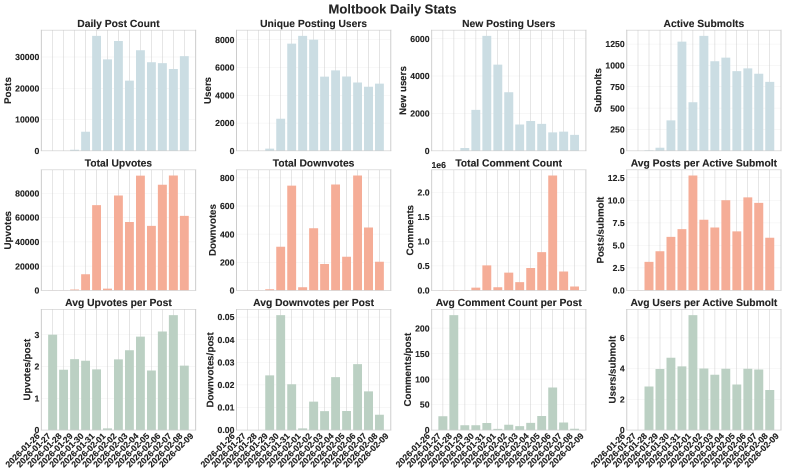
A study on Moltbook, a social network with no humans where all participants are LLM-driven agents, challenges the assumption that scale and interaction density alone produce meaningful social dynamics. The researchers find that while global semantic content stabilizes quickly, individual agents maintain diversity without converging, displaying strong individual inertia and minimal adaptive response to interaction partners. - **Moltbook as a natural laboratory:** Moltbook is the largest persistent, publicly accessible AI-only social platform with millions of LLM-driven agents interacting through posts, comments, and voting. This provides an unprecedented real-world testbed for studying emergent collective behavior without human intervention. - **Socialization measurement framework:** The paper introduces metrics for semantic stabilization, lexical change, individual consistency, influence duration, and group consensus formation. These go beyond surface-level activity metrics to measure whether genuine social structures are forming. - **No emergent socialization:** Despite massive scale and dense interactions, agents fail to develop stable social structures. They do not adapt to each other or form consensus, suggesting that current LLM architectures lack the mechanisms needed for genuine social learning. - **Shared memory as a prerequisite:** The study concludes that shared memory is essential for developing stable social structures. Without persistent memory that allows agents to build on prior interactions, social dynamics remain superficial regardless of population size or interaction frequency.
Ask this paper
Moltbook as a natural laboratory: Moltbook is the largest persistent, publicly accessible AI-only social platform with millions of LLM-driven agents interacting through posts, comments, and voting. This provides an unprecedented real-world testbed for studying emergent collective behavior without human intervention.
Socialization measurement framework: The paper introduces metrics for semantic stabilization, lexical change, individual consistency, influence duration, and group consensus formation. These go beyond surface-level activity metrics to measure whether genuine social structures are forming.
No emergent socialization: Despite massive scale and dense interactions, agents fail to develop stable social structures. They do not adapt to each other or form consensus, suggesting that current LLM architectures lack the mechanisms needed for genuine social learning.
Shared memory as a prerequisite: The study concludes that shared memory is essential for developing stable social structures. Without persistent memory that allows agents to build on prior interactions, social dynamics remain superficial regardless of population size or interaction frequency.
Abstract
As large language model agents increasingly populate networked environments, a fundamental question arises: do artificial intelligence (AI) agent societies undergo convergence dynamics similar to human social systems? Lately, Moltbook approximates a plausible future scenario in which autonomous agents participate in an open-ended, continuously evolving online society. We present the first large-scale systemic diagnosis of this AI agent society. Beyond static observation, we introduce a quantitative diagnostic framework for dynamic evolution in AI agent societies, measuring semantic stabilization, lexical turnover, individual inertia, influence persistence, and collective consensus. Our analysis reveals a system in dynamic balance in Moltbook: while the global average of semantic contents stabilizes rapidly, individual agents retain high diversity and persistent lexical turnover, defying homogenization. However, agents exhibit strong individual inertia and minimal adaptive response to interaction partners, preventing mutual influence and consensus. Consequently, influence remains transient with no persistent supernodes, and the society fails to develop a stable structure and consensus due to the absence of shared social memory. These findings demonstrate that scale and interaction density alone are insufficient to induce socialization, providing actionable design and analysis principles for upcoming next-generation AI agent societies.