Intelligent AI Delegation
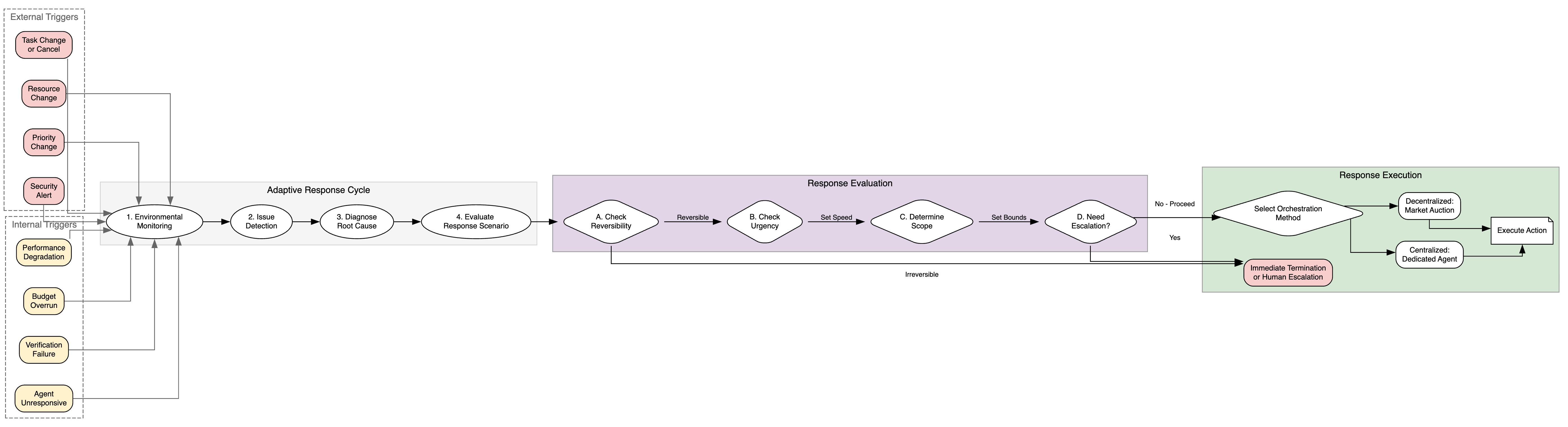
Google DeepMind introduces a comprehensive framework for intelligent AI delegation that goes beyond simple task assignment. The framework models delegation as a sequence of decisions: whether to delegate, how to instruct, and how to verify and integrate AI outputs, addressing the gap between what AI agents can do and how humans should interact with them. - **Adaptive delegation structure:** The framework treats delegation as a dynamic process involving task allocation, transfer of authority, responsibility, and accountability. Rather than static heuristics, it enables real-time adaptation to environmental shifts and resilient failure management across both human and AI delegators. - **Trust calibration mechanisms:** Introduces formal trust models that account for capability uncertainty, task complexity, and historical performance. This prevents both over-delegation (assigning tasks beyond agent capability) and under-delegation (failing to leverage available AI capacity). - **Verification and integration:** Defines structured approaches for validating AI outputs before integration, including confidence-aware acceptance criteria and fallback protocols. This is critical for production deployments where blind trust in agent outputs creates compounding errors. - **Multi-agent delegation networks:** Extends the framework to scenarios where AI agents delegate to other AI agents, creating delegation chains that require accountability tracking and authority propagation rules across the network.
Ask this paper
Adaptive delegation structure: The framework treats delegation as a dynamic process involving task allocation, transfer of authority, responsibility, and accountability. Rather than static heuristics, it enables real-time adaptation to environmental shifts and resilient failure management across both human and AI delegators.
Trust calibration mechanisms: Introduces formal trust models that account for capability uncertainty, task complexity, and historical performance. This prevents both over-delegation (assigning tasks beyond agent capability) and under-delegation (failing to leverage available AI capacity).
Verification and integration: Defines structured approaches for validating AI outputs before integration, including confidence-aware acceptance criteria and fallback protocols. This is critical for production deployments where blind trust in agent outputs creates compounding errors.
Multi-agent delegation networks: Extends the framework to scenarios where AI agents delegate to other AI agents, creating delegation chains that require accountability tracking and authority propagation rules across the network.
Abstract
AI agents are able to tackle increasingly complex tasks. To achieve more ambitious goals, AI agents need to be able to meaningfully decompose problems into manageable sub-components, and safely delegate their completion across to other AI agents and humans alike. Yet, existing task decomposition and delegation methods rely on simple heuristics, and are not able to dynamically adapt to environmental changes and robustly handle unexpected failures. Here we propose an adaptive framework for intelligent AI delegation - a sequence of decisions involving task allocation, that also incorporates transfer of authority, responsibility, accountability, clear specifications regarding roles and boundaries, clarity of intent, and mechanisms for establishing trust between the two (or more) parties. The proposed framework is applicable to both human and AI delegators and delegatees in complex delegation networks, aiming to inform the development of protocols in the emerging agentic web.