GLM-5
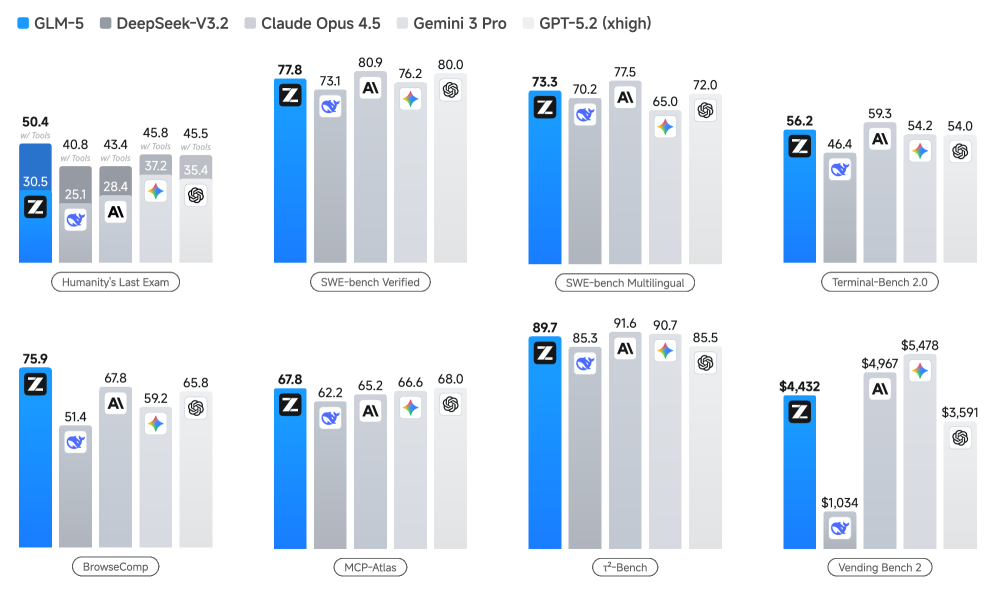
GLM-5 is a foundation model from Zhipu AI designed to transition from vibe coding to agentic engineering. The model introduces novel asynchronous agent RL algorithms that separate generation from training for improved efficiency, and uses DSA technology to reduce computational requirements while preserving long-context understanding. - **Asynchronous agent RL:** The training infrastructure decouples trajectory generation from policy optimization, enabling parallel scaling of both components. This addresses a key bottleneck in agent RL where sequential generate-train loops limit throughput and experimentation speed. - **Agentic engineering focus:** GLM-5 targets end-to-end software engineering tasks rather than isolated code generation. The model handles project-level context, multi-file edits, and iterative development cycles that reflect real production workflows. - **DSA compression:** The model's Distributed Sparse Attention mechanism reduces computational overhead for long-context processing without quality degradation. This allows the model to maintain full project-level context during extended development sessions. - **Strong benchmark results:** GLM-5 demonstrates exceptional performance on real-world software engineering projects, surpassing earlier systems on end-to-end development tasks, including specification understanding, implementation, testing, and debugging.
Ask this paper
Asynchronous agent RL: The training infrastructure decouples trajectory generation from policy optimization, enabling parallel scaling of both components. This addresses a key bottleneck in agent RL where sequential generate-train loops limit throughput and experimentation speed.
Agentic engineering focus: GLM-5 targets end-to-end software engineering tasks rather than isolated code generation. The model handles project-level context, multi-file edits, and iterative development cycles that reflect real production workflows.
DSA compression: The model’s Distributed Sparse Attention mechanism reduces computational overhead for long-context processing without quality degradation. This allows the model to maintain full project-level context during extended development sessions.
Strong benchmark results: GLM-5 demonstrates exceptional performance on real-world software engineering projects, surpassing earlier systems on end-to-end development tasks, including specification understanding, implementation, testing, and debugging.
Abstract
We present GLM-5, a next-generation foundation model designed to transition the paradigm of vibe coding to agentic engineering. Building upon the agentic, reasoning, and coding (ARC) capabilities of its predecessor, GLM-5 adopts DSA to significantly reduce training and inference costs while maintaining long-context fidelity. To advance model alignment and autonomy, we implement a new asynchronous reinforcement learning infrastructure that drastically improves post-training efficiency by decoupling generation from training. Furthermore, we propose novel asynchronous agent RL algorithms that further improve RL quality, enabling the model to learn from complex, long-horizon interactions more effectively. Through these innovations, GLM-5 achieves state-of-the-art performance on major open benchmarks. Most critically, GLM-5 demonstrates unprecedented capability in real-world coding tasks, surpassing previous baselines in handling end-to-end software engineering challenges. Code, models, and more information are available at https://github.com/zai-org/GLM-5.