Lossless Context Management (LCM)
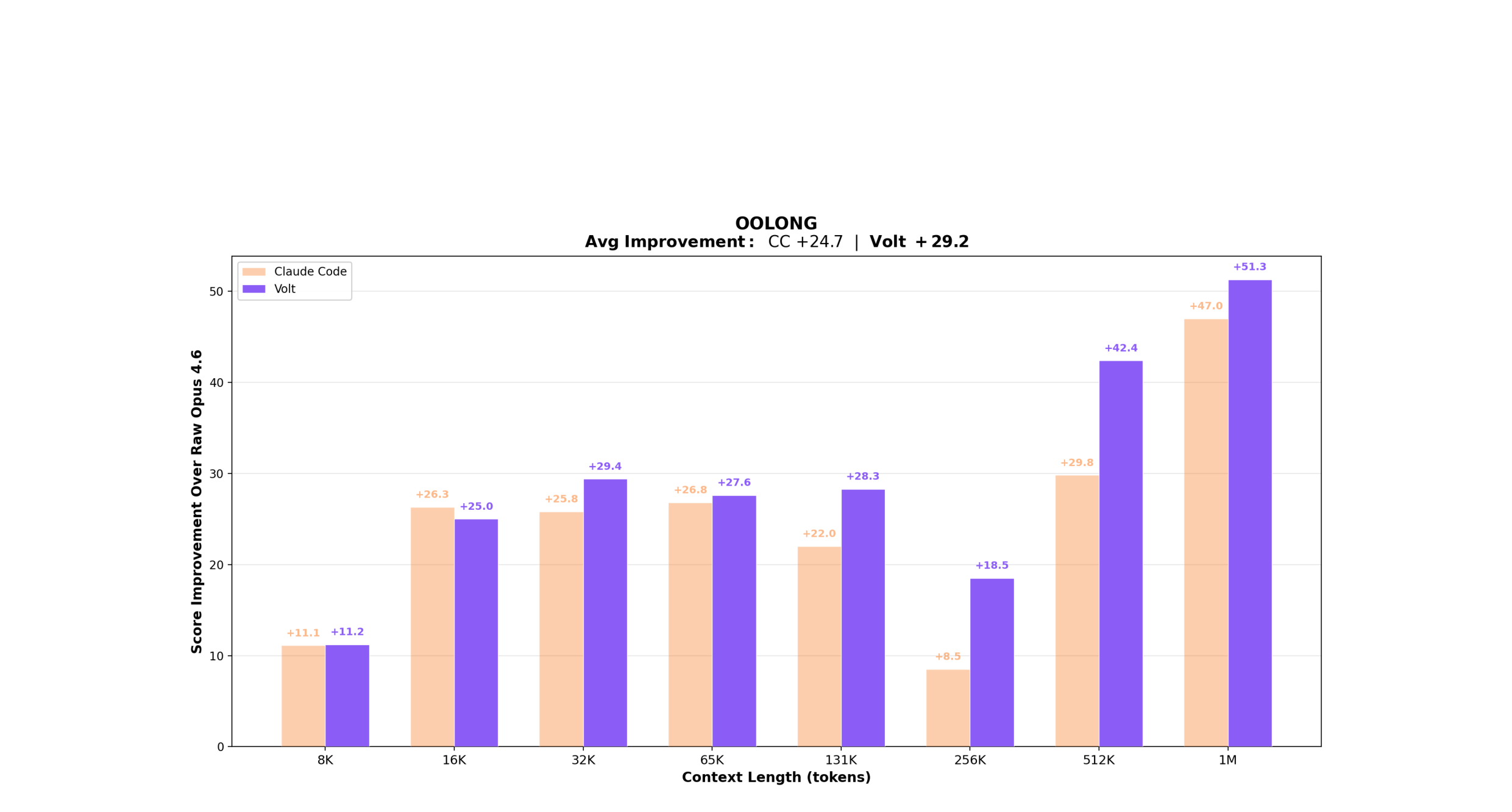
Lossless Context Management (LCM) is a deterministic architecture for LLM memory that outperforms Claude Code on long-context tasks. Benchmarked on the OOLONG eval using Opus 4.6, the LCM-augmented coding agent Volt achieves higher scores than Claude Code at every context length between 32K and 1M tokens. LCM extends the recursive paradigm pioneered by Recursive Language Models (RLMs) with two engine-managed mechanisms. - **Recursive context compression:** As the active context window fills, older messages are compacted into a hierarchical summary DAG while retaining lossless pointers to every original message. This trades flexibility for termination guarantees and zero-cost continuity on short tasks. - **Recursive task partitioning:** Engine-managed parallel primitives like LLM-Map replace model-written loops, analogous to the move from GOTO to structured control flow. This ensures deterministic execution and lossless retrievability of all prior states. - **Three-level escalation:** LCM reduces context overflow via a structured fallback: summary nodes for older messages, compact file references for large inputs, and a guaranteed convergence mechanism that prevents runaway context growth. - **Outperforms Claude Code:** On OOLONG, Volt with LCM achieves +29.2 average improvement over raw Opus 4.6, compared to +24.7 for Claude Code. The advantage is largest at 1M tokens (+51.3 vs +47.0), demonstrating that deterministic context management scales better than native file-system access at extreme lengths.
Ask this paper
Recursive context compression: As the active context window fills, older messages are compacted into a hierarchical summary DAG while retaining lossless pointers to every original message. This trades flexibility for termination guarantees and zero-cost continuity on short tasks.
Recursive task partitioning: Engine-managed parallel primitives like LLM-Map replace model-written loops, analogous to the move from GOTO to structured control flow. This ensures deterministic execution and lossless retrievability of all prior states.
Three-level escalation: LCM reduces context overflow via a structured fallback: summary nodes for older messages, compact file references for large inputs, and a guaranteed convergence mechanism that prevents runaway context growth.
Outperforms Claude Code: On OOLONG, Volt with LCM achieves +29.2 average improvement over raw Opus 4.6, compared to +24.7 for Claude Code. The advantage is largest at 1M tokens (+51.3 vs +47.0), demonstrating that deterministic context management scales better than native file-system access at extreme lengths.
Abstract
A deterministic architecture for LLM memory that outperforms Claude Code on long-context tasks, using recursive context compression and task partitioning.