Doc-to-LoRA
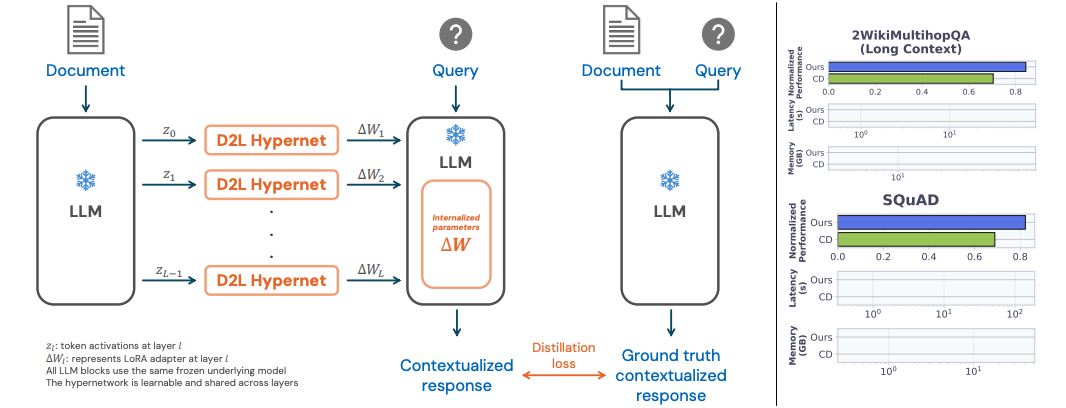
Sakana AI introduces Doc-to-LoRA (D2L), a lightweight hypernetwork that meta-learns to compress long documents into LoRA adapters in a single forward pass. Instead of processing long contexts through expensive quadratic attention, D2L converts the document into parameter-space representations that the target LLM can use without re-consuming the original text. - **Single-pass context compression:** D2L generates LoRA adapters from unseen documents in one forward pass. Once compressed, subsequent queries are handled using only the adapter weights, eliminating the need to re-process the full document and dramatically reducing both inference latency and KV-cache memory demands. - **Beyond native context windows:** The method achieves near-perfect zero-shot accuracy on needle-in-a-haystack tasks at sequence lengths exceeding the target LLM's native context window by over 4x. This suggests that parametric compression can effectively extend context capabilities without architectural changes. - **Real-world QA performance:** On practical question-answering datasets, D2L outperforms standard long-context approaches while consuming less memory. The compressed representations retain enough information for accurate retrieval and reasoning across the full document. - **Practical deployment benefits:** For applications requiring repeated queries over the same document (customer support, legal analysis, codebase understanding), D2L compresses the document once and amortizes the cost across all subsequent interactions.
Ask this paper
Single-pass context compression: D2L generates LoRA adapters from unseen documents in one forward pass. Once compressed, subsequent queries are handled using only the adapter weights, eliminating the need to re-process the full document and dramatically reducing both inference latency and KV-cache memory demands.
Beyond native context windows: The method achieves near-perfect zero-shot accuracy on needle-in-a-haystack tasks at sequence lengths exceeding the target LLM’s native context window by over 4x. This suggests that parametric compression can effectively extend context capabilities without architectural changes.
Real-world QA performance: On practical question-answering datasets, D2L outperforms standard long-context approaches while consuming less memory. The compressed representations retain enough information for accurate retrieval and reasoning across the full document.
Practical deployment benefits: For applications requiring repeated queries over the same document (customer support, legal analysis, codebase understanding), D2L compresses the document once and amortizes the cost across all subsequent interactions.
Abstract
Long input sequences are central to in-context learning, document understanding, and multi-step reasoning of Large Language Models (LLMs). However, the quadratic attention cost of Transformers makes inference memory-intensive and slow. While context distillation (CD) can transfer information into model parameters, per-prompt distillation is impractical due to training costs and latency. To address these limitations, we propose Doc-to-LoRA (D2L), a lightweight hypernetwork that meta-learns to perform approximate CD within a single forward pass. Given an unseen prompt, D2L generates a LoRA adapter for a target LLM, enabling subsequent queries to be answered without re-consuming the original context, reducing latency and KV-cache memory consumption during inference of the target LLM. On a long-context needle-in-a-haystack task, D2L successfully learns to map contexts into adapters that store the needle information, achieving near-perfect zero-shot accuracy at sequence lengths exceeding the target LLM's native context window by more than 4x. On real-world QA datasets with limited compute, D2L outperforms standard CD while significantly reducing peak memory consumption and update latency. We envision that D2L can facilitate rapid adaptation of LLMs, opening up the possibility of frequent knowledge updates and personalized chat behavior.