Evolution Strategies at Hyperscale
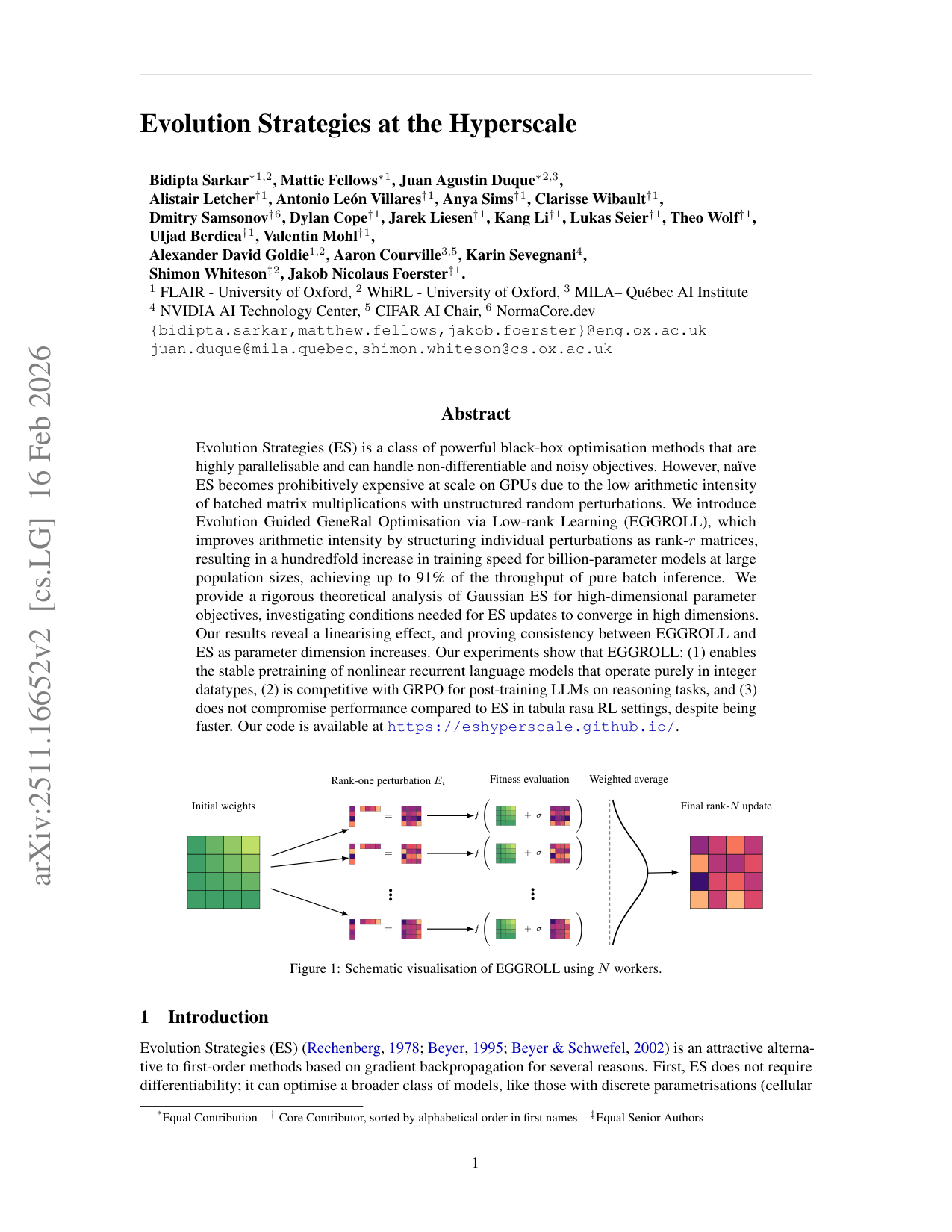
EGGROLL (Evolution Guided General Optimization via Low-rank Learning) is an evolution strategies algorithm designed to scale backprop-free optimization to large population sizes for billion-parameter neural networks. By using low-rank matrix perturbations instead of full-rank ones, EGGROLL achieves a hundredfold increase in training throughput while nearly matching pure batch inference speed. - **Low-rank perturbation approach:** Instead of sampling full-rank perturbation matrices, EGGROLL generates two smaller random matrices A and B to form low-rank perturbations. This reduces auxiliary storage from mn to r(m+n) per layer and forward pass cost from O(mn) to O(r(m+n)), with theoretical analysis showing the low-rank update converges to full-rank at O(1/r) rate. - **Competitive with GRPO for LLM reasoning:** On RWKV-7 models fine-tuned for countdown and GSM8K reasoning tasks, EGGROLL outperforms GRPO under the same hardware and wall-clock time. EGGROLL enables 1024 parallel generations per GPU versus GRPO's 32, achieving 35% validation accuracy compared to 23% on countdown tasks. - **Pure integer pretraining demonstration:** The paper introduces EGG, a nonlinear RNN language model operating entirely in integer datatypes. EGGROLL enables stable pretraining of this model with population sizes up to 262,144 - two orders of magnitude larger than prior ES work - on a single GPU. - **Strong RL performance without compromise:** Across 16 reinforcement learning environments including Brax, Craftax, and Jumanji, EGGROLL matches or outperforms standard OpenES on 14 of 16 tasks while being significantly faster due to efficient batched low-rank adapter inference.
Ask this paper
Low-rank perturbation approach: Instead of sampling full-rank perturbation matrices, EGGROLL generates two smaller random matrices A and B to form low-rank perturbations. This reduces auxiliary storage from mn to r(m+n) per layer and forward pass cost from O(mn) to O(r(m+n)), with theoretical analysis showing the low-rank update converges to full-rank at O(1/r) rate.
Competitive with GRPO for LLM reasoning: On RWKV-7 models fine-tuned for countdown and GSM8K reasoning tasks, EGGROLL outperforms GRPO under the same hardware and wall-clock time. EGGROLL enables 1024 parallel generations per GPU versus GRPO’s 32, achieving 35% validation accuracy compared to 23% on countdown tasks.
Pure integer pretraining demonstration: The paper introduces EGG, a nonlinear RNN language model operating entirely in integer datatypes. EGGROLL enables stable pretraining of this model with population sizes up to 262,144 - two orders of magnitude larger than prior ES work - on a single GPU.
Strong RL performance without compromise: Across 16 reinforcement learning environments, including Brax, Craftax, and Jumanji, EGGROLL matches or outperforms standard OpenES on 14 of 16 tasks while being significantly faster due to efficient batched low-rank adapter inference.
Abstract
Evolution Strategies (ES) is a class of powerful black-box optimisation methods that are highly parallelisable and can handle non-differentiable and noisy objectives. However, naïve ES becomes prohibitively expensive at scale on GPUs due to the low arithmetic intensity of batched matrix multiplications with unstructured random perturbations. We introduce Evolution Guided GeneRal Optimisation via Low-rank Learning (EGGROLL), which improves arithmetic intensity by structuring individual perturbations as rank-$r$ matrices, resulting in a hundredfold increase in training speed for billion-parameter models at large population sizes, achieving up to 91% of the throughput of pure batch inference. We provide a rigorous theoretical analysis of Gaussian ES for high-dimensional parameter objectives, investigating conditions needed for ES updates to converge in high dimensions. Our results reveal a linearising effect, and proving consistency between EGGROLL and ES as parameter dimension increases. Our experiments show that EGGROLL: (1) enables the stable pretraining of nonlinear recurrent language models that operate purely in integer datatypes, (2) is competitive with GRPO for post-training LLMs on reasoning tasks, and (3) does not compromise performance compared to ES in tabula rasa RL settings, despite being faster.