MAPLE
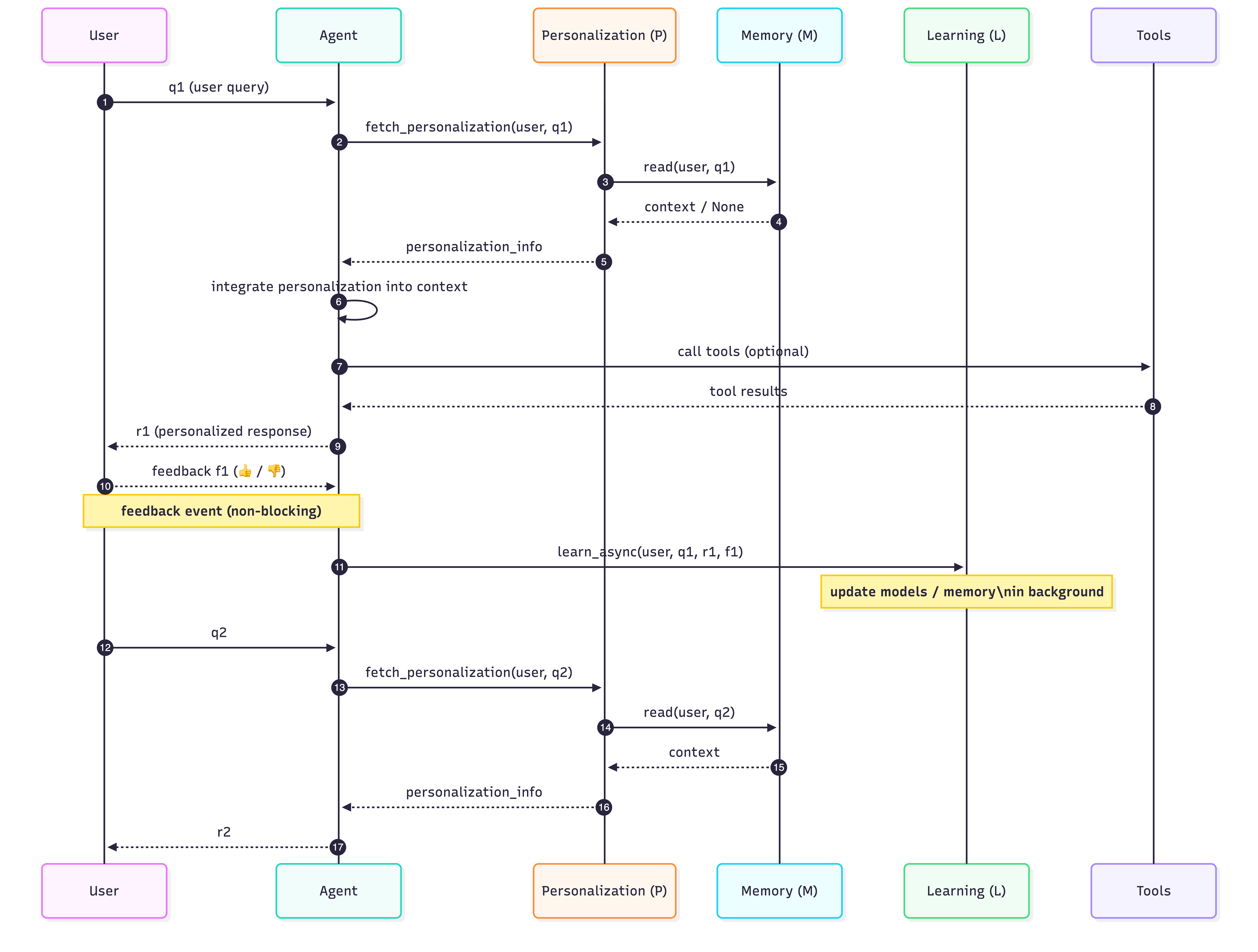
MAPLE proposes separating memory, learning, and personalization into specialized sub-agents rather than treating them as a unified capability. The framework achieves a 14.6% improvement in personalization scores over stateless baselines and increases trait incorporation from 45% to 75%, validated through the MAPLE-Personas benchmark. - **Sub-agent decomposition:** Memory handles storage and retrieval infrastructure, Learning extracts intelligence from accumulated interactions asynchronously, and Personalization applies learned knowledge in real-time within finite context budgets. Each operates at different timescales with distinct objectives. - **Asynchronous learning:** The Learning sub-agent processes interaction history offline, distilling patterns and preferences without consuming real-time context. This avoids the common problem of memory systems that flood the active context window with raw history. - **Context-budget-aware personalization:** The Personalization sub-agent selects which learned knowledge to inject based on available context budget and current task relevance. This prevents context dilution while ensuring the most impactful personalizations are always applied. - **Benchmark validation:** The MAPLE-Personas benchmark specifically evaluates whether agents can genuinely adapt to individual users over time, measuring trait incorporation and behavioral consistency across extended interaction sequences.
Ask this paper
Sub-agent decomposition: Memory handles storage and retrieval infrastructure, Learning extracts intelligence from accumulated interactions asynchronously, and Personalization applies learned knowledge in real-time within finite context budgets. Each operates at different timescales with distinct objectives.
Asynchronous learning: The Learning sub-agent processes interaction history offline, distilling patterns and preferences without consuming real-time context. This avoids the common problem of memory systems that flood the active context window with raw history.
Context-budget-aware personalization: The Personalization sub-agent selects which learned knowledge to inject based on available context budget and current task relevance. This prevents context dilution while ensuring the most impactful personalizations are always applied.
Benchmark validation: The MAPLE-Personas benchmark specifically evaluates whether agents can genuinely adapt to individual users over time, measuring trait incorporation and behavioral consistency across extended interaction sequences.
Abstract
Large language model (LLM) agents have emerged as powerful tools for complex tasks, yet their ability to adapt to individual users remains fundamentally limited. We argue this limitation stems from a critical architectural conflation: current systems treat memory, learning, and personalization as a unified capability rather than three distinct mechanisms requiring different infrastructure, operating on different timescales, and benefiting from independent optimization. We propose MAPLE (Memory-Adaptive Personalized LEarning), a principled decomposition where Memory handles storage and retrieval infrastructure; Learning extracts intelligence from accumulated interactions asynchronously; and Personalization applies learned knowledge in real-time within finite context budgets. Each component operates as a dedicated sub-agent with specialized tooling and well-defined interfaces. Experimental evaluation on the MAPLE-Personas benchmark demonstrates that our decomposition achieves a 14.6% improvement in personalization score compared to a stateless baseline (p < 0.01, Cohen's d = 0.95) and increases trait incorporation rate from 45% to 75% -- enabling agents that genuinely learn and adapt.