Kimi-Audio
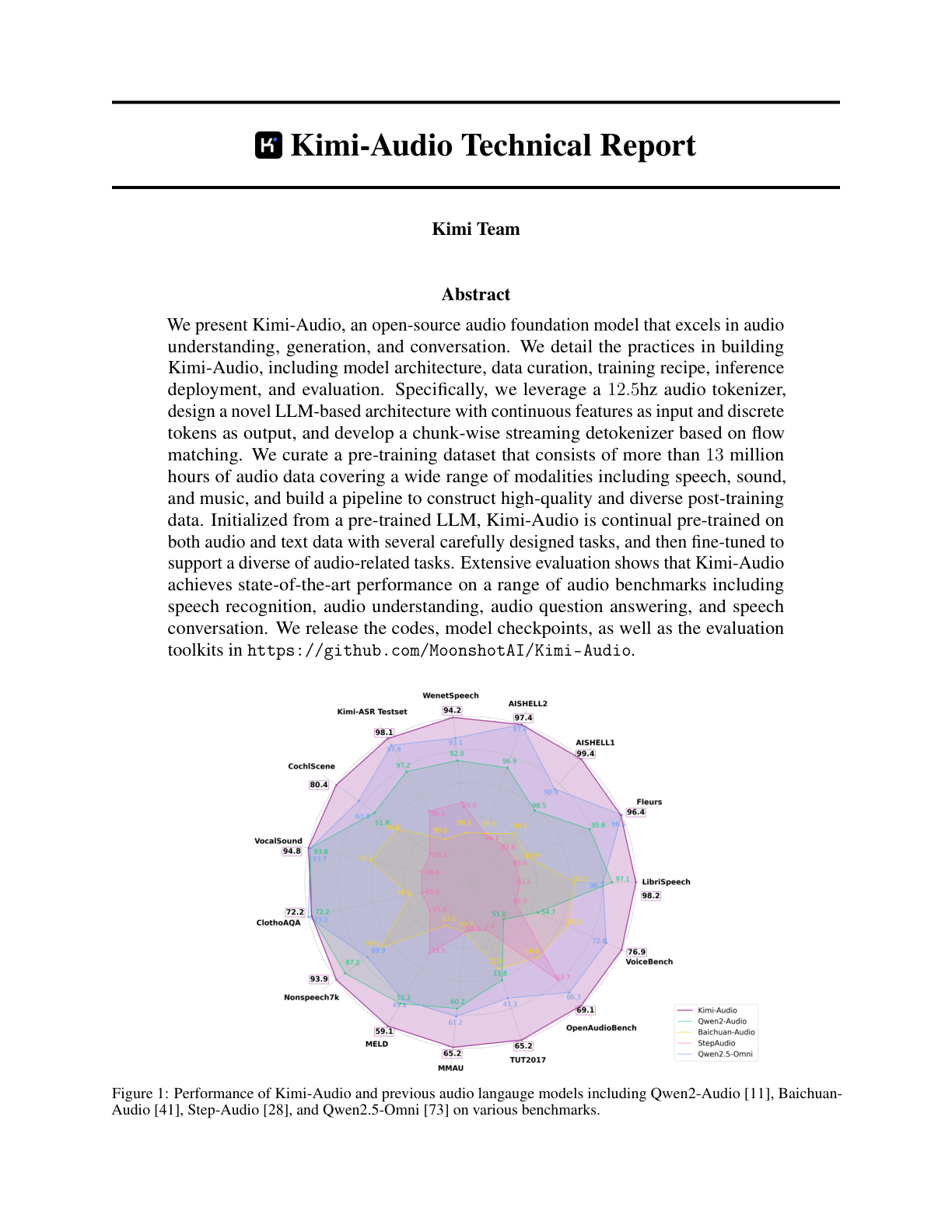
Kimi-Audio is a new open-source audio foundation model built for universal audio understanding, generation, and speech conversation. The model architecture uses a hybrid of discrete semantic audio tokens and continuous Whisper-derived acoustic features. It is initialized from a pre-trained LLM and trained on 13M+ hours of audio, spanning speech, sound, and music. It also supports a streaming detokenizer with chunk-wise decoding and a novel look-ahead mechanism for smoother audio generation. Extensive benchmarking shows that Kimi-Audio outperforms other audio LLMs across multiple modalities and tasks. Key highlights:
Ask this paper
Architecture: Kimi-Audio uses a 12.5Hz semantic tokenizer and an LLM with dual heads (text + audio), processing hybrid input (discrete + continuous). The audio detokenizer employs a flow-matching upsampler with BigVGAN vocoder for real-time speech synthesis.
Massive Training Corpus: Pretrained on 13M+ hours of multilingual, multimodal audio. A rigorous preprocessing pipeline adds speech enhancement, diarization, and transcription using Whisper and Paraformer-Zh. Fine-tuning uses 300K+ hours from 30+ open datasets.
Multitask Training: Training spans audio-only, text-only, ASR, TTS, and three audio-text interleaving strategies. Fine-tuning is instruction-based, with both audio/text instructions injected via zero-shot TTS.
Evaluation: On ASR (e.g., LibriSpeech test-clean: 1.28 WER), audio understanding (CochlScene: 80.99), and audio-to-text chat (OpenAudioBench avg: 69.8), Kimi-Audio sets new SOTA results, beating Qwen2.5-Omni and Baichuan-Audio across the board.